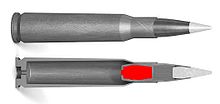

Tracer trains - pyrotechnic trains that make the flight path of fast-moving objects (bullets, shells, etc.) visible.
They were developed at the beginning of World War I and tracer ammunition was used. They found especially widespread use in World War II, when small-caliber anti-aircraft fragmentation shells and almost all aircraft shells were equipped with tracers. In the post-war period, they began to be equipped with unguided rockets. First-generation ATGM missiles ( 9K11 Baby , SS.10 ).
They are divided into fire (the most common) and smoke. Firing compares favorably with night visibility. Consist of: oxidizing agent, fuel and binder. Tracer compositions burn at a speed of several mm / sec, forming a bright flame during combustion. The color of the flame distinguishes tracers of red, white, yellow, blue and green fire.
Tracer trains are used mainly for military purposes to visually establish the range and direction of flight (bullets, shells) and aim weapons at the target.
Compositions producing radiation have been developed mainly in the infrared region of the spectrum. The route can be observed through night vision devices: it consists of SrO 2 - 34.5%, BaO 2 - 34.5%, MgCO 3 - 10%, calcium resinate - 10%, silicon - 1%, Ba (NO 3 ) 2 - ten %.
Combustion products (smoke, slag) accelerate the corrosion of metal parts. Intense firing with tracer bullets leads to premature barrel wear of small arms. Tracer bullets of small arms due to design features have less penetrative power.
In the USSR , Russia and some CIS countries , tracer marking of small arms ammunition is adopted - transparent green varnish at the tip of a bullet.
In NATO countries , tracer bullets are marked with opaque red paint on the tip.
Links
- Tracer compositions - an article from the Great Soviet Encyclopedia .
- A. A. Shidlovsky. Pyrotechnics Basics