Zhou Yang ( Chinese trad. 周揚 , ex. 周扬 , pinyin : Zhōu Yáng ; November 7, 1908 , Yiyang , Hunan - July 31, 1989 , Beijing ) - Chinese literary critic , literary critic , publicist , translator , chairman of the All-China Association of Literature and Art Workers (1979-1988) [3] [4] .
| Zhou Yang | |
|---|---|
| 周揚 | |
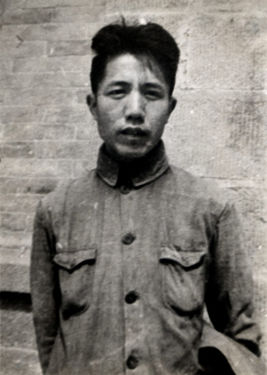 | |
| Birth name | baby: Zhou Yuni adult: Zhou Qiing |
| Aliases | Zhou Yang, Zhou Jian, Qi Ying, Gu Yang, Zhou Xianden, etc. |
| Date of Birth | |
| Place of Birth | |
| Date of death | |
| Place of death | |
| Citizenship |  Qing Empire → Qing Empire →  Republic of China → Republic of China →  China China |
| Occupation | literary critic , literary critic , publicist , translator , teacher |
| Language of Works | Chinese |
Content
Biography
Born November 7, 1908 in Yiyang County, Hunan Province, Great Qing State.
From 1926 to 1928 he studied at Dasia University in Shanghai . Here he met with the Marxist teachings . In 1927 he joined the CCP . From 1929 to 1931 he continued his studies in Japan . Upon returning to China, he joined the League of Leftist Writers (中国 左翼 作家 联盟). Since 1932 he became editor of the League’s magazine - Wensue Yuebao (Literary Monthly).
In 1937 he moved to Yan'an , where he first taught and was dean at the Lu Xin Art Institute , then took over as rector of Yan'an University . He was a member of the leadership of the All-China Association of Literature and Art Workers on repelling the enemy and edited the association’s journal. He worked as the head of the education department of the Shaanxi-Gansu-Ningxia border region.
After the formation of the PRC in 1949, he held the posts of Deputy Minister of Culture of the PRC (1949-1954), Deputy Head of the Propaganda Department of the Central Committee of the CPC (1949-1966), and Deputy Chairman of the All-China Association of Literature and Art (1949-1966) [3] [4 ] ] .
During the cultural revolution, he was persecuted for the “revisionist black line in the arts and literature”, spent nine years in prison from 1966 to 1975. In addition, two years before the persecution began, he was included in the group of five for cultural affairs in July 1964 revolution . He was fully rehabilitated in 1979 [5] .
After that, he served as chairman of the All-China Association of Literature and Art (1979-1988), vice president of the PRC Academy of Social Sciences .
He died on July 31, 1989 in Beijing [6] .
Creative activity
He began to publish in 1929. A significant part of Zhou Yang's journalism is devoted to revolutionary literature. Among others, he wrote articles “On Socialist Realism and Revolutionary Romanticism”, “Soviet Literature for 15 Years,” “Gorky Romanticism,” “Gogol's Dead Souls,” and others.
He translated from English the works of Alexandra Kollontai , Maxim Gorky , Leo Tolstoy , Nikolai Chernyshevsky and other writers.
He acted as editor and compiler of a number of periodicals and non-periodicals [3] .
Editions in Russian
Zhou Yang. The path of socialist literature and art in our country. Report at the Third All-China Congress of Literature and Art Workers July 22, 1960. - Beijing: Publishing House of Literature in Foreign Languages, 1961. - 80 p.
Notes
- ↑ 1 2 Encyclopædia Britannica
- ↑ 1 2 SNAC - 2010.
- ↑ 1 2 3 V.V. Petrov . JOU YAN . FEB “Russian literature and folklore” . Brief Encyclopedia of Literature (1975). Date of treatment April 6, 2014.
- ↑ 1 2 Zhou Yang . - article from Encyclopædia Britannica Online . Date of treatment April 6, 2014.
- ↑ Jian Guo, Yongyi Song, Yuan Zhou. The A to Z of the Chinese Cultural Revolution 360-361. Rowman & Littlefield (2009). Date of treatment April 6, 2014.
- ↑ 抛 结 发 妻子 与 女 学生 “闪 婚” 周扬 晚年 忏悔 (Chinese) . Guangdong Yangcheng Evening News Digital Media (July 2, 2010). Date of treatment April 6, 2014.