Louis XVIII ( fr. Louis XVIII ), Louis-Stanislas-Xavier ( fr. Louis Stanislas Xavier ; , - , ) - King of France in 1814–1824 (de jure since 1795), with a break in 1815, brother of Louis XVI , who during his reign had the title of Count of Provence ( Fr. comte de Provence ) and the honorary naming of Monsieur ( fr. Monsieur ), and then, during emigration, he took the title of Count de Lille . He took the throne as a result of the Restoration of the Bourbons , which followed the overthrow of Napoleon I. Louis was the last monarch of France who was not overthrown as a result of the revolution (kings Charles X , Louis-Philippe I and Emperor Napoleon III were overthrown).
| Louis XVIII | ||||||||||||||||
|---|---|---|---|---|---|---|---|---|---|---|---|---|---|---|---|---|
| Louis XVIII | ||||||||||||||||
 | ||||||||||||||||
| Coronation | not crowned | |||||||||||||||
| Predecessor | title restored | |||||||||||||||
| Successor | Karl X | |||||||||||||||
| ||||||||||||||||
| Predecessor | title restored ( Napoleon I as emperor) | |||||||||||||||
| Successor | title abolished ( Napoleon I hundred days ) | |||||||||||||||
| ||||||||||||||||
| Predecessor | Louis XVII | |||||||||||||||
| Successor | monarchy restored | |||||||||||||||
| Birth | ||||||||||||||||
| Death | ||||||||||||||||
| Burial place | ||||||||||||||||
| Rod | ||||||||||||||||
| Father | ||||||||||||||||
| Mother | ||||||||||||||||
| Spouse | ||||||||||||||||
| Religion | ||||||||||||||||
| Autograph | ||||||||||||||||
| Monogram |  | |||||||||||||||
| Awards |
| |||||||||||||||


Before the Revolution
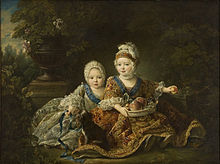
The middle name, Stanislav, Count Provensky was named after his great-grandfather Stanislav Leschinsky . After the death of his father, the dauphin Louis Ferdinand , in 1765 became the second in the line of succession to the throne. At the age of 15 (April 16, 1771), he married 17-year-old Maria-Josephine of Savoy; He had no children (according to some sources, this marriage was generally bogus). After the marriage, he was given higher titles of the Duke of Anjou and Vendome, but he was later known primarily as the Count of Provence.
After the death of his grandfather Louis XV in 1774, and before the birth of his nephew Louis Joseph in 1781, the Count of Provence was heir to his elder brother Louis XVI. He led a relatively modest life at his court.
Head of Expatriation (1791–1814)
In 1791, he fled abroad simultaneously with Louis XVI, but, unlike him, successfully. He organized the flight of Besiad , his confidant, who also became his reference partner. Since then, he lived in Brussels , then in Koblenz , then in Verona , then in Blankenburg , then in Mitau , then in Warsaw , then again in Mitau, expelled at the request of the French government or taken as a result of hostile relations with him: so, Russia adopted it in 1797, expelled it in 1801, adopted it again in 1805, and again expelled it after the Peace of Tilsit .
After receiving the news of the death in France of his young nephew, Louis XVII , in 1795, he proclaimed himself as the eldest in the dynasty, king of France under the name of Louis XVIII.
After a short stay in Sweden, Louis finally settled in England, bought Hartwell Castle (in Buckinghamshire ) and waited for the outcome of events. Although he was recognized as the head of emigration, he did not have the energy or enterprise necessary in this position: even physically, he was extremely clumsy due to his excessive obesity; only with great reluctance, forced by others, he twice, in 1792 and 1796, briefly took part in hostilities. Providing an active role to his more energetic brother, Count d'Artois , he at times published manifestos (mostly, however, they were only signed), which reminded Europe of his existence.
In 1800, he addressed the Consul Bonaparte with a naive letter, in which he said: “ Return her king to France, and future generations will bless your name .” He resolutely and firmly renounced a pension of 2 million francs, which Bonaparte offered him for refusing to claim the throne. But he took cash aid from others, including 300,000 francs from the Lavalee family living in Russia, for which in 1814 he awarded Ivan Stepanovich, the head of the family, the French title of count, which passes on to all his descendants . He differed from other emigrants in that he was able to learn lessons from events - he realized that a complete return to the past is unthinkable, and being in England convinced him of the compatibility of the monarchy with the constitutional regime. The softness and pliability of character, which he resembled his elder brother, pushed him on a constitutional road, but weakness and indecision, which he resembled him, prevented him from consistently holding her.
The beginning of the reign. Constitutional reforms (1814–1815)
When the Senate on April 6, 1814, proclaimed the restoration of the Bourbons and the constitution , Louis refused to recognize this constitution as created by the usurper's servants. Only after heightened insistence of the emperor Alexander I , who declared that, until Louis gave a formal promise to introduce constitutional order, he, Alexander, would not allow him to enter Paris , did Louis sign the declaration drawn up by Talleyrand (known as the St. Petersburg Declaration ) with the promise of a constitution and Solemnly entered Paris on May 3, 1814. On May 27, the Constitutional Charter of 1814 was signed, but immediately, despite Louis’s desire to hold on to her, her gross violations began: supporters of the emperor and the republic, as well as Protestants were persecuted, freedom of the press existed only nominally.
Napoleon's Hundred Days and the Return to Power (1815–1824)
At the news of the landing of Napoleon (“ One Hundred Days ”), Louis issued a proclamation in which he again promised to abide by the charter, and hastily fled from Paris. After the Battle of Waterloo, he returned to Paris under the protection of the Duke of Wellington , and in the new proclamation he confirmed his promise and also announced a general amnesty, from which, however, "all traitors and perpetrators of the secondary accession of Napoleon" were excluded; then followed the death penalty ( Michelle Ney was shot), the expulsion of Bonapartists, the “regicides” and the Republicans from France in general, the confiscation of property and similar measures. Louis himself did not sympathize with such extremes, but did not resist them, and the reactionary terror lasted about a year. The prefect of the Paris police, Pasquier, presented to Louis, after the final coronation, an elegantly intertwined volume with an incomplete list of police agents since 1790. Later, Pascier was able to become Minister of Foreign Affairs (1819–1821) [3] . This was followed by several years of moderate-liberal government (see Richelieu , Dekaz ), after the assassination of the Duke of Berry again gave way to a reaction (see Villel ).
Louis in the last years of his life suffered from severe gout and was practically chained to the chair. He died from the gangrene of both legs and became the last French monarch buried in the basilica of Saint-Denis .
The successor of the childless monarch was the younger brother, 67-year-old Karl X. It was the only completely regular change of power in France throughout the nineteenth century (until 1871, the change of power was accompanied by some kind of coup, and then no president of the French Republic remained in office from 1871 to 1906 until the end of his term).
Louis XVIII, the last really reigning king of France with this name, came to the throne (1814) exactly 1000 years after the Frankish emperor Louis I the Pious (814), from which his French namesake was numbered.
On March 5, 1800, he was awarded the Order of St. Andrew the First Called [4] .
Genealogy
In the cinema
- "The Mystery of the Count of Monte Cristo" (1934)
- Marie-Antoinette (1938)
- The Lame Devil (1948)
- "Napoleon: The Path to the Top" (1955)
- " Marie Antoinette - Queen of France " (1956)
- Waterloo (1970)
- “Farewell, my queen” (2012)
In fiction
- Dumas A. , "Chevalier de Saint - Ermin"
- Dumas A. , The Count of Monte Cristo
Notes
- ↑ 1 2 3 4 Encyclopædia Britannica
- ↑ 1 2 3 4 The Peerage
- ↑ Chernyak, 1991 , p. 461.
- ↑ Karabanov P. F. Lists of remarkable faces of Russians / [Additional: P. V. Dolgorukov]. - M .: Univ. typ., 1860. - 112 p. - (From the 1st book. “Readings in the Society of History and Antiquities of Russia, under Moscow University. 1860”).
Literature
- Bovykin D.Yu. Veron Declaration of Louis XVIII // New and Newest History 2013, No. 3, P. 118-129.
- Bovykin D.Yu. Recognition of Louis XVIII (view from Russia) // Russia and France of the XVIII — XX centuries. M. , 2003. Vol. 5. pp. 56-77.
- Bovykin D.Yu. Religion and the Church in the political projects of Louis XVIII and his circle (1795-1799) // French Yearbook 2004. M. , 2004.
- D. Yu. Bovykin. “I Think Differently ...” Louis XVIII and Constitutional Monarchists (1795–1799) // EUROPE: International Almanac. Issue 5. Tyumen, 2005. pp. 101-113.
- Materials relating to the stay in Mitau of the French royal family in 1798 / Reported K. A. Voensky // Russian past , St. Petersburg. 1896. - T. 85. - № 2. - p. 377-380.
- Chernyshevsky N. G. "The struggle of the parties under L. XVIII and Charles X" ("Sovrem.", 1860)
- Chernyak, E. B. Five Centuries of Secret War. From the history of secret diplomacy and intelligence. - Moscow: International Relations, 1991. - 560 p.
- Mémoires de Louis XVIII ( P. , 1831–33, apocryphal work)
- Daudet E. “Histoire de Immigration. Les Bourbons et la Russie pendant la révolution ”( P. , 1886)
- Viel-Càstel “Hist. de la Restauration "( P. , 1860)
- Vaulabelle "Histoire des deux Restaurations"
Links
- Vodovozov V.V. Louis XVIII // Encyclopedic dictionary of Brockhaus and Efron : in 86 tons (82 tons and 4 extras). - SPb. , 1890-1907.