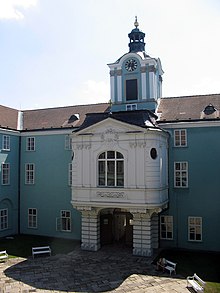
Dacice Castle or New Dacice Castle ( Czech Zámek Dačice, Nový dačický zámek ) is one of two castles in the southern Bohemian city of Dacice , rebuilt in the 19th century in a Empire style, rare for Czech architecture. The castle is located at the intersection of Gavlichkova Square and Gradecka Street. In 2001 it was declared a national cultural monument of the Czech Republic .
| Castle | |
| Dachice | |
|---|---|
| Zámek dačice | |
 Castle view | |
| A country |  Czech Czech |
| City | Dachice |
| Architectural style | Empire |
| Architect | Karl Shleps |
| Founder | Oldrich Kraiř of Kryk |
| First mention | 1591 year |
| Status |  National Cultural Monument of the Czech Republic No. 250 NP National Cultural Monument of the Czech Republic No. 250 NP |
| Site | zamek-dacice.eu |

In the sixteenth century, Dacice was the center of an extensive pandemonium of the feudal family of Kraiří from Krajk ( Czech Krajířové z Krajku ). The first Renaissance castle, decorated with sgraffito paintings, was erected by this family in Dacice in 1579 . Now it is called the old castle , since 1991 it houses the city hall .
A new castle in its original Renaissance style was erected in the west of Dacice as the new residence of Pan Oldřich Craiří from Krajk (d. 1600 ) shortly before 1591 under the leadership of Italian architect Francesco Garof de Bissone . In 1591, in the property registers of Dacice, the castle was registered as a new building [1] .
In the XVII century, the new Dacice castle changed owners several times: from 1610, the castle was acquired by Willem Dubski from Trebomyslitsy , who added the side and rear wings of the castle, in 1622 the castle and pans were bought by Leo Burian Berka from Duba , after which the castle was transferred to the princes Fürstenberg , and then to Wenceslas Wojtech from Vrbna and Bruntal.
In 1713, the castle tower was rebuilt in the Baroque style and a clock was installed on it. In 1728, Count Daczyce was bought by Count Heinrich Karl von Ostein , who rebuilt the castle in the Baroque style . The reconstruction was carried out under the leadership of the Italian architect Francesco Camelli . The author of the sculptural decorations of the castle was the sculptor Sebald Kölbl.
In 1809, the castle was inherited by the Rhine aristocratic clan of the Dalbergs . Karl Anton Maximilian von Dahlberg (1792-1859) began the gradual reconstruction of the Baroque castle into a luxurious and comfortable residence. In the years 1818 - 1820 the interior of the castle was substantially transformed: the rooms were repainted, the so-called The “Gothic Hall”, whose paintings were discovered in 2007 , the castle was lined with neoclassical furniture. In the 30s of the XIX century, in accordance with the project of the Viennese architect Karl Schleps, the castle underwent a massive reconstruction in the Empire style . The symmetrically arranged facade from the side of the main entrance acquired risalit . The interior of the first floor of the representative wing of the castle was substantially changed, the staircase of which since its inception has become one of the most beautiful examples of Czech classicism .
The New Daczyce Castle acquired its final appearance under Frederick von Dahlberg (1863–1914), which in 1909 changed the appearance of the castle’s courtyard. During the reconstruction of windows in the castle corridors, an original Renaissance arcade was discovered. It was decided to glaze the arcade arches , and on the opposite side of the courtyard, at the south wing, a new-barreled chapel was built. The author of the chapel was the Viennese architect Hans Prutscher, and later he designed the Art Nouveau interior for the castle library.
After the death of Johann von Dahlberg ( 1909 - 1940 ), the Dacice castle became the property of the German family Salm-Salm , but in 1945 the castle was nationalized by the Czechoslovak government and was open to the public. In 1990 - 1996, a general restoration of the castle was carried out. Currently, the restoration of the interiors of the castle and the gradual restoration of the castle park continue. The city museum of Dacice is located in the southern wing of the castle; in summer, theater performances and concerts are held in the castle's courtyard.
Notes
- ↑ History of the castle on its official website Archival copy of April 7, 2014 on the Wayback Machine