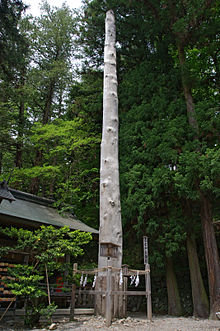
Ombashira ( 御 柱 ) is a festival held every six years [1] in the area of Lake Suva in Nagano Prefecture , Japan . The aim of the festival is to symbolically repair the Suva-tai chi temple. "Ombassira" is literally translated as "honorary columns." The Ombassir Festival has been held for 1,200 years. It is held once every six years, during the years of the Monkey and Tiger of the Chinese calendar , however, local residents can say "once every seven years", because of the traditional Japanese custom, include the current year when calculating the length of time. Ombashira lasts several months, and consists of two segments, Yamadashi and Satobiki. Yamadashi is traditionally held in April , Satobiki is held in May . "Yamadashi" literally means "coming out of the mountain." Huge trees are cut down in front of this part of the festival during the Shinto ceremony with axes and texels specially made for one-time use. Logs are decorated in red and white regalia, these are the traditional colors of Shinto ceremonies, and are attached to ropes. During Yamadashi, teams of men ride down logs from the mountain to the four shrines of Suva-tai chi. A total of 16 logs should be delivered. Such a ride is traumatic, deaths are not uncommon.
The course of logs goes on rough terrain, and at certain points, logs can roll or fall down steep slopes. Young people prove their courage by riding logs down the slope. This ceremony is called "Gi-otoshi." The Satobiki festival includes the symbolic placement of new logs to support the foundation of the shrine. Logs are solemnly lifted by a group of people who carried logs and rode on a log, and sing from the top of the log to report a successful lift. This ceremony was performed as part of the opening ceremony of the Nagano Winter Olympics in 1998 . After two festivals, the important event “Construction of Hoden” takes place. This event is not well known, and few people know that the event is held even among people who live nearby and participated in Yamadashi and Satobiki. The end of this event marks the end of the Ombasir festival.
Notes
- ↑ in Japanese 6 年 (数 え で 7 年 年) に 1 度 行 わ れ る (that is, 7 years according to the old style of counting and 6 years to the new style; see https://web.archive.org/web/ 20100413003115 / http: //mainichi.jp/select/jiken/news/20100412k0000m040039000c.html or http://www.taipeitimes.com/News/taiwan/archives/2004/04/11/2003136206