The ship of His Majesty the Bussard ( German SMS Bussard - Kanyuk ) is the armored cruiser Kaiserlichmarine , built in the 1880s. The lead ship of the Bussard type, which includes five more ships. The cruiser keel was laid in 1888, the cruiser was launched in January 1890 and in October of the same year it entered the fleet. It was intended for service abroad. The armament of the cruiser was the main battery of eight 105-mm guns. The ship had a speed of 15.5 knots (28.7 km / h).
| Bussard | |
|---|---|
| SMS [~ 1] Bussard | |
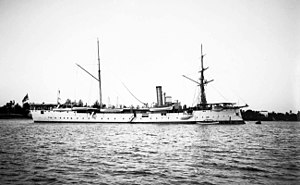 The Bussard in Dar es Salaam 1907 | |
| Service | |
 Germany Germany | |
| Class and type of vessel | Bussard armored cruiser |
| Manufacturer | Kaiserliche Werft , Danzig |
| Construction started | 1888 |
| Launched | January 23, 1890 |
| Commissioned | October 7, 1890 |
| Status | cut to metal 1913 |
| Main characteristics | |
| Displacement | 1 868 t (standard) |
| Length | 82.6 m |
| Width | 12.5 m |
| Draft | 4.45 m |
| Engines | 2 three - cylinder steam engines |
| Speed | 15.5 knots (28.7 km / h) |
| Sailing range | 3610 km at 9 knots |
| Crew | 9 officers 152 sailors |
| Armament | |
| Artillery | 8 × 105 mm KL / 35 guns 5 revolving guns |
| Mine torpedo armament | 2 × 350 mm torpedo tubes |
Bussard spent most of his career abroad, first as part of an East Asian squadron (in the mid-1890s) and then in German East Africa (first decade of the 20th century). The ship’s service was relatively peaceful, the main event occurred when the cruiser was based in Asia in 1894, he helped to suppress the riot in Samoa. In 1910 he returned to Germany, where he remained in service for over two years. In October 1912 it was struck off the list and the next year it was disassembled for metal in Hamburg .
Content
Description
The cruiser hull was 82.6 m long and 12.5 m wide, draft of 4.45 m, displacement of 1868 tons at full combat load. The power plant consisted of two horizontal three-cylinder steam engines powered by four cylindrical coal-fired boilers. The cruiser developed a top speed of 15.5 knots (28.7 km / h) and could cover a distance of 2990 km with a speed of 9 knots. The crew of the ship consisted of 9 officers and 152 sailors [1] .
The cruiser’s armament was made up of eight 105-mm KL / 35 quick-fire guns on single supports, the total ammunition was 800 rounds, the aiming range of the guns was 8,200 m (the Bussard was the only ship of the series armed with older guns). Two guns were placed side by side on the bow, two on each side in sponsons and two aft. On board were also five turret guns [2] and two 350-mm torpedo tubes with five torpedoes mounted on deck [1] .
Service
The Bussard was laid at the imperial shipyard ( Kaiserliche Werft ) in Danzig under contract "C" on January 23, 1890, the tests were carried out quickly. October 7, 1890 the cruiser became part of the imperial fleet. Later, Bussard served at the overseas bases of the German Empire [1] . At the beginning of his career, the cruiser served at the East Asian base as part of the East Asian squadron. In July 1893, he and the Falke ship of the same type participated in the suppression of the rebellion raised by Mataafa Josepho in Samoa . They joined the old British corvette Curacao and the three ships that fired on the rebel positions on July 7, forcing them to surrender. Mataafa was taken to the capital of Apia, and the Bussard remained to make sure that Mataafa’s supporters were disarmed [3] .
In 1898, the Bussard returned to Germany, in March it entered the Elbe River . On the way back, he captured several tropical birds for the Berlin Zoo [4] . Upon arrival, the sailing armament of the barge was reduced to sailing armament of the schooner. A new large wheelhouse was installed. The work was completed in 1900 and Bussard returned to service [5] . He was sent to China in response to a boxer uprising that erupted at the beginning of the year [6] . On the way to China on August 6, 1900, the boiler exploded due to the blowing out of the manhole cover. Three sailors were killed and three were seriously injured [7] . Upon arrival in China, the Bussard and the same-type ships Seeler and Geyer took part in the assault on Dagu fortresses . During the campaign, the Bussard crew did not suffer any losses [6] .
In 1901, the Bussard was assigned to the East African base in German East Africa along with the armored cruiser Schwalbe. At that time, only the gunboats Habicht and the older Wolf were in Africa; these two ships were based in German East Africa [8] . The Bussard remained at the East African base in 1904, when the Schwalbe was replaced by the Sperber ship of the same type [9] . At this time (and for two years), the future pacifist politician Hans Pache held the post of navigator on the Bussard [10] .
In 1908, the Sperber was transferred to German West Africa, and the cruiser Seeadler took its place [11] . The Bussard remained in Africa until 1910, after which it returned to Germany for the second and last time. He remained in service only for a short time, on October 25 he was deleted from the maritime register and the next year he was cut into metal in Hamburg [1] .
Notes
- ↑ 1 2 3 4 Gröner, p. 97
- ↑ Gardiner, p. 253
- ↑ Clowes et al., P. 414
- ↑ Krämer, p. 505
- ↑ Gröner, pp. 97-98
- ↑ 1 2 Sundries , p. 547
- ↑ Phelps, p. 175
- ↑ Naval Notes , 1901, p. 1502
- ↑ Naval Notes , 1904, p. 1079
- ↑ Lange, p. 27
- ↑ Naval Notes , 1908, p. 710
- Comments
- ↑ dumb Seiner Majestät Schiff Ship of His Majesty.
Literature
- Clowes, William Laird. The Royal Navy: A History From the Earliest Times to the Death of Queen Victoria / William Laird Clowes, Clements Markham, Alfred Thayer Mahan ... [and others. ]. - London, UK: Sampson Low, Marston and Company, 1903. - Vol. VII.
- Conway's All the World's Fighting Ships 1860–1905 / Gardiner, Robert. - Greenwich: Conway Maritime Press, 1979. - ISBN 0-8317-0302-4 .
- Gröner, Erich. German Warships 1815–1945. - Annapolis, MD: Naval Institute Press, 1990. - ISBN 0-87021-790-9 .
- Krämer, Augustine. The Samoa Islands: Material Culture. - Honolulu, HI: University of Hawaii Press, 1994. - Vol. II. - ISBN 978-0-8248-1634-6 .
- Lange, Werner. Hans Paasche: Militant Pacifist in Imperial Germany. - Victoria, BC: Trafford, 2005 .-- ISBN 978-1-4120-5246-7 .
- Naval Notes // Journal of the Royal United Service Institution. - London, UK: JJ Keliher & Co., 1901. - December ( vol. XLV ). - P. 1496-1510 . - ISSN 0035-9289 .
- Naval Notes // Journal of the Royal United Service Institution. - London, UK: JJ Keliher & Co., 1904. - June ( vol. XLVIII ). - P. 1071-1081 . - ISSN 0035-9289 .
- Naval Notes // Journal of the Royal United Service Institution. - London, UK: JJ Keliher & Co., 1908. - June ( vol. LII ). - P. 704-715 . - ISSN 0035-9289 .
- Phelps, Harry. Notes on Ships and Torpedo Boats (Neopr.) // General Information Series. - Washington, DC: Government Printing Office, 1901. - T. XX . - S. 9-182 .
- Sundries ( Neopr .) // The United Service Magazine. - London, UK: William Clowes & Sons, 1902. - T. XXV . - S. 545-550 .