The Battle of Al-Fula is a battle between the army of the Saracens under the command of Salah ad-Din and the troops of the Kingdom of Jerusalem , led by Guy de Lusignan in the area of the village of Al-Fula (now Afula ) in 1183 . The battle came down to a shootout that did not reveal the winner.
| Battle of Al-Fula | |||
|---|---|---|---|
| Main Conflict: Crusades | |||
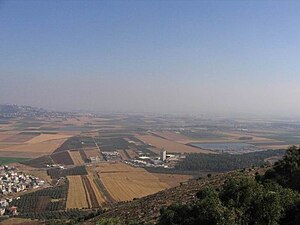 Jezreel Valley , along which the troops of the Crusaders and Saracens moved | |||
| date | September 1183 | ||
| A place | 8 km southeast of Afula , Israel | ||
| Total | vague | ||
| Opponents | |||
| |||
| Commanders | |||
| |||
| Forces of the parties | |||
| |||
| Losses | |||
| |||


Content
Background
In May 1182, Salah ad-Din invaded the Kingdom of Jerusalem from Eilat and Galilee . In the summer, he was successfully opposed by King Baldwin IV of Jerusalem in a campaign near Belvoir Castle , but the lands of the crusaders were badly damaged by Saracen raids. By September 1183, the Baldwin IV of Jerusalem , exhausted by leprosy, could no longer rule the state. Guy de Lusignan 's sister's husband, King Sibylla, was appointed regent.
Campaign
On August 24, 1183, Salah ad-Din returned to Damascus , conquering Aleppo and several cities in Mesopotamia. In September, he launched a new large-scale invasion of the Kingdom of Jerusalem . Crossing the Jordan River , Salah ad-Din sacked the abandoned city of Baysan . Moving west to the Jezreel Valley , Salah ad-Din stationed his army near the wells, about 8 km southeast of the village of Al-Fule . At the same time, the Muslim leader sent troops to plunder the surroundings. The raiders destroyed the villages of Jenin and Afrabal, attacked the monastery on Mount Tabor and destroyed the garrison of Kerak , trying to join the crusader army.
Anticipating the attack, Guy de Lusignan gathered an army of crusaders from Sephoria . When the sentinels reported the Saracen movement, Guy de Lusignan sent an army to a small castle in La Fève. His army was increased at the expense of pilgrims and Italian sailors to 1,300 horsemen and more than 15,000 foot soldiers. It was the largest crusader army “in memory of the living” [2] .
Battle
Muslim chroniclers mention that the Mamelukes Salah al-Din , led by Jorduk al-Nuri and Javili, faced an unexpected attack by the crusaders, but they strengthened themselves at the foot of the mountain and forced the crusaders to retreat.
“Muslims were persecuted with archery and exhausted with constant attacks; the Franks were forced to march, and so the shootout never became a battle ” [3]
Unable to stop the enemies or provoke them into an open battle, Salah ad-Din led his army down the river Jordan . The Frankish army camped around the wells (on the site of the former Saracen camp) and remained passive for eight days, refusing to accept the battle. The Saracens tried to provoke the Franks by intercepting their supply convoys. Soon the situation with provisions became critical. Fortunately, the crusaders discovered a considerable amount of fish in Ain-Tubaun, which allowed them to avoid hunger in the conditions of the blockade [3] .
Then Salah ad-Din moved to Mount Tabor , hoping to ambush the Franks. Instead, Guy de Lusignan retreated to Al Foul . During this movement, the Saracen army turned around and again attacked the crusaders, but they were not able to stop or disrupt the movement. Salah ad-Din , also having supply problems, decided to end the campaign. After this, Guy de Lusignan returned to the main base in Cephoria .
Consequences
Guy de Lusignan successfully thwarted the invasion of Salah ad-Din , keeping his army untouched. But, as in 1182, the Saracen raids caused significant damage to crops and villages. The Regent was sharply criticized for his indecision, however some barons, such as Raimund III , supported his cautious strategy. They noted that the army of Salah ad-Din was located on rough terrain unsuitable for the Frankish heavy cavalry. Shortly after this battle, Guy de Lusignan lost his post of regent. When Guy de Lusignan commanded an army of crusaders the next time, he was reminded of how severely criticized he was, avoiding the battle in 1183 [4] . As a result, he took rash steps that led to a complete disaster at the battle of Hattin in 1187 .
Literature
- Reston, James, Jr. Warriors of God. New York: Anchor Books, 2001. ISBN 0-385-49562-5
- Smail, RC Crusading Warfare 1097–1193. New York: Barnes & Noble Books, (1956) 1995. ISBN 1-56619-769-4
Notes
- ↑ The Life of Saladin Behaudin Tekstualno
- ↑ Smail, p 155.
- ↑ 1 2 Smail, p 154
- ↑ Reston, p 54
See also
- Crusades