The siege of Shayzar took place from April 28 to May 21, 1138 . The allied forces of the Byzantine Empire , the Principality of Antioch and the county of Edessa besieged the city of Shayzar in Syria - the capital of the Emirate of Munkyzit. The siege forced the emir Shayzar to pay tribute and recognize himself as a vassal of the Byzantine emperor. The campaign emphasized the limited nature of Byzantine suzerainty over the northern crusader states and the lack of a common goal among the crusaders and Byzantines.
| Siege of shayzar | |||
|---|---|---|---|
| Main Conflict: Crusades | |||
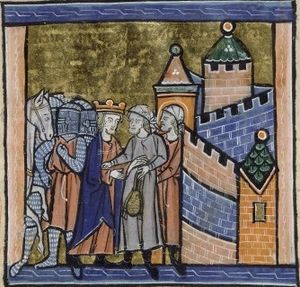 John II Comnenus trades with the Emir of Shaizar , a 13th-century manuscript. | |||
| date of | April 28 - May 21, 1138 | ||
| A place | Shayzar ( Syria ) | ||
| Total | Incomplete victory of Christians | ||
| Opponents | |||
| |||
| Commanders | |||
| |||
| Forces of the parties | |||
| |||
| Losses | |||
| |||


Content
- 1 Background
- 2 Campaign
- 3 siege
- 4 Consequences
- 5 notes
- 6 Literature
Background
Having secured against external threats in the Balkans and Anatolia , the Byzantine emperor John II Komnin ( 1118 - 1143 ) was able to concentrate his attention on the Levant , where he sought to strengthen Byzantine claims of suzerainty over the crusader states and defend his claims to Antioch . These rights went back to the Devil Treaty of 1108 , but Byzantium was not able to enforce it. A necessary measure in preparation for the subjugation of Antioch was the restoration of Byzantine control over Cilicia . In 1137, the emperor conquered the Cilician cities of Tarsus , Adana and Mopsuestia , and in 1138 Levon I and most of his family were taken prisoner to Constantinople [1] .
Control of Cilicia paved the way for Antioch . Faced with the approach of the formidable Byzantine army, Raimund de Poitiers , Prince of Antioch , and Joslen II , Count of Edessa , recognized themselves as vassals of the emperor. John II Comnenus demanded the unconditional surrender of Antioch and, after receiving permission from the king Fulk of Jerusalem , Raimund de Poitiers agreed to surrender the city to the emperor. The agreement under which Raimund de Poitiers pledged to pay tribute to the emperor was drawn up on the basis of the Devol Treaty, but Raimund de Poitiers introduced new conditions in it: he recognized himself as a Byzantine vassal in exchange for investing with Aleppo , Shaizar , Homs and Hama , as soon as they would be conquered by Muslims [2] .
Campaign
In February, by order of the Byzantine emperor, authorities in Antioch arrested all merchants and travelers from Aleppo and other Muslim cities so that they would not issue military preparations when they returned home. In March, the imperial army crossed Cilicia and arrived in Antioch , where it was joined by troops from Edessa and the Templars . The combined forces invaded enemy territory and occupied the Balat. On April 3, they passed through Bizaa, which resisted for five days. It was hoped that Aleppo would be taken by surprise, but at that time the most powerful Muslim leader in Syria, Imad ad-Din Zangi , was nearby Hama with the army. He had enough strength and time to quickly strengthen the garrison of Aleppo . On April 20, the Christian army launched an attack on the city, but found it too well defended. Then the emperor relocated the army south, occupying the fortresses of Atereb, Maarat al-Numan and Kafartab, with the aim of capturing the city of Shayzar . It is likely that Shayzar became the target of the attack because he was the capital of the independent emirate of Munkyzit, so it could be expected that Zangi would not go to his aid [3] .
Siege
Crusader leaders were distrustful of each other and of John II . In particular, Raimund de Poitiers did not show interest in Shayzar - a city with a major Muslim population and vulnerable to attack. Many crusaders also considered the taking of the city inappropriate. As a result, the emperor was forced to rely solely on his own strength [4] .
After several skirmishes, John II Komnin divided his army into units on a national basis and carried them out in front of the city walls in full uniform to awaken the defenders [5] . Although the emperor fought for Christian domination in Syria, his allies Raimund de Poitiers and Joslen of Edes sat idle, playing dice and feasting, instead of participating in the siege. Reproaches from the emperor could only provoke them to hostile actions. Latin and Muslim sources admire the energy and personal courage of John II during the siege. The emperor personally traveled around the troops, checked the condition of the siege vehicles and reassured the wounded. The walls of Shayzar were eventually punched out of trebuchet . The emir ’s nephew, poet, writer and diplomat Osama ibn Munkiz , was impressed by the power of the Byzantine artillery, capable, according to him, of destroying an entire house with one blow [4] .
The city was taken, but the citadel, protected by cliffs, refused to give up. Belatedly, Zangi gathered an army and moved to Shaizar . The Muslim army was smaller than the Christian one, but John II Komnin did not want to leave his siege machines in order to meet Zangi , and also did not trust his allies. At the same time, Sultan ibn-Munkyz, the emir of Shayzar , in exchange for lifting the siege, offered to pay a large indemnity, donate a cross inlaid with rubies to the emperor, become his vassal and pay an annual tribute. John II Comnenus reluctantly accepted the offer. On May 21, the siege was lifted [6] .
Consequences
Zangi’s troops fired with the retreating Christians, but did not dare to actively impede their movement. Returning to Antioch , John II Komnenus solemnly entered the city. Nevertheless, Raimund de Poitiers and Joslen of Edessa conspired to postpone the promised transfer of the Antioch citadel to the emperor and began to provoke popular unrest in the city against the emperor and the local Greek community. Hearing of the invasion of Anatolian Seljuks into Cilicia , John II Komnin himself refused to gain control of the citadel, insisting only on the extension of the oaths of allegiance to Raimund and Zhoslen . He then left Antioch to punish the Seljuk Sultan Masud ( 1116 - 1156 ) and return to Constantinople .
Campaign events emphasized that the suzerainty of the Byzantine emperor over the northern crusader states was of little practical use. The Latins enjoyed the emperor’s protection from the Muslim threat. However, personal interests for them were above the interests of Christians in the region [7] .
John II Komnenus returned to Syria in 1142 , determined to occupy Antioch by force [8] . The death of the emperor in the spring of 1143 as a result of a hunting accident prevented this from happening. His son and successor, Manuel I ( 1143 - 1180 ), took his father’s army to Constantinople to secure his power, and lost the opportunity to conquer Antioch [9] .
Notes
- ↑ Cinnamus, 1976 , pp. 21-22.
- ↑ Runciman, 1952 , pp. 213–214.
- ↑ Runciman, 1952 , p. 215.
- ↑ 1 2 Runciman, 1952 , p. 216.
- ↑ Choniates & Magoulias, 1984 , p. 17.
- ↑ Runciman, 1952 , pp. 215–217.
- ↑ Runciman, 1952 , pp. 217–218; Angold, 1997 , p. 156.
- ↑ Choniates & Magoulias, 1984 , p. 22.
- ↑ Cinnamus, 1976 , pp. 27–28; Choniates & Magoulias, 1984 , pp. 24-26; Angold, 1997 , pp. 157-158.
Literature
- Choniates, Niketas & Magoulias, Harry J. (trans.) (1984), O City of Byzantium: Annals of Niketas Choniates , Detroit, Michigan: Wayne State University Press, ISBN 978-0-81-431764-8 , < https: //books.google.com/books?id=O8arrZPM8moC >
- Cinnamus, Ioannes. Deeds of John and Manuel Comnenus . - New York, New York and West Sussex, United Kingdom: Columbia University Press, 1976. - ISBN 978-0-23-104080-8 .
- Angold, Michael. The Byzantine Empire, 1025–1204: A Political History . - London, United Kingdom: Longman, 1997 .-- ISBN 978-0-58-229468-4 .
- Runciman, Steven. A History of the Crusades, Volume II: The Kingdom of Jerusalem and the Frankish East, 1100-1187 . - Cambridge, United Kingdom: Cambridge University Press, 1952.