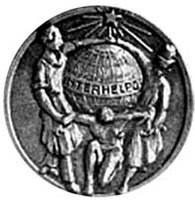
Interhelp (translated from the ido language as “mutual assistance”) is a fishing cooperative from Czechoslovakia that voluntarily went after the call of Vladimir Lenin to build socialism on the territory of present-day Kyrgyzstan. Mainly consisted of Czechs, Slovaks and Hungarians.
| Interhelpo | |
|---|---|
 | |
| Type of | fishing cooperative |
| Base | |
| Abolished | |
| Founders | I. Samuel and R. Marechek |
| Location |  Czechoslovakia : Zilina . Czechoslovakia : Zilina .  USSR : Frunze (now USSR : Frunze (now  Kyrgyzstan : Bishkek ). Kyrgyzstan : Bishkek ). |
| Key figures | Alexander Dubcek |
| Products | , , and |
In 1925 he was recognized as the best cooperative of the Soviet Union. It was liquidated in 1943, many interhelpites were repressed, others returned to Czechoslovakia or died at the front. Part of the Intergelpivts remained to live in the city of Frunze ( Bishkek ).
Content
History
The cooperative "Intergelpo" was created in 1923 in the city of Zilina , Czechoslovakia . In 1924, an agreement was concluded between the Soviet government and representatives of Intergelpo for resettlement in Kyrgyzstan [1] . On April 24 of the same year, the first train arrives in Kyrgyzstan (14 cars with equipment - machines for carpentry, locksmith, turning, wheeled, tailoring and shoe workshops, agricultural machines, some machines for a tannery, a full sawmill - and 13 - with people [2] ):
"... On the allotted Intergelpo area of 230 hectares in the" bare steppe "factories should smoke, the noise of the workshop machines, the town of Intergelpo with the first electricity should have blossomed. The first was a brick factory. The communards did not wait for the construction of the workshops, they hung the transmissions right on the trees and with the help of a locomobile they moved the first lathes and locksmiths. 1925 - the year of the construction of a power plant, a sawmill, a tannery, central workshops, offices and residential buildings - however, not everything went so smoothly. Fire, a tragic event still bothers Zeisel, Merz, Yurachek and others - all children under 5 years old (40 children) died from typhoid and dysentery among the members of Intergelpo. In November 1925, inter-transport arrived from Czechoslovakia to help, he brought the main machines for the tannery and part of the machines for the flour mill. In 1926, the main echelon with 606 people arrived - it was the echelon of textile workers. In Pishpek, a textile factory named after Clement Gottwald. The farmers of Intergelpo for the first time sowed sugar beets, participated in the construction and commissioning of the Kant sugar factory. The Czechs remaining in Kyrgyzstan are the organizers and leaders of the republic’s industry, they laid the foundation for the republic’s industry. In 1930, Intergelpo accounted for 45% of the country's total industry. These were mainly skilled workers of the dynasties of Glozl, Madel, Merz, Zeisel, Wagner, Dubcek, Kugink, Pokorn, Goracek, Tomáš, Halupka and others. The contribution of Intergelp members to the development of agricultural production is undeniable. "Svetlana Kiral [3] ., Czech society" Nazdar ", Bishkek.
Activities
In addition, the Intergelpians built in Kyrgyzstan:
In 1925, a power station, in 1927 a textile factory, in 1928 a smelter, as well as: a furniture workshop, hospitals, extended the railway, carpentry shops, a tannery, built the then residence of the Kyrgyz government. The mechanical workshops of Intergelpo subsequently became the Frunze plant.
In 1934, Intergelpo produced 20% of all industrial production in Kyrgyzstan.
“Thousands of people passed through Interhelpo. Here they received vocational training, working training. In 1935, a large, united multinational team worked at the enterprises of the cooperative. Among the 525 members of the cooperative were 261 Russian, 76 Ukrainians, 40 Slovaks, 39 Czechs, 22 Hungarians. 21 German, 14 Kazakhs and 52 people of other nationalities ” [2] .
The Czechoslovak journalist Julius Fucik described the scale of construction at Interhelpo:
We went to a country about which bourgeois storytellers spoke of as a wild exotic country. But we found ourselves in a country whose pace of construction is much higher than in the most advanced, most civilized countries of the capitalist West. [four]
Intergelpovs in photographs
The first tractor in Kyrgyzstan
Arrival of the second echelon. 1926
Dugout members of a cooperative. 1928
Little Alexander Dubcek (left) in the city of Frunze (Bishkek). 1925
Interesting Facts
Most of the descendants of the Interhelpites in Bishkek are members of the Nazdar Czech public association.
Notes
- ↑ Pishpek: Intergelpo "FOTO.KG - Project" KYRGYZ PHOTO ARCHIVE "
- ↑ 1 2 Street history: Intergelpo Street “FOTO.KG -“ KYRGYZ PHOTO ARCHIVE ”project
- ↑ http://www.assembly.kg , Public associations of the ANC, Public Association of Czechs "Nazdar" (2003)
- ↑ “Soviet Kyrgyzstan” on June 25, 1930
Links
- Radio Prague: “Czechs brought the first technology to Kyrgyzstan”
- INTERGELPO. JULIUS FUCHIK: CONTRIBUTION TO THE CITY DEVELOPMENT
- Documentary about Interhelpo
- Intergelpo Street in Bishkek
- Promotional video with the history of Intergelpo
- Natalia Andrianova. Bishkek's monumental art: a subjective view of the cohabitation of imperial and international discourses