The siege of Tripoli lasted from 1102 to July 12, 1109 and took place on the site of the modern Lebanese city of Tripoli . As a result of the capture of the city, the Crusaders formed the fourth Christian state in the east - the county of Tripoli .
| Siege of Tripoli | |||
|---|---|---|---|
| Main Conflict: Crusades | |||
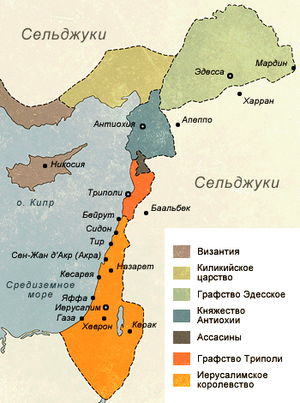 County of Tripoli and its neighbors in 1140. | |||
| date | 1102 - 1109 years | ||
| A place | Tripoli ( Levant ) | ||
| Total | The decisive victory of the crusaders | ||
| Changes | Tripoli County Education | ||
| Opponents | |||
| |||
| Commanders | |||
| |||


Background
After the fall of Antioch in June 1098 and the massacre in Maarre ( January 13, 1099 ), the Syrian emirs , fearing the advance of the crusaders, began to surrender their cities to them. On January 14, Emir Shayzar Sultan ibn-Munkid sent an embassy to Raimund IV of Toulouse , one of the leaders of the Crusade, to offer his soldiers food and feed for horses, as well as to drive to Jerusalem . In February, the emir of Homs Janah ad-Daul, who bravely fought during the siege of Antioch , also offered horses to Raimund . Kadi Tripoli Jalal al-Mulk sent rich gifts to the Franks and invited them to send an embassy to their city. The ambassadors marveled at the splendor of the city, and an alliance was concluded. The Crusaders set out to besiege Acre ( February 14 - May 13 ), and then Jerusalem , leaving Tripoli and neighboring lands untouched.
Raimund's Return to Tripoli
The siege of Jerusalem was successful and led to the creation of the Kingdom of Jerusalem . Most of the crusaders returned home, but some of them went to the Rear Guard Crusade to fight against the Seljuks in Anatolia . Raimund IV took part in this campaign, and after a series of setbacks he returned to Syria. He had with him only three hundred knights. Fahr al-Mulk, Kadi Tripoli , was not as amiable as his predecessor, and sent troops against the crusaders, asking for help from the governors of Damascus and Homs . However, the sent soldiers fled as soon as they reached Tripoli , and the Cadi troops were defeated in early April, losing seven thousand people. Raimund IV could not take the city itself, but managed to occupy Tortosa , which became the basis for future operations against Tripoli .
Siege
The following year, Raimund IV, with the help of Byzantine engineers, built the Mont Peleren fortress (“Qalaat Saint-Gilles” - “Saint-Gilles fortress”) to block the roads from Tripoli to the interior of the country. With the help of the Genoese Hugo Embriaco, he also occupied Byblos north of the city. After the Battle of Harran in 1104, Fahr al-Mulk asked Sukman al-Artuk of the Turkic dynasty of Artukids , the governor of Jerusalem , to intervene. Sukman's troops entered Syria, but were forced to return.
In September 1104, Fahr al-Mulk attacked Mont Peleren , killing many Franks and destroying one wing of the fortress. Raimund IV himself was seriously injured and, according to the generally accepted version, died five months later, in February 1105 . He was replaced at the head of the crusaders by his nephew Guillaume Jordan , Count of Cerdani . On his deathbed, Raimund IV reached an agreement with the Cadi: if he stops attacking the fortress, the crusaders will cease to impede the tripolitans trade. Kadi accepted the terms.
In 1108, transporting food to the city by land became even more difficult. Many residents fled to Homs , Tire, and Damascus . Representatives of the nobility sent ambassadors to the Franks with a proposal to surrender the city, but the ambassadors were executed in the crusader camp. Fakhr al-Mulk had to wait for help from the Seljuk Sultan Muhammad I, to whom he went to Baghdad in late March with 500 soldiers and rich gifts. He passed through Damascus , where the ruler Tugtegin received him with cordiality. In Baghdad, the sultan met with the Qadi , but did not provide assistance, since he was busy with dynastic disputes in Mosul . Fahr al-Mulk returned to Damascus in August, where he learned that Tripoli , tired of waiting for his return, had handed over the city to al-Afdal, the Egyptian vizier.
The following year, the forces of the Franks at the walls of Tripoli brought together Baldwin I of Jerusalem , Baldwin II of Edessa , Tancred of Tarenta , Guillaume Jordan and the eldest son of Raimund IV Bertrand . The army of the Crusaders was replenished by the Genoese, Pisans and Provencal. The city itself waited in vain for reinforcements from Egypt.
The crusader leaders held a council near the walls of the city and decided that after the capture of the city a new Christian state would be formed - the county of Tripoli . Due to disputes between Guillaume Jordan and Bertrand, it was supposed to be divided into two parts.
The city fell on July 12 and was plundered by the crusaders. One hundred thousand volumes of the Dar-em-Ilm library were recognized as "wicked" literature and burned. The Egyptian fleet arrived too late, eight hours after the fall of the city. Most of the inhabitants were enslaved, the rest were deprived of their possessions and expelled. Bertrand , the illegitimate son of Raimund IV, became the master of Tripoli , as Guillaume Jordan died during the battle. Thus, Tripoli became the center of the new, fourth state of the Crusaders in the Levant .
Literature
- Mills, C. 1844. The History of the Crusades: For the Recovery and Possession of the Holy Land . Lea & Blanchard, p. 97. No ISBN.
- Michaud, JF 1852. History of the Crusades . Translated by W. Robson, p. 287. No ISBN.
- Archer, TA, Kingsford, CL and HE Watts. 1894. The Story of the Crusades . Putnam, pp. 133, 155-158.
- Riley-Smith, J. 1983. " The Motives of the Earliest Crusaders and the Settlement of Latin Palestine, 1095-1100 ." The English Historical Review 98 (389) : 721-736.