TsKB-39 OGPU them. Menzhinsky - the first of the "Experimental Design Bureau", created in late 1929 for the needs of the Soviet aircraft industry, using the labor of prisoner aircraft designers and engineers. It was a special unit of the OGPU . Later, similar design bureaus began to appear in various sectors of the economy, having the slang term “sharaga” or “sharashka” . In the aircraft industry there were two of them. After TsKB-39 of the OGPU in 1938, TsKB-29 of the NKVD was created.
| TsKB-39 OGPU them. Menzhinsky | |
|---|---|
 | |
| Type of | Experienced design bureau in the structure of the OGPU (first in the territory of Butyrskaya prison, then aircraft plant No. 39 named after Menzhinsky) |
| Base | 1929 |
| Location |  USSR , Moscow USSR , Moscow |
| Key figures | • Dmitry Pavlovich Grigorovich ; • Nikolai Nikolaevich Polikarpov ; • Andrey Nikolaevich Sedelnikov ; • Vasily Alexandrovich Tisov; • Victor L. Corvin-Kerber ; • Alexander Vasilievich Nadashkevich ; • Nikolai Gustavovich Mikhelson ; • Ivan Mikhailovich Kostkin; • Evgeny Ivanovich Majoranov; • Alexander Dmitrievich Melnitsky |
| Industry | Engineering |
| Products | Experienced aircraft manufacturing |
Content
First Arrests and Investigation
The beginning of the history of TsKB-39 OGPU them. Menzhinsky can be considered August 31, 1928, when the founder of the marine aircraft industry was arrested in Moscow, on the seaplanes of which Russia fought the entire First World War and the Civil War - Dmitry Pavlovich Grigorovich . The reason for the detention was the failure of Dmitry Pavlovich in recent years. Since 1924, the team he heads, the Department of Marine Experimental Aircraft Engineering (OMOS) , located at the Krasny Pilot plant in Leningrad, has not created any decent cars. For the time of the arrest, OMOS had not existed for almost a year, and Dmitry Pavlovich himself headed another design unit in Moscow - the Experimental Department-3 (OPO-3). Most of his former OMOS employees remained in Leningrad and dispersed to other teams.
The catalyst for the arrest was only in the summer the first process in the history of Soviet Russia that wrecked pest engineers. It was called the Shakhty affair . Then the authorities first tested the notorious 58th article of the Criminal Code of the RSFSR, which entered into force on February 25, 1927. Such notions as “ pest ” and “ enemy of the people ” were introduced into the practice of legal proceedings. With the approval of wide layers of workers, large business executives were called "malicious pests." Some of them were sentenced to the highest degree, and the rest sent to the construction of socialism. Beginning with the Shakhty case, they began to use the most qualified convicts by profession, but in closed institutions and under the protection of the OGPU . The experience of using slave mental labor in the country did not exist yet, so the expediency of organizing such institutions was to be evaluated.
Shortly after D.P. Grigorovich , five more people were arrested. The former OMOS designers were detained in Leningrad: A. N. Sedelnikov (November 5), with whom Grigorovich created the first flying boats at the Gamayun plant in Tsarist Russia, and V. L. Corvin-Kerbera (November 6), the former naval pilot who fought on Grigorovich’s planes, and since 1922 entered his design team in Moscow at the Duks plant . On November 13, the former OMOS test pilot, A. D. Melnitsky, was also arrested. In addition, in Moscow they took into custody the motorist of the Dux factory V.M. Dneprov, who suffered only because he was the brother of D.P. Grigorovich's wife. Suddenly, the assistant to the commander of the Trans-Baikal Air Force M.N. Shalimo was in this company. Unlike the others, he was left on his own recognizance. A few weeks later, the case against M. N. Shalimo was dismissed. Comdiv M.N. Shalimo will be shot on October 2, 1938 as the head of an anti-Soviet organization, an agent of Japanese intelligence and the organizer of sabotage.
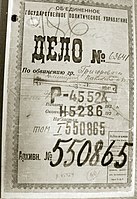
Cases of the aforementioned defendants were merged into a general legal proceedings - Case No. 63641 “on charges of gr. Grigorovich Dmitry Pavlovich and others. " For this reason, all Leningraders were sent to Moscow, to the internal prison on the Lubyanka . The investigation went very sluggishly, so far with the observance of procedural norms and without the application of physical impact methods. The times of G. G. Yagoda and N. I. Yezhov had not yet arrived, and V. R. Menzhinsky , who was head of the OGPU at that time, was known as a liberal. There was no experience with those arrested. During interrogations, which usually dealt with the technical issues of creating aircraft, they easily shared their doubts with investigators, admitted certain errors, believing that they can be qualified as natural during experimental design work.
Contrast was the testimony of witnesses in the case. Recent OMOS colleagues have often played in this role. So, the test pilot Y. I. Sedov showed:
“Sedelnikov and Corwin-Kerber obviously sabotaged, trying only to harm the business ... The details of the planes were made on purpose so that they didn’t fit, why alterations were inevitable ... When in the drawing room they talked about irregularities and disorder, then Sedelnikov usually answered:“ go to hell, I’m spitting on this matter, I’ll go abroad anyway “” .
- [1]
He was echoed by the young designer V. B. Shavrov :
“... If Grigorovich was a pest, he could not have done worse. He so decomposed the matter, having lost four years, deceiving the hopes placed on the department, that he deserves and deserved to be prevented earlier ... This [he] was promoted by the enormous reputation and authority enjoyed by Grigorovich, and even in tsarist times, several successful aircraft. The result is a complete crisis ... the Division’s achievements are zero. ”
- [1]
It should be noted that one of the important reasons for the OMOS failures was indeed a team conflict with the chief designer. They were based on a constant mess with the requirements that were presented to the projects. For example, the customer could easily afford to change the basic characteristics of the aircraft (engine power, flight range, payload) at a time when the prototype of the aircraft was already in production.
New Arrests and Creation of OKB OGPU
The investigation into the case of D.P. Grigorovich and employees was completed by the fall of 1929. The trial, chaired by the secretary of the OGPU collegium A.M. Shanin, took place on September 20 and sentenced all five to different terms of "concentration camps", after which the convicts were transferred to Butyrki to wait for the stage . By the fall of 1929, the OGPU had finally matured a plan to create the first aviation “sharaga” , but it was obvious that the five convicts, with all their qualifications, could not cope with the daunting tasks. At least in September 1929 (before the court or after - it is unknown) D.P. Grigorovich was asked to compile lists of aviation workers who should be involved in the execution of a special task of the government. Grigorovich was not initiated into the final plan of the OGPU and could not imagine what would happen when the lists were ready.
And there were new arrests. In October 1929, a former OMOS officer, N. G. Mikhelson , who co-authored the first flying boats of D. P. Grigorovich built at the Gamayun plant, was taken into custody in Leningrad. In Moscow, they took the chief of the OSS, N. N. Polikarpov, and his colleagues - I. M. Kostkin, V. A. Tisov, E. I. Mioranov, V. F. Goncharov, P. M. Kreyson, V. V. Kalinin. A little later, A. V. Nadashkevich, a leading specialist in the USSR in aircraft weapons, was arrested. Investigators now did not bother to prove their guilt. The court hearings of the OGPU collegium began in November, and by December it was all over. The sentences were the most diverse, but unlike the Grigorovich group, without any clear motivation. So, N. N. Polikarpov, who could not have been presented with half of what was blamed on Grigorovich, was nevertheless sentenced to death. The task was simple. The process of demoralization that the persons involved in the Grigorovich case underwent for almost a year, the new party of prisoners had to go through at an accelerated pace in two to three weeks. When the preparatory period was completed and, from the point of view of the “psychologists” of the OGPU , the collective (where everyone was sitting in solitary confinement for now and did not even realize that they were members of the collective) was completely ready for “creative accomplishments,” the last autumn day of 1929 happened the birth of the first domestic Special Design Bureau (OKB OGPU), or in other words, “sharagi” .
On that day, all the imprisoned designers and engineers right in Butyrky , in the premises of the former prison church, were brought together for the first time. Basically, they were familiar with each other, but did not even realize that they were sitting in neighboring chambers. Further, as V. L. Corwin-Kerber recalled, the following happened:
“In the afternoon, Deputy Chief of the Air Force Comrade Commander J. I. Alksnis . He announced the task: to design, and then build a fighter under the Jupiter engine, but one that will surpass any of the capitalist countries in service, both in speed and rate of climb and armament. We need two machine guns firing through a screw, and it is advisable to provide two more, as well as a photo mount and bomb racks for four 25 kg bombs. The project should be completed in record time, and the drawings are ready for production by the end of March. Then the layout should be presented. The project will not be submitted to NTC. Grigorovich was appointed the chief designer, Polikarpov was his deputy. ”
- [2]
The beginning of the OKB OGPU activity and renaming into “TsKB-39 OGPU them. Menzhinsky »
OGPU OKB was directly supervised by the assistant to the head of the technical department of the OGPU Economic Department A. G. Goryanov-Gorny (Benkovich), and his authorized representative, who was inseparable from the prisoners, was S. M. Zmuda [3] . The imprisoned aircraft engineers were transferred to enhanced food, they were allowed walks and visits with loved ones. Work on the fighter project began right in the prison church.
According to the memoirs of V. L. Corvin-Kerber:
“In January 1930, events occurred that no one expected. Suddenly after dinner, everyone was asked to pack their things and get ready in the cell for the exit. We were loaded into a small bus and taken around the city. Nobody understood where, why. Finally, the door of the bus opened and everyone saw the wooden hangar workshop of plant No. 39 . We went inside the hangar and at the very end, going out the door, were in a spacious room. Beds stood along the walls, and in the middle a large table with stacks of newspapers and magazines. Zmuda, who accompanied all of them, offered to stay in beds at his discretion. To the right of the entrance are: B. F. Goncharov, N. N. Polikarpov, V. A. Tisov, I. M. Kostkin, A. N. Sedelnikov, me and E. I. Majoranov. On the left - D. P. Grigorovich, P. M. Kreyson, N. G. Mikhelson and others. ” }
- [2]
The transfer to the plant was required due to the fact that work on the fighter reached the stage of prototyping and creating a prototype. It was impossible to organize production in prison conditions. A small aircraft factory (rather workshops), adjacent to the Central airfield, was surrounded by barbed wire, and security was set up. The prisoners were brought here. From that moment, “OKB OGPU” by the number of the plant became known as “TsKB-39 OGPU them. Menzhinsky. ”
After evaluating the project and realizing that the "pests" and "enemies of the people" were successfully re-educated, the curators of the OGPU decided to complicate the task. Corwin Kerber wrote:
“One evening, big bosses arrived: A. G. Goryanov-Gorny and M. I. Gai (Shtoklyand - Head of the 8th and 9th departments of the Economic Department of the OGPU). Zmuda with a guard brought baskets and boxes into the room. Wine immediately appeared on the tables and a large quantity of appetizers. All members of the Central Design Bureau were invited to the table. Everyone was alert, we could not understand what the purpose of such a banquet was. Guy took the floor. He praised those present for their successful work and added that by the decision of the command, the deadline for building the fighter plane was postponed from June 1 to May 1, and on March 26, a model should be presented. It was impossible to challenge the new deadlines. I had to assure the authorities that the team will cope with the task. But besides the plane, by May 1, everything will need to be built for the stat. tests . "
- [2]
Despite such a tight deadline, a dozen or so versions of the fighter project were developed, of which only three were selected for the construction of prototypes. The options differed in details (projects for different engines, different weapons, the presence or absence of engine fairings, etc.). The first prototype aircraft, originally called the VT-11 (“internal prison” - the 11th option) was ready for the appointed date. It was tested here at the Central Airfield. Pilot B. L. Buchholz on April 28, 1930, already in the first flight, praised the quality of the aircraft, and the OGPU concluded that the effectiveness of bonded mental labor. Thus, the creation of the scientific and technical “sharag” was launched in almost all sectors of the national economy, and especially in the military industry.
New tasks and the disbandment of “TsKB-39 OGPU im. Menzhinsky »
History TsKB-39 OGPU them. Menzhinsky did not end. After the successful completion of work on the VT-11 fighter, its understudy “Klim Voroshilov” (built according to version 13 of the project, but did not get the name VT-13 from superstition) and the third prototype, “Gift to the 16th Party Congress” [2] , called I- 5 fighter was launched into the series. The OGPU decided that it was too early to part with the imprisoned designers and gave the “pests" new tasks. Now it was necessary to build not one plane, but several at once. The prisoners were ordered to create the first domestic I-Z cannon fighter, TB-5 bomber, four-engine sea bomber, TS-1 and TS-2 attack aircraft, and a two-seat fighter.
It is clear that such a volume of work could not be performed by the limited forces of prisoners, and in the autumn of 1930 it was decided to expand the team at the expense of civilian specialists. Of course, all of them could be immediately arrested, but the OGPU chose a different model - a mixed team of prisoners and free engineers, so that the latter would constantly feel where they could be tomorrow. TsKB-39 was expanded to more than 300 people. For example, G. E. Chupilko, S. V. Ilyushin , A. S. Yakovlev , V. B. Shavrov , S. N. Shishkin and others came. Under the same roof condemned and some of those who recently testified against them. History is silent about, say, the relations between D.P. Grigorovich and V. B. Shavrov.
Not all of the new projects were successful, but overall the OGPU was enough. Since the summer of 1931, prisoners have begun to release designers in turn. On July 10, 1931, the Pravda newspaper published a resolution of the Central Executive Committee of the USSR, which stated:
«Амнистировать нижеследующих конструкторов — бывших вредителей, приговоренных коллегией ОГПУ к различным мерам социальной защиты, с одновременным их награждением:
- a) Dmitry Pavlovich Grigorovich, chief designer for pilot aircraft construction, who repented of his previous deeds and proved his repentance in a year's work, with a letter from the Central Executive Committee of the USSR and a monetary award of 10,000 rubles;
- b) the chief designer (in armament. - G.K.) Nadashkevich Alexander Vasilyevich - a letter from the Central Executive Committee of the USSR and a cash prize of 10,000 rubles;
- c) the former technical director of plant No. 1 Kostkin Ivan Mikhailovich - a cash award of 1,000 rubles;
- d) Kreyson Pavel Martynovich - a monetary award of 1,000 rubles;
- d) Corvin-Kerber Victor Lvovich - a cash award of 1,000 rubles;
- f) amnesty for all engineers and technicians sentenced by the OGPU to various social protection measures for sabotage and now conscientiously working in the Central Design Bureau ”
- [4]
As for TsKB-39 of the OGPU itself, by Order of the All-Union Aviation Association (VAO) No. 265 dated August 27, 1931, TsKB 39 and TsAGI were united into a single organization, the chief of which was appointed Chekist N. E. Paufler . A little later, on January 13, 1933, by the order of the Deputy People's Commissar of Heavy Industry of the USSR and the head of the Main Directorate of the Aviation Industry P. I. Baranov at Plant No. 39 named after Menzhinsky , a new Central Design Bureau (TsKB) was formed to organize a closed cycle of design and production of light aircraft under the leadership of S. V. Ilyushin .
The final point in the case of Grigorovich and employees was set only on June 25, 1993:
“... on the basis of the Law of the RSFSR of 10.10.91“ On the rehabilitation of victims of political repressions ”, the prosecutor of the department for the rehabilitation of victims of political repressions of the General Prosecutor of the Russian Federation decided: “ Grigorovich Dmitry Pavlovich, Sedelnikov Andrey Nikolaevich, Corvin-Kerber Victor Lvovich, Melnitsky Alexander Dmitrievich, Dneprov Vladimir Mikhailovich are subject to rehabilitation . ”
- [1]
List of “pests” creating the I-5 fighter
- Bessonov Anatoly Alekseevich [5] . Designer Plant No. 24 named after M.V. Frunze. Creator of the first Soviet high-altitude piston engine M-15. In TsKB-39 he was engaged in the engine .
- Goncharov Boris Fedorovich [6] . Before the revolution, he was a military pilot, chief of the 1st Special Purpose Aviation Unit. In 1926 - Senior Head of the Department of Aircraft Engineering of the Academy of the Air Force of the Red Army. Zhukovsky and at the same time head of the design bureau of the Aviation Trust (pilot plant No. 25). At TsKB-39 he was engaged in aerodynamic calculations .
- Grigorovich Dmitry Pavlovich . One of the first Russian aircraft designers with pre-revolutionary experience, who started at the Shchetinin factory (Gamayun) before the First World War. Chief designer of a large number of seaplanes. In TsKB-39 he carried out general project management .
- Dneprov Vladimir Mikhailovich . Mechanic, employee of the factory number 1 "Duks." In TsKB-39 - an engineer .
- Kalinin Vladimir Vladimirovich . [7] Aircraft designer is one of the authors of the first Soviet passenger aircraft AK-1 (1924). Specialist in structural strength. In TsKB-39 he was engaged in strength calculations .
- Corvin-Kerber Victor Lvovich . Before the revolution, he was a marine pilot, a graduate of the Baku School of Naval Aviation (1917). Aircraft designer, associate of D.P. Grigorovich since 1922. At TsKB-39 he headed pilot production and prototyping. He designed some instruments and a system for firing through a rotating screw .
- Kostkin Ivan Mikhailovich [8] . Aircraft designer, closest associate of N. N. Polikarpov. Director of the aircraft factory number 1 "Duks" In TsKB-39 was engaged in the design of wings .
- Kreyson Pavel Martynovich . Permanent member of the Scientific and Technical Committee of the Air Force Office of the Red Army. Specialist in Statistical Tests. In TsKB-39 he was engaged in centering calculations .
- Nadashkevich Alexander Vasilievich [9] . Military pilot, graduate of the Moscow military aviation school of aerobatics (1918). Since 1925, member of the scientific and technical committee of the Air Fleet of the Red Army. An unrivaled specialist in aircraft armament. At TsKB-39 he was engaged in the design of weapons .
- Majoranov Evgeny Ivanovich [10] . Before the revolution, he was a marine pilot, a graduate of the Baku School of Naval Aviation (1917). Aircraft designer, associate of Grigorovich since 1922, then (since 1923) - N. N. Polikarpova. In TsKB-39 - design engineer .
- Melnitsky Alexander Dmitrievich . Born 12/26/1891 (01/07/1892). Graduated from the Marine Corps (1911); navigational officer 2 category (1915), naval pilot. Graduate of the Petrograd School of Naval Aviation. He served and. the inspector of destroyers "Don Cossack" (1912-1913), "Troops" (since 1913); officer of the Guards crew (from 04.25.1915). Decorated with orders: St. Stanislav 3rd art. with swords and bow (06/01/1915), St. Anne 3rd art. with swords and bow (01/23/1915). After the revolution in the White forces of the Northern Front in the British Air Force, then the commander of the land reconnaissance unit in the Murmansk Air Division. According to some reports [11] , he was captured and shot in Bear Mountain. In fact, since 1925, a test pilot of the Department of Marine Experimental Aircraft Engineering (OMOS) D.P. Grigorovich. In TsKB-39 - design engineer .
- Mikhelson Nikolay Gustavovich . Aircraft designer with pre-revolutionary experience, the closest associate of D. P. Grigorovich starting from the Shchetinin factory (“Gamayun”). At TsKB-39, he headed the drawing group .
- Polikarpov Nikolay Nikolaevich . One of the first Russian aircraft designers, who started at the Russian-Baltic plant under the direction of I. I. Sikorsky . At TsKB-39, he acted as deputy project manager, was engaged in the general view and fuselage .
- Popov A.A. Aircraft designer, closest associate of N.N. Polikarpov. Specialist in pilot production. In TsKB-39 - design engineer .
- Rubinchik A.R. In TsKB-39 - design engineer .
- Sedelnikov Andrey Nikolaevich . Aircraft designer with pre-revolutionary experience, the closest associate of D. P. Grigorovich starting from the Shchetinin factory (“Gamayun”). At TsKB-39 he was engaged in the design of the chassis .
- Tarasevich Boris Nikolaevich [12] . Director of the Kolomna Locomotive Plant. At TsKB-39, a design engineer .
- Tisov Vasily Alexandrovich . Aircraft designer, closest associate of N. N. Polikarpov. Specialist in aircraft equipment and pilot production of aircraft. At TsKB-39, a design engineer .
- Fokht V. Ye. Head of Technical Department, Rybinsk Machine-Building Plant No. 26. Engaged in the engine at TsKB-39 .
The management team of TsKB-39 from OGPU
- Prokofiev, Georgy Evgenievich - head of the economic department of the OGPU. Sentenced to capital punishment and executed on August 14, 1937. Not rehabilitated.
- Guy (Shtokland) Mark Isaevich - head of the 8th and 9th departments of the Economic Department of the OGPU. Sentenced to capital punishment and executed on June 20, 1937. Not rehabilitated.
- Goryanov-Gorny (Benkovich) Anatoly Georgievich - assistant to the head of the technical department of the Economic Department of the OGPU. Head of Central Clinical Hospital-39 . Sentenced to capital punishment and executed on October 27, 1937. Rehabilitated on June 8, 1957 by the decision of the Military Collegium of the Supreme Court of the USSR.
- Paufler Nikolai Evgenievich - director of the aircraft plant number 39 named after Menzhinsky. Deputy Head of TsKB-39 . He did not live to be shot, he died suddenly on February 10, 1934. He was not rehabilitated.
- Zmuda Stanislav Matveevich [3] - employee of the economic department of the OGPU. Head of security TsKB-39 . Sentenced to capital punishment and executed on April 25, 1938. Rehabilitated on June 6, 1956 by a ruling of the Military Collegium of the Supreme Court of the USSR.
Notes
- ↑ 1 2 3 Materials of case No. 63641 on charges of D.P. Grigorovich and employees
- ↑ 1 2 3 4 Corvin-Kerber V. L. Memoirs of N. N. Polikarpov (manuscript)
- ↑ 1 2 Zmuda Stanislav Matveevich
- ↑ Khvoshchevsky G. I. "Pages of history ..."
- ↑ Bessonov Anatoly Alekseevich
- ↑ Goncharov Boris Fedorovich
- ↑ Kalinin Vladimir Vladimirovich
- ↑ Kostkin Ivan Mikhailovich
- ↑ Creators of Soviet aviation. Nadashkevich Alexander Vasilievich
- ↑ Majoranov Evgeny Ivanovich
- ↑ Melnitsky Alexander Dmitrievich
- ↑ Tarasevich Boris Nikolaevich
Literature
- Grigoryev A. B. Aircraft from ... Butyrki. // Veteran. - 1990. - No. 9. - P.14;
- Kerber L. L. And the thing went to war ... ;
- Kerber L. L. On the communist bureaucracy and the “sharag” system ;
- Sobolev D. A. Repression in the Soviet aircraft industry ;
- Yakovlev A.S. Airplanes of the thirties.// Aviation and astronautics. - 1966. - No. 9 .;
- Kopytov G.A. Kerbery. Surname code. XIV — XXI centuries second book // ed. "Petersburg - XXI century." 2013 ;
- The first aircraft of the aircraft plant number 39 ;
- Designers and inventors of TsKB-39 (inaccessible link) ;
- Case File No. 63641