Viljem II from Pernstein and on Helfstein ( Czech Vilém II. Z Pernštejna a na Helfštejně ; 1438 - April 8, 1521 , Pardubice ) - a medieval Czech-Moravian tycoon and statesman from the noble family of Pernštejnov , one of the most influential and richest dignitaries King Vladislav II ( 1471 - 1509 ), the highest marshal and the highest hofmeister of the Czech Kingdom . Grandfather Vratislava II from Pernshtein .
| Willem II of Pernstein | |||||||
|---|---|---|---|---|---|---|---|
| Czech Vilém II. z Pernštejna | |||||||
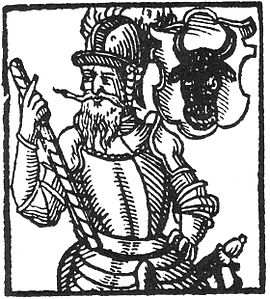 Willem II of Pernstein. "The Mirror of the Glorious Margrave of Moravian." Bartosh Paprotsky . | |||||||
 | |||||||
| Successor | Wojtech I from Pernstein | ||||||
| |||||||
| Monarch | Vladislav II | ||||||
| Birth | 1438 | ||||||
| Death | April 8, 1521 Pardubice | ||||||
| Burial place | Catholic church of the Exaltation of the Holy Cross , Dorabravnik | ||||||
| Kind | Pernsteins | ||||||
| Father | Jan II of Pernstein | ||||||
| Mother | Goddess from Lomnice | ||||||
| Spouse | Yoganka of Liblitz (d. 1515) | ||||||
| Children | Jan IV , Vojtech I , Bogunka | ||||||


Content
- 1 Biography
- 2 Properties
- 3 Family
- 4 notes
- 5 Literature
- 6 References
Biography
Viljem II was the son of the influential Moravian tycoon Jan II of Pernstein (d. 1475 ) and his second wife Bogunka of Lomnice. At the age of 14, his father sent him to the court of the twelve-year-old King Ladislav Postum , however, the sudden death of Ladislav in 1457 prevented Vilem’s future cloudless career at court. Soon Villem entered the service of Jiří from Podebrad , whose side was taken by his father.
After the death of King Jiri from Podebrad, in 1472, Willem was forced to go to the service of Matthias Hunyadi, as his older brother Zikmund from Pernshtein was taken hostage by supporters of Matthias. Vilemus became the commander of Matthias, while he easily departed from the Hussite faith and converted to Catholicism . Villem II throughout his life was generally quite tolerant in matters of religion - his famous phrase “S Římany věřím, s husity žiji, s bratřími umírám” is known ( I believe with the Romans, I live with the Hussites, I die ) [1] .
In 1474, Villem occupied the position of the highest Moravian commander, whose functions included managing the Zemstvo treasury and other property (he remained in this position until 1487 ). After the end of the war for the Czech throne in 1479 between Vladislav II Jagiellon and Matias Hunyadi Vil from Pernshtein, he became one of the closest nobles of King Vladislav. In 1483, Villem II was appointed to the post of the highest marshal of the kingdom (held him until 1490 ). Since 1488, he provided protection and patronage to the Czech brothers , whom King Matias Hunyadi tried to expel from Moravia.
In 1490 (according to other sources, in 1487 [2] ), Villem II took the position of the highest hofmeister . After the death of Matthias Hunyadi (in 1490), Willem from Pernshtein carried out successful diplomatic activities aimed at the election of Vladislav Jagiellon as king of Hungary.
In 1507, Vilhem began to move away from active political activity, focusing on managing his vast estates. In 1514, he left the post of the highest hofmeister of the kingdom, however, leaving, he achieved the appointment of his youngest son Wojtech . The last political achievement of Willem II was his participation in the preparation and conclusion of the Svyatovaclav Treaty of 1517, which regulated the relationship between the urban and noble estates of the Czech Republic.
Villemus was an entrepreneurial business executive and, unlike many other aristocrats, was not afraid to introduce progressive production methods and new branches of management, such as fish farming, brewing, sheep breeding, mining , into his estates.
The famous Czech historian Frantisek Palacki described the personality of Willem II of Pernstein:
“He was a man whose equal is in vain to seek in the history of the Czech and, possibly, other peoples. As a warrior, he belonged to the Middle Ages, as a large industrialist, he belonged to the New Age. As an excellent mind and noble character - to all eras. ” [2]
Original text (Czech)"Byl muž, jemuž rovného bychom marně hledali v dějinách českých a snad iu jiných drahně národův. Co válečník, náležel ještě středověku, co velký průmyslník patřil již věku novému. Co výtečná hlava a ušlechtilý charakter věkům všem. ”
Villem II died on April 8, 1521 in Pardubice at the age of 83 and was buried in the family crypt under the altar of the church of the Exaltation of the Holy Cross in Doubravnick .
Holdings
In 1472 - 1473, it was mentioned under the name Wilhem on Mezirici , which indicates that he owned at that time the town of Mezirici , which previously belonged to his maternal grandfather Jan from Lomnice. After the death of his older brother Zikmund (in 1473 ) and their father (in 1475), extensive family estates, including the Moravian castle of Pernštejn , came under the control of Vilém, who took the place of the eldest in the Pernštejn family.
Thanks to the marriage with the Joganka from Liblitz, Villem II got an impressive fortune and in 1475 Villem II bought the castle Gelfshtin in Moravia , according to which until the end of his days Villem from Pernstein and Gelfshtin signed. In 1482, Moravsky-Krumlov became the residence of Willem, in respect of whom he acquired custody and from where he regularly visited for important meetings in Prague.
The 90s of the XV century became a period of the rapid expansion of the territorial possessions of Wilhem from Pernstein in Moravia and the strengthening of his wealth. In 1490, Vilem acquired the Kunetitsk pansque together with the Kunetická Hora castle , which he substantially transformed, and in the same year he received a pledge and the Gluboká castle from King Vladislav II for 21,000 Hungarian florins [3] . In 1491, Villem II bought the Bogdanec panh and the Pardubice pan with a castle , which was rebuilt into a four-winged Renaissance palace, which became its new permanent residence. After the death of his younger brother Vratislava I from Pernshtein in 1496, Villem II inherited the Moravian castle Plumlov with the same name , as well as the Prostejov and Kostelec nad Gan panamas . Shortly afterwards, Villem bought the castle of Dragotushe and the panels of Prerov , Lipnik and Hranice .
In 1503, Vilhem II acquired the Moravian Panavia of Tovacov and Coetin . In addition, the pledges of Trebic and Glubchyce were secured by Willem from Pernstein. Among the possessions of Willem from Pernstein there were also the castles of Litice (near уamberk ), Potstein , Sadek and Tsymburk ; the towns of Ivančice (since 1486 [4] ), Жydlochovice , Hodonin (since 1512 [5] ), Pogorželice (since 1512 [6] ). The territorial expansion of Villem II’s property stopped with the acquisition of an impressive Lithuanian pannage in the vicinity of Brno , which included, in addition to the village of Litava, 12 villages, several fortresses and three empty castles [2] .
Family
In 1475, Vilhem II married a Yoganka from Liblitz (she died in 1515 ), from whom she was born:
- The Bogunka from Pernshtein (1485-1549);
- Jan IV “The Rich” from Pernstein (1487-1548), Moravian Zemsky Hetman (1515-1519, 1526-1528, 1530), Count Glac (from 1537);
- Vojtech I from Pernstein (1490-1534), the highest hofmeister of the Czech Kingdom (1514-1523).
Notes
- ↑ Bílý, Jiří. Jezuita Antonín Koniáš. Praha. Vyšehrad. 1996. ISBN 80-7021-191-1
- ↑ 1 2 3 Vilém z Pernštejna on the official website of the city of Doubravnik
- ↑ 16.století //www.zamek-hluboka.eu Archived March 22, 2014 on the Wayback Machine
- ↑ Několik vět o městě Ivančice ... // www.ivancice.cz unopened (unavailable link) . Date of treatment March 23, 2014. Archived March 23, 2014.
- ↑ Hodonín v datech //www.hodonin.eu
- ↑ Historie města Pohořelice //www.pohorelice.cz
Literature
- Hofman, Ladislav; Novák, Jan Václav. z Pernšteina (Czech) // Jan Otto Ottův slovník naučný: Illustrovaná encyklopaedie obecných vědomostí. - Praha, 1902. - Sv. 19: "P — Pohoř . " - S. 507-509.
- Sedláček, August . Hrady, zámky a tvrze království českého. - Praha: Výtvarný odbor Umělecké besedy, 1882. - T. I. Chrudimsko. - S. 36-38. - 250 S.
- Vorel, Petr. Páni z Pernštejna. Vzestup a pád rodu zubří hlavy v dějinách Čech a Moravy. - Praha: Rybka Publishers, 1999 .-- 318 S.