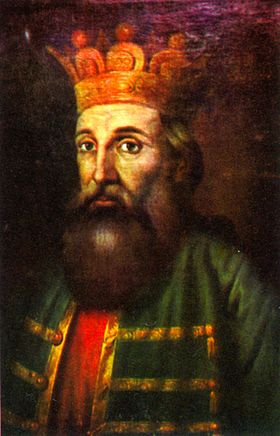
Peter II Mushat ( Peter Voevoda , Mold. Petru Mushat ) - ruler of the Moldavian principality in 1375 - 1391 , son of Kostya (Stefan of Shchepenits) and Mushaty (Margarita), the first of the rulers of the Mushatov (Mushatinov) dynasty.
| Peter I Mushat | |||||||
|---|---|---|---|---|---|---|---|
| Mold Petru Mushat | |||||||
 | |||||||
 | |||||||
| Predecessor | Kostya (Stefan) or Mushata (Margarita) (regent) or Giurgiu (challenger) | ||||||
| Successor | Roman I Mushat | ||||||
| the first of the rulers of the Mushatin dynasty | |||||||
| Birth | |||||||
| Death | 1391 | ||||||
| Rod | Mushats (Mushatin) | ||||||
| Father | Kostya (Stefan) | ||||||
| Mother | |||||||
| Spouse | relative of Vladislav II Jagiello | ||||||
| Children | Roman Petrilovich and Ivashko | ||||||
| Religion | orthodoxy | ||||||
Content
History
During the reign of Peter II Mushat, the Moldavian principality was actively involved in the international relations of southeastern Europe. It was from that time that the first reliable act, issued by the Moldovan Chancellery, dated May 1, 1384, was preserved. In this act, Peter II Mushat has the title “Petrus Waiwoda dei gratia dux Terre Moldavie” (Petrus Voyevoda , by the grace of God, the ruler of Moldavian Land). Recognizing in 1387 in Lviv the suzerainty of the Polish king Wladyslaw II Jagiełło , Peter II Mushat included the Moldavian principality into the system of the Polish-Lithuanian unions. The region near the fortresses of Khotyn , Cecina and Khmelev , is part of the Moldavian principality.
At the beginning of 1388, Vladislav II Yagello asked for Peter II Mushat 4,000 silver rubles in debt for three years, promising Pokutye as a pledge. February 10, 1388 Peter II Mushat sent him 3,000 rubles in silver.
In 1386, the son of Dmitry Donskoy, Vasily, after three years spent as a hostage in the Golden Horde, is hiding in the Moldavian principality. Russian chronicle reports:
In the same year, Prince Vasile, the Grand Duke, the son of Dmitriyev, running from the Horde to the Podolsk land in the Great Volokh to Peter the Voivode ...
A delegation from Dmitry Donskoy came to Petr Mushat, which marked the first official Moscow-Moldavian contact.
In 1389, Peter II Mushat was a mediator in the negotiations between Wallachia and Poland . During his reign, Moldavian economy developed rapidly. For the first time, references to Yass , Romana , Siret , Bayi , Targu-Nyamts , Hirleu , Khotina appear in official documents. In 1385, Suceava became the capital of the Moldavian principality. Approved positions Pyrkalab and vinnik . On his behalf, the Holy Trinity Church was built in Siret, one of the first known structures in the Moldovan architectural style .
In 1387, Peter II Mushat, with the blessing of Metropolitan Galich, appointed Joseph head of the Moldavian Orthodox Church. In response, the patriarch of Constantinople anathematized the entire Moldavian principality. In the same year, Anthony IV, Patriarch of Constantinople, sent his two exarchs to Moldova. About one sources are silent. The other, Theodosius "was not accepted by the people of Moldova and he returned without any success." As N. Jorg writes, “the ruler well understood that Theodosius was only a metropolitan of Greek origin and he did not want his Moldova to be the head of a foreign shepherd”. In 1391, the envoy of the Patriarch of Constantinople, Theodosius, arrived in the principality to study the canonical legitimacy of the unauthorized appointment of the head of the Moldovan church, but his visit was unsuccessful and Peter did not give up his decision.
In the letter of Peter Mushat of 1392 there is the first mention of the north-western part of the Moldavian principality - Bukovina .
Peter was married to a close relative of his overlord Vladislav II Yagello . He had two sons - Roman and Ivashko, who unsuccessfully claimed the Moldavian throne.
Coinage
Peter II Mushat began regular minting of the first Moldovan silver coins - pennies . The coins were made in Suceava and were among the most solid in the region, due to which they became widespread. Moldovan coins of the Mushat times were found on the territory bounded by Poland, Lithuania, the Crimea , the Black Sea coast and Yugoslavia.
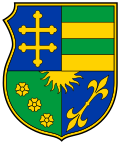
The face of the coins in a dotted circle always depicted the head of a tour with lyre-curved horns, between which a five-pointed star was placed. Next to the bull's muzzle there is a rosette and a crescent moon that do not have a clearly fixed place - right or left. Sometimes, instead of a rosette, a lily flower was depicted on a coin, the stalk of which was clamped in the lips of a bull. The central part of the back of the coin is a dissected triangular shield. The first field of this heraldic figure intersects three, rarely four, the so-called beams or fascia. The second field is decorated with lilies, the number of which varies from one to seven. In some instances, the lily was depicted above the shield. Most often there are coins with two lilies, a little less with seven, very rarely with three and four lilies, and pennies with one lily are considered unique.
On both sides of the penny there were Latin circular inscriptions, divided into parts by crosses , rosettes, lilies, stars, colons, etc. The preserved inscriptions are very distorted. It is believed that the inscription was SIM PETRI WOIWODI (printed by Peter Voevoda) on the obverse, and on the reverse - SI MOLDAVIENSIS (Moldavian seal), where si and sim appear to be abbreviations of the Latin word sigillum .
Only a few copies of the half-webs, released by Peter Mushat, are known. They were made of silver and, by external signs, are close to pennies with seven lilies. There were no legends on the half-corners, but there were three additional lilies - on the sides of the shield and above it. On the obverse, the half-gross shows a bull's head with a five-pointed star between the lyre horns, a crescent on the right, a rosette on the left. The weight of the coins is 0.22—0.24 g., Diameter - 12.0—13.5 mm.
See also
- Nyametsky fortress
- Cecina fortress
Notes
Sources
- Stati B. History of Moldova .. - Kish. : Tipografia Centrală, 2002. - pp. 56-57. - 480 s. - ISBN 9975-9504-1-8 .
- Stati V. The light of Orthodox truth // Nezavisimaya Moldova. - March 14, 2003. Archived September 28, 2007.
- Krylov A. B. Religious situation and ethno-political factors in the Republic of Moldova // Moldova. Current development trends. - Russian Political Encyclopedia, 2004. - P. 318. - ISBN 5-8243-0631-1 .
- Lord of the "Land of Moldavia" in coin minting. The first coin issues of Moldova // STRATUM Plus. - Chisinau, 1999. - № 6 . - p . 182-201 .Portrait of Peter I Mushat on a postage stamp of the Republic of Moldova
| Predecessor: Kostya (Stefan) or Mushata (Margarita) (regent) or Giurgiu (challenger) | Ruler of the Moldavian Principality 1375 - 1391 | Successor: Roman I Mushat |