Tseng u-Ren (Zeen Ureena) - sometimes called the Bible for women - is one of the most important elements of the religious education of Jewish women.
| Tseng U-Ren | |
|---|---|
| צאינה וראינה | |
 The cover of Zeng U-Ren's book (2014) | |
| Author | Yaakov bin Yitzhak Ashkenazi from Yanov |
| Genre | The Holy Books of Judaism |
| Original language | Yiddish |
| Original published | 1622 |
| Translators | Yisroel Nekrasov, Alexandra Polyan (head of "Tisza") |
| Publisher | Gesharim / Bridges of Culture |
| Release | January 25, 2014 |
| Pages | 400 |
| ISBN | 978-593273-376-9 |
The author of the book, Rabbi Yaakov ben Yitzhak Ashkenaz from Janow (born in English) was born around 1550, and lived in Poland for most of his life. The book was first published in 1590 and has since survived over 300 reprints. The language of the book is Yiddish. Since, until the beginning of the 20th century, Jewish education was considered obligatory only for boys, many women did not speak Hebrew and, accordingly, could not read the prayer book. Yiddish, including written, was owned by the vast majority of women. This is what caused the success of Zeng U-Ren's book. Arrangement of the Pentateuch, the five scrolls (books of Ruth, Esther, Kogelet, Eikh and Shir ha-Shirim), with excerpts from the Prophets and other Bible books, became a favorite Saturday reading of Jewish women, and indeed one of the most popular Jewish books. The simplicity of presentation and accessibility in terms of language attracted those men who could not afford to seriously study the Torah.
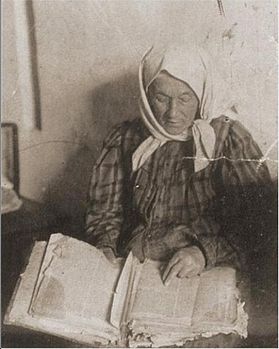
Woman reads to Tseng u-Renu (30s of XX century)

Title page of the 1853 edition

In the second half of the 20th century, the number of people who know Yiddish decreased, both because of the Holocaust and because of the repatriation of Jews to Israel, where revived Hebrew became the spoken language. There was a need for translation into other languages. In 1973–75, the book was translated into Hebrew, and the first edition was published in English in 1983–84, in 2012 the publishing houses Knizhniki and Gesharim / Bridges of Culture began translation into Russian, and the first two volumes are currently translated and published.
Notes
Links
- “Zeena u-reena” - article from the Electronic Jewish Encyclopedia
- Tseen-u-Reen // Jewish Encyclopedia of Brockhaus and Efron . - SPb. , 1908-1913.
- Chumash for women