“Afonso di Albuquerque” is the sloop of the Portuguese fleet, named after the Portuguese admiral of the 16th century di Albuquerque . The ship spent most of its service in the Indian and Pacific Oceans, defending Portuguese territories in Mozambique , India, Macau and Timor. He was badly damaged in the battle on December 18, 1961 when protecting Goa from the invasion of India, and landed ashore. [one]
| Afonso di Albuquerque | |
|---|---|
| NRP [~ 1] Afonso de Albuquerque | |
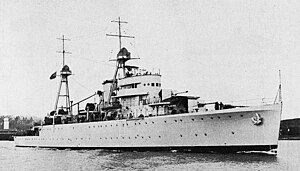 Afonso di Albuquerque in 1935 | |
| Service | |
 Portugal Portugal | |
| Class and type of vessel | sloop / memo [1] frigate |
| Manufacturer | Hawthorn leslie |
| Launched | in 1934 |
| Commissioned | May 28, 1934 |
| Withdrawn from the fleet | 1961 year |
| Status | for scrap in 1961 [1] |
| Main characteristics | |
| Displacement | 2480 t (full) [1] |
| Length | 103.2 m [1] |
| Width | 13.49 m |
| Draft | 3.83 m [1] |
| Engines | 2 Parsons turbines, 2 boilers [1] |
| Power | 8 000 hp |
| Speed | 21 knots (39 km / h) |
| Sailing range | 8,000 miles [1] |
| Crew | 9 officers 152 sailors |
| Armament | |
| Artillery | 4 × 120 mm guns 2 × 76 mm guns |
| Flak | 4 × 40 mm anti-aircraft guns "Pom-pom" [1] |
| Mine torpedo armament | 2 bomb spreaders 40 min [1] |
| Aviation group | 1 plane [1] |
The sloop was the first ship of the Afonso di Albuquerque type (the Bartolomeu Dias ship also belongs to this type). In the Portuguese fleet, these ships were classified as avisos coloniais de 1ª classe (1st class colonial advice notes or sloops). They were intended to ensure a naval presence in the colonies of Portugal. Their combat capabilities with other surface ships were limited, since they were mainly intended for landing and supporting the landing. [one]
After World War II, Afonso di Albuquerque class ships were retrained as frigates.
Content
- 1 Service
- 1.1 RMS Nova Scotia
- 1.2 Timor
- 1.3 Goa
- 2 notes
- 3 References
Service
RMS Nova Scotia
November 28, 1942 "Afonso di Albuquerque" was in Lawrence Marches . On this day, off the coast of the province of Natal (South Africa), a German U-177 submarine torpedoed and drowned the British military transport Nova Scotia . On board the New Scotia were 1,052 people, most of whom were Italian prisoners of war and civilian internees. According to the Triton Zero order, which Admiral Doenitz issued two months earlier, the U-177 submarine left the site of the death of New Scotia without taking measures to save the survivors. [2] . The commander of the German submarine forces turned for help to the Portuguese authorities, who sent the Afonso di Albuquerque ship to the scene of the tragedy [2] . The ship reached the scene the next day, by which time the survivors in the water were drowned or eaten by sharks [3] .
Five survivors gave a signal by firing a rocket launcher and were rescued by the Portuguese [4] . The next day, the Afonso di Albuquerque team discovered that hundreds of bodies were floating around the ship [4] . As a result, the ship saved 130 Italian internees, 42 security guards, 17 crew members, three military personnel and military sailors, one ship weapon operator and one passenger [2] . 858 people were lost: 650 Italian internees, 96 crew members, 88 South African security guards, 10 ship armament operators, eight military personnel and naval sailors, five passengers and the owner of New Scotia [2] .
Timor
In December 1941, Portuguese Timor was occupied by Australian and Dutch forces, allegedly to protect these territories from a possible Japanese invasion. However, in February 1942, under the pretext of the Australian and Dutch occupation, Japan captured and occupied Timor until the end of the war.
At the end of the war, Afonso di Albuquerque joined the Portuguese naval expedition sent to Timor to restore Portuguese control over the territory and restore the colony. The Afonso di Albuquerque arrived in Timor on September 29, 1945, escorting the Angola transport with Portuguese expeditionary forces on board.
Goa
In late 1961, after Indian diplomats failed to convince Portugal to transfer colonies to India on the Indian subcontinent, the Indians launched Operation Vijay to capture Goa , Daman and Diu . By this time, the Afonso di Albuquerque was in Goa as the leading ship of the Portuguese naval command in India, the ship was headed by captain Cunha Aragão .
On the morning of December 18, 1961, Afonso di Albuquerque received information that the armed forces of India had begun Operation Vijay. The crew took up combat posts. After the ground communications infrastructure was bombed and destroyed by the Indian Air Force, the ship was given the task of maintaining radio communications between Goa and Lisbon .
At 09.00, the Afonso di Albuquerque crew noticed in the immediate vicinity of the port of Mormugan three Indian ships headed by the INS Betwa , a Leopard frigate. Two frigates and a mine layer made up the vanguard of the battle group of the Wikrant aircraft carrier and ten cruisers, destroyers, frigates and mine layers.
At 12.00, after the Portuguese commanders refused to surrender, the frigates "Betva" and "Bis" ( INS Beas ) went to the port entrance and opened fire on the ship "Afonso di Albuquerque", which advanced towards the enemy and opened fire. The last radio message was sent to Lisbon: “We were attacked. We are responding. ”
Afonso di Albuquerque was hit by enemy fire. At 12.20, while trying to make a maneuver to take a position in which all guns could be used, the command bridge was destroyed, the communications officer was killed, commander Aragan was seriously injured and ordered the senior officer Sarmento Gouveia to take command. Aragan forbade Guwei to give up. Under heavy enemy fire aimed at the ship, several crew members transported the wounded commander ashore and took him by car to the hospital in Panaji .
At 12.35, being under massive fire, after the almost complete destruction of the boilers and cars, the crew threw the ship ashore [1] , where it continued to act as a floating battery. The crew continued to resist and fought until 14.10. The next day at 20.30 the crew was captured by Indian forces.
During the final battle, Afonso di Albuquerque fired an estimated 400 shells. Five crew members were killed, 13 were injured, as were several officers. Indian ships had a great advantage, were more modern and armed with quick-firing guns.
The core of Afonso di Albuquerque lay near the beach by Don Paula . In 1962 he was raised and towed to Bombay . Parts of the ship are exhibited at the Bombay Museum. The remainder was sold for metal [5] .
Notes
- ↑ 1 2 3 4 5 6 7 8 9 10 11 12 13 Portuguese Navy. S.V. Patyanin, M.S. Drums. Ships of the Second World War. Navy of the Netherlands and small countries of Western Europe (Belgium, Ireland, Iceland and Portugal)
- ↑ 1 2 3 4 Helgason, Guðmundur Nova Scotia . uboat.net . Guðmundur Helgason (1995–2013). Date of treatment March 29, 2013.
- ↑ Bezuidenhout, Leon. Pieter Snyman, Springbok-soldier 1940-43 . - March 2008. - P. 13.
- ↑ 1 2 Colao, Alex Anniversary of Nova Scotia - Alessandro Cerrato . Alex Colao Blog (November 28, 2011).
- ↑ [1] (inaccessible link)
- Comments
- ↑ port. Navio da República Portuguesa Ship of the Portuguese Republic
Links
- Jane's Fighting Ships 1938 , p. 398.
- Area Militar: the Afonso de Albuquerque
- Image
- Revista da Armada 2001