Darwinilus sedarisi (lat.) - species of short-winged beetles of the subfamily Staphylininae (subtribe Xanthopygina ). South America : Argentina (Bahía Blanca). The first copy of the beetle was found in 1832 by Charles Darwin during his round-the-world voyage on the Beagle ship , and the first scientific description was published only in 2014 [1] .
| Darwinilus sedarisi |
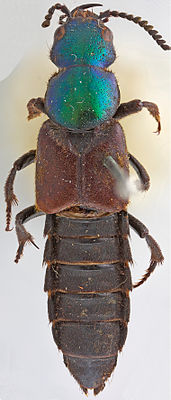
Beetle Darwinilus sedarisi |
| Scientific classification |
|---|
| No rank : | Bilateral symmetrical |
| Subtype : | Tracheo-breathing |
| Infraclass : | Winged insects |
| Treasure : | Fully Transformed Insects |
| Infrastructure : | Staffiliform |
| Superfamily : | Staphylinoid |
| Gender: | Darwinilus Chatzimanolis, 2014 |
|
| International scientific name |
|---|
Darwinilus sedarisi Chatzimanolis, 2014 |
|
Content
The genus name is given in honor of Charles Darwin (who found the first specimen of a new species), and the species name is in honor of the American writer David Sedaris , whose audio books were listened to by the author of the description at the time of preparing his various scientific publications [2] .
The holotype of the species was collected in September 1832 by Charles Darwin in the Bahía Blanca in Argentina , during his round-the-world voyage on the Beagle , but was not scientifically described and later recognized as lost [1] [3] .
In 2008, when conducting an audit of beetles of the Xanthopygina subtribe by the American entomologist Stylianos Chatzimanolis ( Stylianos Chatzimanolis ; University of Tennessee in Chattanooga , USA ), a sample with serrated antennas was found - an atypical morphological feature for staphilinids . Upon further examination, it was revealed that the sample belonged to an indescribable genus and refers to the collections of Charles Darwin, made by him during a round-the-world trip on the Beagle ship [1] . The next five years were spent by Stylianos Chatzimanolis in search of other specimens of this species around the world. To date, only two specimens of Darwinilus sedarisi are known , one found in the vaults of the Museum of Natural History of London , and the second in the collection of the Museum of Natural History at Humboldt University ( Berlin ) [1] .
Body length 20-21.5 mm. Coloring of head and pronotum with metallic luster, green with bluish-violet tint on lateral edges. Elytra light brown. The oral apparatus, legs, body are dark brown. Antennae dentate, dark brown, except for 4–7 antennomeres, which are mainly yellowish-brown. Pronotum with microsculpture in the form of alternating medium and large punctures. Elytra longer than pronotum, uniformly punctured. Abdominal tergites with transverse microsculpture [1] .
Argentina - Bahia Blanca , Buenos Aires , Río Cuarto [1] . The habitat of the species is unknown. A number of historically known sites of its habitat in Argentina were plowed under crops, which suggests a possible extinction of this species (it has not been found for more than 80 years since the 1930s) [1] .
