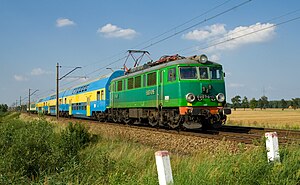
EU07 - cargo and passenger DC electric locomotive , built in Poland under the license of the British company Metropolitan Vickers & English Electric Co. for PKP .
| EU07 | |
|---|---|
 | |
| Production | |
| Country of construction | Poland |
| Plant | Pafawag , HCP |
| Years of construction | 1965 - 1974 (4E) 1983 - 1992 (303E) |
| Total built | 489 |
| Technical details | |
| Kind of service | freight-passenger |
| Type of current and voltage in the contact network | 3 kV DC |
| Axial formula | 2 O -2 O |
| Full Service Weight | 80000/83400 kg |
| Rail axle load | 20 t (4E) 20.85 t (303E) |
| Locomotive length | 15915/16235 mm |
| Wheel diameter | 1250 mm |
| Track width | 1435 mm |
| Hour power of TED | 2080 kW |
| Continuous power TED | 2000 kW |
| Construction speed | 125 km / h |
| Exploitation | |
| A country | Poland |
| Company | |
| Period | - |
Content
- 1 History
- 2 Operation
- 3 See also
- 3.1 Related Series
- 4 Literature
History
The production of these locomotives with the factory designation 4E was started in 1965 at the PaFaWag factory in Wroclaw , based on the documentation of the EU06 electric locomotive produced in England (conversion to the metric system and rounding of sizes). Locomotives have an identical EU06 design, with the exception of changing the heating system of the driver’s cabs and replacing part of the components and equipment with Polish counterparts. Until 1974, 240 units of 4E type locomotives were built; in addition, from 1976 to 1977, another 4 units (No. 241 ... 244), rebuilt from EP08 (EP08-002 ... 005; type 4Ea ) were included in the EU07 series. Initially, the production of 300 locomotives was planned at the PaFaWag plant, but production was discontinued in favor of ET22 .
In 1983, production was resumed at the Tsegelsky plant, HCP in Poznan (No. 301 ... 536, 538 ... 543). However, these locomotives, which received the factory designation 303E , originated from the ET41 two-section electric locomotive (type 203E , development of type 4E ) and differed from the original in the design of the body, frame, pneumatic system and control devices. EU07 under the number 537 type 303E did not exist, because by the time of its release in 1991 (adopted by the PKP in January 1992 ), the PKP already had a reconstructed version, and the locomotive under the serial number 303E-437/91 , which was to become EU07- 537, the first vacant number 540 was assigned (EU07-538 and EU07-539 were issued in the same batch and received their serial numbers).
In 1990 - 1994 Three sections of the ET41 electric locomotive (No. 537, 544 and 545) were rebuilt in the EU07 series by equipping them with a second cab. EU07-537 rebuilt from section B ET41-036 (section A decommissioned as a result of the incident) in October 1990 , EU07-544 rebuilt from section A ET41-088 (section B decommissioned) in January 1992, EU07-545 rebuilt from section A ET41- 116 (section B decommissioned as a result of the incident) in August 1994. No. 537 and 544 were later transferred to the EP07 series under the same numbers.
Operation
These locomotives were designed for driving fast passenger trains weighing up to 700 tons with a maximum speed of 125 km / h, or light freight trains with a total weight of up to 2000 tons with a maximum speed of up to 70 km / h. EU07 are operated on most electrified lines and are currently used almost exclusively for driving fast trains.
Since 1995, various repair companies have been re-equipping EU07 locomotives. In order to increase the operating time of traction electric motors (TED), by reducing the number of revolutions of the motor shafts at high speeds, the gearbox ratio is changed. Converted electric locomotives receive the EP07 series, but their numbers remain the same. The disadvantage of this modification is heavy pulling and speeding, which limits the use of these locomotives exclusively to the passenger service.
Since 2007, part of the EU07 locomotives became the property of the Interregional Transportation Division of Regional Transport LLC (Przewozy Regionalne Sp. Z oo). The upgraded locomotives received the designation EP07 and numbers from 1001 and above. Changes included the removal of multiple traction equipment across a multi-unit system . After separation of the Inter-Voivodeship Transport Department from the Regional Transport structure, all EU07 / EP07 locomotives were transferred to PKP Intercity .
Since 2011, 24 units of the EU07 series have been upgraded for PKP Cargo . These locomotives received new numbers from 1501 onwards, and include two subtypes. In version 303Eb , the ergonomics of the driver’s workplace have been improved, air conditioning systems, lighting controls and train communication devices have been installed. The control panels, seats, electric drives of the wipers were replaced, as well as the thermal and sound insulation of the cabin. Mounted modernized TED, as well as a modern speed meter in accordance with the European train control system . An additional voltage converter for powering on-board electronic devices and disconnectors for traction motors with access from the driver's cab are installed. The second version of 303Ec additionally received high and low voltage electrical cabinets manufactured by Electric Locomotive Repair Shops in Gliwice (ZNLE Gliwice, from 2013 Newag ). The VN cabinet uses electronically controlled contactors. A computer control and diagnostic system, operator panels in the cabs and, instead of a helm-type controller, control with a joystick are also installed.
At the end of 2011, TS Opole purchased and upgraded 9 EU07 locomotives and 2 EP07 units previously operated by PKP Intercity. An unusual move was the conversion of 2 electric locomotives EP07 to EU07, despite the fact that EP07 locomotives are more reliable due to the reduced speed of the TED. As part of the overhaul, all worn-out elements were replaced, but the bearing bushes of the hollow shafts were retained, and in the case of two EP07, the gearbox was replaced. The driver’s cabs received new chairs and new sound and heat insulation. All locomotives were modernized not in Opole , but in repair shops in Gdansk and Olesnica ( ZNTKiM Gdańsk and ZNTK Oleśnica ).
Since mid-2011, electric locomotives of type 4E (up to EU07-244) have been reclassified by PKP Polskie Linie Kolejowe to the EU07E series to distinguish locomotives with axle loads of up to 20 tons (permitted for use on Class C lines). Some locomotives received an additional letter E followed by a number (for example, EU07-237E).
Only a few locomotives are operated outside the PKP group. In 1999, the Railway Transport and Mining Enterprise in Zabrze (Przedsiębiorstwo Transportu Kolejowego i Gospodarki Kamieniem w Zabrzu) through the repair shops in Luban (ZNTK Lubań Śląski) acquired the locomotive EU07, which was set aside from work. He received series 4E and number 4E-004. In 2011, it was operated by DB Schenker Rail Polska . In 2011, PHU Lokomotiv bought 9 locomotives from PKP Intercity (EU07E-009, 080, 082, 083, 089, 093, 157, 162, 166) for use in freight traffic. In 2013 PHU Lokomotiv acquired 2 more electric locomotives (Nos. 109 and 148) from repair shops in Olesnitsa.
See also
Related Series
- EU06 - a fundamental series. Locomotives Built in the UK Based on Class 83 Electric Locomotives
- EP07 - passenger version
- EP08 - passenger version with a modified gear ratio, new TED and replacement of bearings with roller
- EU07A - deeply upgraded version with induction motors
- ET41 - two-piece version
- ET22 - freight locomotive, largely based on EU07 design
Literature
P. Terczyński. Atlas lokomotyw. - Poznań: PKMK, 2007 .-- ISBN 978-83-920757-7-6 .