Australian pilonos [1] [2] ( lat. Pristiophorus nudipinnis ) is a species of cartilaginous fish of the genus of pilonos family of pilonos sharks . These sharks are endemic to the southern coast of Australia, they are found in temperate waters to a depth of 165 m. The maximum recorded length is 124 cm. In pilonos, the elongated snout forms a long rostrum dotted with lateral teeth. On the lower surface of the rostrum there are antennae. These sharks breed by egg-laying . The diet consists of small bottom animals. These sharks are of little interest to commercial fishing [3] .
| Australian pilonos |
 |
| Scientific classification |
|---|
| No rank : | Bilateral symmetrical |
| Squad: | Pyliform ( Pristiophoriformes Compagno , 1973 ) |
|
| International scientific name |
|---|
Pristiophorus nudipinnis Günther , 1870 |
| Synonyms |
|---|
- Pristiophorus owenii Günther, 1870
|
| Area |
|---|
|
| Security status |
|---|
Least ConcernedIUCN 3.1 Least Concern : 41846 |
|
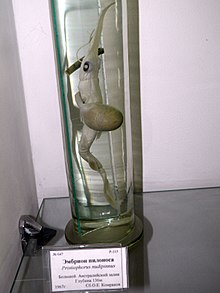
Australian Pylonos Embryo
Content
The species was first scientifically described in 1870 [4] . Syntype is a 104 cm long adult male caught off the coast of Tasmania or off the southern coast of Australia. Species epithet comes from the words lat. nudus - “naked” and lat. pinnis - “wings” and is associated with the fact that in these sharks the dorsal fins and the dorsal surface of the pectoral fins are devoid of scales [5] .
One of the earliest illustrations depicting an Australian pilonos (1881)
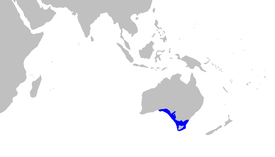
Australian pilonos are endemic to temperate and subtropical waters, washing the southern coast of Australia and Tasmania. These sharks are found at the bottom of the continental shelf at a depth of 37 to 165 m [3] .
In Australian pylons, the body is elongated, slightly flattened, but not flattened like a ray. The head is also slightly flattened, but not stretched laterally . Snout elongated and flattened, elongated in the form of a sawtooth rostrum with lateral teeth. In general, the rostrum is not very long, wide and sharply tapers towards the tip. On the ventral surface of the snout is a pair of antennae, which performs the function of touch. On each side of the rostrum in front of the antennae there are 13 large teeth and 6 behind the antennae. The edges of large teeth are smooth. The preoral distance is 23-24% of the body length. The base of the rostral antennae is closer to the mouth than to the tip of the snout. The distance between the rostral antennae and nostrils is equal to the distance from the nostrils to the posterior tip of the mouth. The distance from the mouth to the nostrils is 0.9 times the distance between the nostrils. There are 33–35 teeth on the upper jaw [3] .
The two dorsal fins lack spines at the base. Anal fin missing. The base of the first dorsal fin is located at the level of the space between the pectoral and ventral fins. The pectoral fins are rather large, but not pterygoid. The ventral fins are small. The mouth is located before the eyes. There are nasal grooves that do not connect to the mouth. Labial grooves are short. Oval rather large eyes are elongated horizontally. The third eyelid is absent. 5 pairs of gill slits. Behind the eyes there are large splashes . Caudal fin asymmetrical, upper lobe elongated, lower lobe absent. The dorsal and dorsal surfaces of the pectoral fins in large individuals are devoid of scales. The body is covered with large, pointed, placoid scales . The maximum recorded length and weight of males and females are 110 cm and 124 cm and 2.2 and 4.3 kg, respectively [6] .
Australian pilonos breed by egg-laying. In the litter from 7 to 14 newborns 28 cm long [3] , and according to other sources 35 cm [6] . Probably, the rostral large teeth erupt shortly before birth, but in order not to cause harm to the mother, they remain pressed to the rostrum, while the small ones erupt between the large ones after birth, then the large teeth straighten out [3] . The breeding cycle is biennial. It is believed that these sharks have a fairly high level of reproduction [6] .
The diet consists of small bottom animals. The long sensitive rostrum has a lateral line capable of detecting vibration and is equipped with electroreceptors . A flat head and snout, a large occipital condyle and specialized cervical vertebrae allow pilonos sharks to use the rostrum as a powerful weapon to dig in the ground and kill the victim. However, such behavior was not recorded firsthand, because, unlike sawfly stingrays , these sharks cannot be kept in captivity. Very short jaws and elongated oral and gill cavities suggest that southern pilonos are capable of suddenly sucking a victim [3] .
Australian pilonos are not dangerous for humans, but care should be taken when handling them, since sharp rostral teeth can seriously injure [3] . These sharks are often caught by-catch in the target fishery using the gill nets of Australian marten sharks . During the period from 1970 to 2001, the combined catch of southern pylonos and Pristiophorus nudipinnis ranged from 43 to 301 tons, accounting for 7% of the total catch of sharks [7] . In addition, the southern pilonos population was caught by-catch as a by-catch by the Southeast trawler fishing fishery fishing a variety of bony fishes using deep-sea trawls off the coast of New South Wales , the east coast of Victoria and Tasmania . The catch of sawn sharks from this sector in 2002 amounted to 106 tons. At present, a moratorium on fishing in the waters of Victoria has been introduced, operating at a distance of 3 miles from the coast [6] .
The International Union for Conservation of Nature has assigned this species a conservation status of “Least Concerns” [6] .
- ↑ Lindberg, G.W. , Gerd, A.S. , Russ, T.S. Dictionary of the names of marine commercial fish of the world fauna. - Leningrad: Nauka, 1980 .-- S. 49. - 562 p.
- ↑ Reshetnikov Yu.S. , Kotlyar A.N. , Russ T.S. , Shatunovsky M.I. The Bilingual Dictionary of Animal Names. Fish. Latin, Russian, English, German, French. / edited by Acad. V. E. Sokolova . - M .: Rus. Yaz., 1989 .-- P. 38 .-- 12,500 copies. - ISBN 5-200-00237-0 .
- ↑ 1 2 3 4 5 6 7 Compagno, Leonard JV 1. Hexanchiformes to Lamniformes // FAO species catalog. - Rome: Food and Agricultural Organization of the United Nations, 1984. - Vol. 4. Sharks of the World: An Annotated and Illustrated Catalog of Shark Species Known to Date. - P. 136–137. - ISBN 92-5-101384-5 .
- ↑ Günther , (1870) Catalog of the fishes in the British Museum. London, British Museum (Natural History). Vol. 8: 549 p.
- ↑ Christopher Scharpf and Kenneth J. Lazara. Fish Name Etymology Database (Neopr.) . The ETYFish Project . Date of treatment March 7, 2014.
- ↑ 1 2 3 4 5 Australian pilonos . The IUCN Red List of Threatened Species . Date of treatment March 7, 2014.
- ↑ Walker, TI, Hudson, RJ and Gason, AS In press. Catch evaluation of target, byproduct, and bycatch species taken by gillnets and longlines in the shark fishery of south-eastern Australia. In: Proceedings of North Atlantic Fisheries Organization Symposium. Elasmobranch Fisheries: Managing for Sustainable Use and Biodiversity Conservation. 11-13 September 2002. Santiago de Compostela, Spain. Journal of Northwest Atlantic Fishery Science