Kim Gu , cor. 김구 ? , 金 九? ( July 11, 1876 - June 26, 1949 ) - Korean, one of the most famous figures in the movement for the independence of Korea from Japan , the sixth and last chairman of the Provisional Government of Korea . His birth name was Kim Chan Soo ( cor. 김창수 ? , 金昌洙? ) [1] , also known under the pseudonym Baek Pom ( cor. 백범 ). In 1962, Kim Gu was awarded (posthumously) the Order of Merit in the Creation of the State of Korea .
| Kim gu | |||||||
|---|---|---|---|---|---|---|---|
| 김구 | |||||||
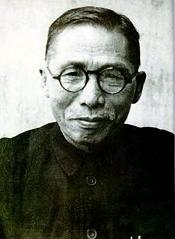 | |||||||
| Vice President | Kim Gyu Sik | ||||||
| Predecessor | Lee Don Nyon | ||||||
| Successor | no | ||||||
| Birth | July 11, 1876  Hwanhead , Korea Hwanhead , Korea | ||||||
| Death | June 26, 1949 (72 years old) Seoul , Republic of Korea Seoul , Republic of Korea | ||||||
| The consignment | Korea Independence Party | ||||||
| Religion | |||||||
| Rank | |||||||

Content
- 1 Early activity
- 2 Provisional Government in Shanghai
- 3 In independent Korea
- 4 Death
- 5 See also
- 6 notes
- 7 References
Early Activities
In 1896, Kim Gu killed Tsuchida Dzosuke ( 土 田 譲 亮 ), one of the participants in the assassination of Empress Menson , after which he was detained and tortured. Although the report of the current administrator of the Incheon Council Hagihar Moriichi on the current situation in Incheon (在 仁川 領事館 事務 代理 萩 原 守 一 ヨ リ 仁川 港 ノ 情況 ニ 付 続 報 ノ 件, April 24, 1896) states that Tsuchida was “ commoner from Nagasaki Prefecture ”(p. 6,“ 長崎 縣 平民 土 田 譲 亮 ”) and“ worker of the Nagasaki trade organization ”(p. 7,“ 貿易商 大 久保 機 一 の 雇人 ”) [2] , in his autobiography Peck Pom Ilji (白 凡 逸 志) Kim Gu claimed that Tsuchida wore a sword and had documents indicating that he was a lieutenant in the Japanese army [3] . Subsequently, after the dispersal of the movement on March 1 , in 1919 , Kim Gu was exiled to Shanghai . There he participated in the activities of the Korean Provisional Government.
Provisional Government in Shanghai
In Shanghai, Kim Gu joined the Provisional Government of Korea , which fought for the independence of Korea from the Japanese . He was the Minister of the Interior, after which, in 1927, he became chairman of the government. In 1931, he organized a patriotic terrorist group, the Korean patriotic legion . On April 29, 1932, one of its members, Yong Bon Gil , ambushed and attacked the Japanese military command in Shanghai, as a result of which the commander of the Japanese army and navy died on the spot. On January 8 of the same year in Tokyo, another member of the organization, Lee Bon Chan , attempted to assassinate the Japanese emperor Hirohito . After escaping to Chongqing , where the Chinese Nationalist Government of Chiang Kai-shek settled, Kim Gu founded the Korean Liberation Army , placing Chi Cheong Cheong at the head of it. When World War II reached the Pacific Ocean in December 1941, Kim Gu declared war on Japan and Germany, after which his Liberation Army fought on the side of the allied forces in China and Southeast Asia . The plans also included the liberation of Korea in 1945, but the allied forces were ahead of the Liberation Army.
In independent Korea
After the Japanese surrender, Kim Gu returned to Seoul , where he became one of the largest leaders of the right-wing forces of the South of the country, which was occupied by American troops. Kim Gu was extremely negative about the Kim Il Sung regime, which was brought to power in the north, which was under Soviet occupation, and brutally suppressed the communist movement in the southern part of the country, but was willing to compromise in the name of preserving the unity of Korea.
When the division of the country became inevitable, Kim Gu visited Pyongyang to negotiate with the government of Kim Il Sung (who later became President of North Korea ). These negotiations were unsuccessful.
In 1948, the Parliament of the Republic of Korea nominated Kim Gu to the post of the first president of the young state, but Lee Seung Man , the first chairman of the Provisional Government, won the election by a large margin. Kim Gu also lost the election of Vice President Lee Xi Young .
Death
In 1949, South Korean Army officer Ahn Du Hee killed Kim Gu in his office. It was suspected that the murder was organized by President Lee Seung Man , but the details of the murder are unknown. Moreover, An Doo-hee himself was killed by one of Kim Gu's supporters in 1956 after giving his last testimony, convicting Kim Chan Ryong of an assassination order.
See also
- History of Korea
- Korea under the control of Japan
Notes
- ↑ Kim's protocol of examination Archived July 19, 2011 to Wayback Machine
- ↑ Japan Center for Asian Historical Records reference code: A04010024500
- ↑ 새 國史 事 典 (Seoul: Kyokhaksa, 1983)