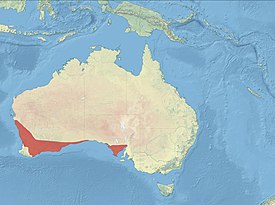
The bird range is the inland southwestern regions of western Australia and the Eyre Peninsula in southern Australia . Initially, it was assumed that it is found only in Western Australia, but was later discovered in the east, where for some time it was mistaken for multi-colored painted malur . The distribution of the species has one feature related to the rupture of their range three hundred kilometers from the cape in the Great Australian Gulf to the Eyre Peninsula .
This unusual bird leads a secretive lifestyle, so it is not so easy to notice. However, females can be noticed if you simulate an alarm. Adult males are even more secretive than females and, as a rule, they can be seen only briefly in the bushes. If the nest or young individuals are at risk, adult females and males use the rodent distraction technique that is characteristic of malyurovs .
Nutrition
The bird feeds mainly on the earth, catching bugs , larvae , ants , weevils , wasps and small invertebrates .
Reproduction
A relatively short breeding season lasts from August to November. This means that the species has time for only one, less often two masonry per year. They build nests, incubate eggs and only females take care of the chicks. The time taken to build the nest is approximately a week. The masonry, on average, consists of three oval cream eggs with large spots and red-brown specks, especially at the base. Little is known about the time of incubation and the development of the chicks, but it is probably the same as that of other close relatives of the family of small ones . However, both parents and other members of the family group feed the chicks.
Vocalization
Communication between birds is supported by gentle short trills. The alarm is a typical short buzzing note typical of malures, repeatedly issued by all members of the group. The song of the male is almost no different from the song of the family group. To protect the territory, the male in the deep foliage of shrubs emits gentle twittering or buzzing trills.