The Cormoran is an unarmored Bussard class cruiser, the fifth ship of six ships of this class. Built for the navy of the German Empire to serve abroad. The cruiser’s keel was laid down in Danzig in 1890, the ship was launched in May 1892, and entered service in July 1893. The cruiser’s armament was the main battery of eight 105 mm guns. "Cormoran" developed a speed of 15.5 knots (28.7 km / h).
| Cormoran | |
|---|---|
| SMS [~ 1] . Cormoran | |
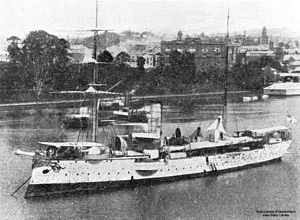 Cormoran in Brisbane (Australia) | |
| Service | |
 Germany Germany | |
| Class and type of vessel | Bussard armored cruiser Gunboat |
| Manufacturer | Kaiserliche Werft, Danzig |
| Construction started | 1890 |
| Launched | May 17, 1892 |
| Commissioned | July 25, 1893 |
| Status | flooded September 28, 1914 |
| Main characteristics | |
| Displacement | 1.864 t (standard) |
| Length | 83.9 m |
| Width | 12.7 m |
| Height | 4.42 m |
| Engines | 2 three-cylinder steam engines |
| Speed | 15.5 knots (28.7 km / h) |
| Sailing range | 5,460 km |
| Crew | 9 officers 152 sailors |
| Armament | |
| Artillery | 8 × 105 mm guns KL / 35 5 revolving guns |
| Mine torpedo armament | 2 * 350 mm torpedo tubes |
The cruiser spent most of his service outside of Germany, mainly in the German colonies in the South Pacific. The cruiser usually carried out oversight service and suppressed colonial riots. At the end of 1894 and the beginning of 1895, the cruiser carried out short-term service in the South African waters and then headed for the Pacific Ocean. "Cormoran" participated in the capture of the concession in Jiaozhou Bay of the Shandong Peninsula from China in 1897. In 1903, "Cormoran" returned to Germany and in 1907-1908 went through modernization. The following year, the cruiser returned to the South Pacific, where he stayed until the outbreak of World War I in August 1914. During the outbreak of hostilities, the ship was being repaired at Qingdao docks and could not take an active part in the war. Therefore, he was disarmed and flooded in the harbor, his guns were used to strengthen the defense of the port.
Content
- 1 Description
- 2 Service
- 2.1 First Period in the Pacific
- 2.2 The second period in the Pacific
- 3 notes
- 4 Literature
Description
The cruiser’s hull was 83.9 m long and 12.7 m wide, draft of 4.42 m, displacement of 1.864 tons at full combat load. The power plant consisted of two horizontal three - cylinder steam engines powered by four cylindrical coal-fired boilers. The cruiser had a top speed of 15.5 knots (28.7 km / h) and could travel a distance of 5460 km at a speed of 9 knots. The crew of the ship consisted of 9 officers and 152 sailors [1] /
The armament of the cruiser was eight 105 mm SK L / 35 quick-firing guns on the central pin, the total ammunition left 800 shots. The guns hit 10.800 m [1] . Two guns were placed side by side on the bow, two on each side and two aft. On board were also five revolver guns [2] and two 350 mm torpedo tubes with five torpedoes mounted on deck [1] .
Service
The Cormoran was built at the imperial shipyard ( Kaiserliche Werft ) in Danzig. Its keel was laid in 1890, the hull was launched on May 17, 1892 [2] . The descent ceremony was attended by Kaiser William II and senior director Kaiserliche Werft [3] . The work was completed on July 25, 1893, after which the ship entered the lists of the fleet of the German Empire [2] . The cruiser passed two-month trials that ended on September 22 [3] . The service of the cruiser began in 1894, it was supposed to take place abroad in the colonial possessions of Germany [4] . On October 2, the crew received orders to go to the East Asian station and replace the Wolf gunboat there, but in view of the growing tension in South Africa, the fleet command sent a new cruiser to German East Africa [3] to pursue German interests there.
On October 16, the Kormoran and the recently launched Cruiser of the same class, the Condor , left Germany heading for the shores of East Africa. On December 15, ships arrived in Lawrence Marches , the capital of Portuguese East Africa , where Cormoran spent the next seven months. In January 1895, the Cormoran towed the Portuguese cruiser Alfonso Albuquerque back to Lawrence Marches. In July, the Condor arrived in Lawrence Marches to replace the Cormoran, which was to return to its original destination in East Asian waters. July 5, the ship left East Africa, stopped on the way to Muscat ( Oman ) where he paid an official visit to the Sultan. On August 5, during the passage of the Strait of Hormuz , the safety valve on the low-pressure cylinder of the starboard machine was damaged. In view of this, the cruiser went to Bushehr (Persia) for repairs, and then went to Basra along the Shatt al-Arab river , where he paid a visit to the local German consul and the Turkish authorities [3] .
First Period in the Pacific
On September 13, the Cormoran arrived in Singapore and joined the German East Asian cruising squadron under the command of Rear Admiral Hoffman, who raised his flag on the Kaiser armored cruiser. In July 1896, the cruiser took part in the stowing of the gunboat Iltis . In October-November 1897, the “Cormoran” set off along the Yangtze River to Hankou . The cruiser took part in the capture of the concession in Jiaozhou Bay. During the US-Spanish war, the ship came to the Philippines in May 1898, but the American cruiser Riley did not allow him to enter Cavite . In November, the cruiser towed the Kaiser from Samsah Bay in Fujian to Hong Kong for repairs. In view of the aggravated political situation in German Samoa , the Admiralty headquarters ordered the Cormoran to go there to strengthen the group of two cruisers of the same type: the Bussard and the Falk [3] .
On the way to Samoa, “Cormoran” flew into the Whirlwind reef off the west coast of New Pomerania on the night of March 23-24, 1899. The ship flew into the reef with its middle part, so that his nose stood out from the water for a meter. The team tried to lighten the cruiser by unloading coal and ammunition, but the ship remained chained to the reef. The ship's commander, Hugo Emsmann, sent a steam boat and a skiff with two officers and eleven sailors to Friedrich Wilhelmshaven 300 km from the scene of the accident. There, sailors met the German ship "Stettin", which on March 29 approached the reef. In the meantime, Emsmann decided to remove all unnecessary coal and ammunition, part of which was unloaded onto the shore, and the rest was simply thrown overboard. The fock and mainsail match was cut down and the stern guns dragged onto the nose. These measures allowed to withdraw from the reef. Then the crew loaded back supplies previously unloaded to the shore. The ship went to Friedrich Wilhelmshaven, where it was examined, additional supplies were loaded. "Cormoran" went to Sydney to carry out repairs in the dry dock. A full examination of the hull revealed only slight damage. Repair work lasted until early June [5] .
In mid-June 1900, Cormoran returned to Sydney for an annual overhaul. Part of the crew was sent to China to suppress the Boxer Rebellion . On October 2, Cormoran anchored in Apia before embarking on a tour of the German colonies in the Pacific. From March 15 to May 1, 1901 the ship was under repair in Sydney. During this period, the Cormoran and the armored cruiser Hansa represented Germany at the first Australian Parliament in Melbourne . On the way back to Samoa, “Cormoran” was sent to the skeletons of St. Matthias where German explorer Menske Germans was killed . Mencke with his assistant. Arriving at the Cormoran Islands and the Meve escort ship attacked the islanders responsible for the killing. July 28, "Cormoran" returned to Apia. During November, the cruiser carried out convoy service and made trips to other islands [5] .
In 1902, the cruiser again visited the Bismarck and Marshall Islands archipelago . Subsequent repairs were carried out in Sydney. On August 18, the cruiser returned to Apia. September 23, the cruiser went on a regular tour of the German colonies. In mid-March, the cruiser returned to Sydney for periodic maintenance and was ordered to return to Germany. March 23 "Cormoran" left Sydney and reached Keel on September 13 [5] . In Germany, the cruiser served in the main fleet. The cruiser was modernized during a long reconstruction that began in 1907 at the imperial shipyard in Danzig. New JW Klawitter boilers were installed, sailing equipment was reduced. A new higher wheelhouse was also installed. The work was completed in 1908 [6] , on May 1, 1909, “Cormoran” was again assigned to the Pacific Ocean [5] .
Second Period in the Pacific
On June 8, 1909, while in Malta , the cruiser was ordered to go to Asia Minor , where German intervention took place, caused by the uprising in Turkey and violence against Armenians. The Cormoran joined the Stettin and Lubeck cruisers, although the latter was recalled to Germany after the situation was discharged. During the incident, “Cormoran” took on board 300 Armenians to protect them. On July 9, while in Port Said , Cormoran received orders to continue its march into the Pacific Ocean. The cruiser had to stop in Jeddah to repair the boilers [5] . Having reached the Pacific Ocean, the ship began escort service, the landing squad undertook a punitive expedition against the cannibals on Kaiser Wilhelm Land . On November 3, the cruiser took part in the flag-raising ceremony in Blanche Bay on the anniversary of the German possession of New Pomerania. Three days later, the cruiser took part in the groundbreaking ceremony during the construction of the Bismarck tower in the city of Tome (located southwest of the capital Herbertshöhe ) [7] .
On November 13, the Kormoran took on board the Governor Herbertshöhe and first sailed to Friedrich-Wilhelmshaven, then to Ganzakhafen and then to the Kaiserin-Augusta River , went 339 km upstream before being ordered to turn around. November 22, the cruiser reached the mouth of the river, January 8, 1910 arrived in Apia. The ship took part in celebrating the tenth anniversary of the German annexation of the islands, which lasted from February 28 to March 3. On the way to Hong Kong, the cruiser hit a hurricane, causing significant damage. Its sides were slightly depressed, all the boats were damaged. Temporary repairs were carried out in Noumea ( New Caledonia ). On May 3, Kormoran arrived in Hong Kong, and on July 15 returned to Apia. Then the Cormoran joined the Condor cruiser, the armored cruiser Scharnhorst , and the light cruisers Emden and Nuremberg from the East Asian squadron. Five ships sailed together until December 13, while in Rabaul, they received orders to go to Pohnpei to suppress the rebellion of the Sokekhov tribe. The cruisers arrived there on December 19 and operated there until February 22, Cormoran, Emden and Nuremberg landed troops to support the police ( Polizei-Soldaten ) from German New Guinea . [8] [9] .
March 23, “Cormoran” returned to Sydney for annual repairs, and then proceeded to the next cruise on the German colonies in the South Pacific Ocean. In September, “Kormoran” and the ship “Planet” gratuitously took the Norwegian barque “Fram” aground. In May 1912, the cruiser underwent a new overhaul in Qingdao, after which he again went on a tour of the German colonies. January 10, 1913 the cruiser returned to Apia. On February 24, 1913, by order of the State Secretary of the Office of the Imperial Navy ( Reichsmarineamt ) Alfred von Tirpitz , the Cormoran was retrained as a gunboat. From June 4 to July 5, the ship was under repair in Sydney. Then he had to make a stop at Bougainville in view of the tribal feuds on the island. A gunboat has landed to help the police force ( Polizeitruppen ) crush the conflict. In early 1914, the ship went to Qingdao for further repairs and arrived there on May 30 [8] .
With the aggravation of the political situation in Europe in July 1914, the commander of the cruiser "Emden" frigate Karl von Muller, as the senior officer in Qingdao, ordered to speed up the repair work on the "Cormoran". After the outbreak of war in August, Emden captured the Russian ship Ryazan and brought it to Qingdao. Since the Kormoran was still not in service, it was withdrawn from the fleet, its crew replenished the Ryazan team, which was re-qualified as the auxiliary cruiser Kormoran. People from the gunboats Iltis and Vaterland, along with other volunteers, also joined the team of the new auxiliary cruiser [10] . Most of the armament of the gunboat "Cormoran" was removed on August 6, 1914 to strengthen the coastal defense of Qingdao to protect the concession from the British attack. On the night of September 28-29, 1914, the gunboat was flooded by a group of imperial docks so that it would not be captured by the enemy [4] [10] .
Notes
- ↑ 1 2 3 Gröner, p. 97
- ↑ 1 2 3 Gardiner, p. 253
- ↑ 1 2 3 4 5 Hildebrand, Röhr, & Steinmetz, p. 193
- ↑ 1 2 Gröner, p. 98
- ↑ 1 2 3 4 5 Hildebrand, Röhr, & Steinmetz, p. 194
- ↑ Gröner, pp. 97-98
- ↑ Hildebrand, Röhr, & Steinmetz, pp. 194-195
- ↑ 1 2 Hildebrand, Röhr, & Steinmetz, p. 195
- ↑ de Quesada, p. 21
- ↑ 1 2 Hildebrand, Röhr, & Steinmetz, p. 196
- Comments
- ↑ dumb Seiner Majestät Schiff Ship of His Majesty.
Literature
- Conway's All the World's Fighting Ships 1860–1905 / Gardiner, Robert. - Greenwich: Conway Maritime Press, 1979. - ISBN 0-8317-0302-4 .
- Gröner, Erich. German Warships 1815–1945. - Annapolis, MD: Naval Institute Press, 1990. - ISBN 0-87021-790-9 .
- Hildebrand, Hans H. Die Deutschen Kriegsschiffe / Hans H. Hildebrand, Albert Röhr, Hans-Otto Steinmetz. - Ratingen : Mundus Verlag, 1993. - Vol. 2. - ISBN 978-3-8364-9743-5 .
- de Quesada, Alejandro. Imperial German Colonial and Overseas Troops 1885–1918. - Oxford: Osprey Publishing, 2013 .-- ISBN 978-1-78096-164-4 .