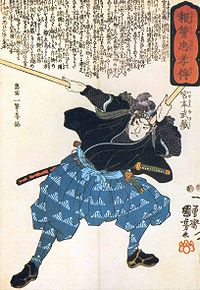
Niten Ichi Ryu ( . Jap 二天一流, «School of the two heavens as one") or Niten Ichi-ryū ( Jap. 兵法二天一流) - an ancient school of kenjutsu , the classical Japanese martial art ( koryu ), founded between 1604 - 1640 years famous fencing master Miyamoto Musashi . Niten Ichi-ryu is best known for fencing techniques using two swords, a katana and a wakizashi , which Musashi called Niten-ichi ( Japanese 二天 一 , “two heavens as one”) or Nito-ichi ( Japanese 二 刀 一 , “two sword as one ") .
| Niten Iti-ryu | |
|---|---|
| 二天 一流 | |
 | |
| Other names | Hyo Niten Ichi-ryu |
| Established | between 1604 - 1640 years |
| A country |  Japan Japan |
| Headquarters | • Kokura , Kitakyushu • Usa , Oita Prefecture |
| Founder | Miyamoto Musashi |
| Derivative BI | Noda ha Niten Iti-ryu |
Content
History
Niten Ichi-ryu school was founded in the XVII century (between 1604-1640, the beginning of the Edo period ) by the master Miyamoto Musashi .
Around about 1640, Musashi decided to transfer the leadership of the school to three of his best students (in total, he had about a thousand of them). These were Terao Magonojo ( Japanese 寺 尾 孫 之 丞 ), his younger brother Terao Kyumanosuke ( Japanese 寺 尾 求 馬 助 ) and Furuhashi Sozaemon ( Japanese 古橋 惣 左衛 門 ). According to Miyamoto Musashi, Magonojo was not very successful in repelling attacks, but was good at attacking. Furuhashi, on the contrary, lacked technicality. As a result, Terao Magonojo received a treatise known as the Book of Five Rings . Hosokawa Mitsuhisa made two copies of this document: one for Furuhashi Sodzaemon and one for himself (the most famous publication to date) [1] .
Subsequently, Magonojo appointed successor to Kyumanosuke, who received Hyo San Jugo and two swords from Miyamoto Musashi [1]
The continuity in Hyoho Niten Ichi-ryu (the name was determined by Musashi himself at the end of his life) does not follow the hereditary principle. The school changes hands by transferring two things: a scroll with a description of the technique and the wooden sword of Miyamoto Musashi himself, with whom he trained and used as a cane in the last years of his life [2] .
In the 20th century, Aoki Kikuo became the 8th soke . In 1961, he issued the title of soke-dai to his closest student, Gosyo Motoharu. Kiyonaga Tadanao was appointed the 9th Soke (Aoki Kikuo wanted the knowledge of the Niten Iti-ryu school not to be lost). In 1955, Gosho Motoharu received the mankyo kaiden of the Miyamoto Musashi school. In 1967, Aoki Kikuo died and in subsequent years, Motoharu and Tadanao continued to represent the school in Japan [1] .
In 1976, Kiyonaga Tadanao suddenly died and did not leave an heir. For this reason, Gosho Motoharu continued to represent the Niten Ichi-ryu school as a soke. After 8 months, the Kiyonaga family asked Gosho to train Imai Masayuki and make him the 10th head of the school. Motoharu taught Imai Masayuki, as well as Kiyonaga Fumiya (son of Tadanao), a full-time school curriculum. Together, they represented Niten Ichi-ryu at various events in many countries of the world [1] .
At the end of 1980, the paths of Imai Masayuki and Gosyo Motoharu diverged. By this time, Gosho received the 8th dan in Iaido , and was also in charge of the Sekiguchi-ryu school .
The most famous record of the original techniques of Niten Iti-ryu was made in 1981 and is located in Budokan. Consonant to her, Gosyo Motoharu is utidati , and Imai Masayuki is sidati .
In November 2003, Imai Masayuki decided to abolish the Soke title. He decided to appoint three successors, who will be called give uti . They became Kiyonaga Fumiya, Chin Kin (the oldest student of Aoki Kikuo) and Iwami Toshio [1] .
In 2004, Kiyonaga Fumiya passed away and ended on the Kiyonaga line. The matter was continued by Gosyo Motohara. So the Niten Ichi-ryu subsidiary line was created. Its current representative is Yoshimoshi Kiyoshi, the son of Motoharu [1] .
The 10th Soke of Imai Masayuki died in 2006. However, during the inauguration of December 20, 2003 in Kokura , the school was transferred to Iwami Toshio from the previous head of the school, Imai Masayuki. Thus, Iwami Toshio became the 11th soke of the main line of Hyoho Niten Ichi-ryu [1] .
During the inauguration of November 24, 2013 in Kokura , the school was transferred by Iwami Toshio to the current chapter, Kadzia Takanori. He became the 12th main line soke of the Hyoho Niten Iti-ryu [1] . In addition to him, Chin Kin, Yoshimoti Kiyoshi, Miyata Kazuhiro (Hosokawa-ke line) and Miyagawa Morihito (Miyagawa-ha line) pass on the traditions of the school today.
Techniques
To date, the following techniques are included in the Hyho Niten Ichi-ryu training program [2] [3] :
Tati Seiho ( 刀勢 法 ) - 12 kata with a long sword [4] :
- Sassen ( Jap. 指 先 );
- Hasso Hidari ( Japanese 八 相左 );
- Hasso Migi ( Japanese 八 相 右 );
- Uke Nagashi Hidari ( Japanese 受 流 左 );
- Uke Nagashi Mige ( Japanese 受 流 右 );
- Moji Gamae ( Jap. 文字 構 );
- Hari Tsuke ( Japanese 張 付 );
- Nagashi Ooty ( Japanese 流 打 );
- Torah Storm ( Japanese я 振 );
- Kazuki ( Japanese 数 喜 );
- Aisen Uchi Dome ( Japanese 合 先打 留 );
- Amasi Uti ( Japanese. 余 ).
Kodati Seiho ( Jap. 小 太 刀勢 法 ) - 7 kata with a short sword [4] :
- Sassen ( Jap. 指 先 );
- Tudan ( Jap. 中段 );
- Uke Nagashi ( Japanese 受 流 );
- Moji Gamae ( Japanese 捩 構 );
- Hari Tsuke ( Japanese 張 付 );
- Nagashi Ooty ( Japanese 流 打 );
- Aisen ( Japanese 合 先 ).
Nito Seiho ( 刀勢 法 ) - 5 kata with two swords corresponding to 5 forms from the Book of Water [4] :
- Tudan ( Jap. 中段 );
- Jodan ( Japanese 上 段 );
- Gadan ( Japanese 下 段 );
- Hidari Waki Gamae ( Japanese 左脇 構 );
- Migi Waki Gamae ( Japanese 右脇 構 ).
Bojutsu - 12 kata with bo (7 - bo against bo, 13 - bo against the sword).
Aikuti Roppo - 6 techniques with a knife.
Jutte or Jutsu - 5 techniques against the sword.
According to Gosho Motoharu Hanshi (Shihan Niten Ichi-ryu), Aikuchi Roppo techniques were formed on the basis of free nito forms using fukuro shinai , but not kata.
Gear Levels
In Nito Ichi-ryu, the following knowledge transfer system has been adopted [5] :
- Shoden ( tachi );
- Chuden ( tati , kodati );
- Okuden ( tati , kodati , nito);
- Menkyou ( tachi , kodati , nito and bojutsu );
- Menkyo kaiden (all the techniques of the school and their deep understanding).
Genealogy
The official Niten Ichi-ryu transmission line is as follows [2] [5] [6] [7] :
- Miyamoto Musashi Fujiwara no Genshin ;
- Therao Kyumanosuke Nobuyuki;
- Therao Köemon Katsuyuki;
- Yoshida Josetsu Masahiro;
- Santo Hikozaemon Kiyoaki;
- Santo Hanbei Kiyoaki;
- Santo Shinjuro Kiyotake;
- Aoki Kikuo Hisakatsu;
- Kiyonaga Tadanao Masazane ( soke from 1967 to 1975 ) / Miyagawa Yasutaka;
- Imai Masayuki Nobukatsu ( soke from 1976 to 2003 , died in 2006 ) / Miyagawa Morihito / Kiyonaga Fumiya;
- Iwami Toshio Harukatsu (from 2003 to 2013 ).
Starting from the 8th school soke , Aoki Kikuo Hisakatsu, the school's transmission line split into several branches. So, for example, Gosho Motohara Hansi received the right to teach [5] . The heirs of Imai Masayuki Nobukatsu are Iwami Toshio Harukatsu [7] and Takanori Kadziya [8] .
Today, the traditions of Niten Iti-ryu convey:
- Chin Kin (11th Soke since 2003);
- Yoshimoshi Kiyoshi (born in 1948 , the 12th Soke since 2007);
- Miyata Kazuhiro (Hosokawa-ke line);
- Miyagawa Morihito (Miyagawa ha line);
- Takanori Kadziya (12th Soke since 2013).
Notes
- ↑ 1 2 3 4 5 6 7 8 Shihan Filip Bartoš. Hyoho Niten Ichi Ryu Kōryūkai Dojo. Date of treatment February 28, 2014.
- ↑ 1 2 3 Hyakutake Colin. Hyoho Niten Ichiryu information-portal . Date of treatment February 28, 2014.
- ↑ Curriculum - Heijoshin Dojo . Heijoshin Dojo. Date of treatment February 28, 2014.
- ↑ 1 2 3 Kajiya Takanori. Hyoho Niten Ichi Ryu in English (inaccessible link) . Date of treatment February 28, 2014. Archived December 24, 2013.
- ↑ 1 2 3 Gosho Motoharu Hyoho Niten Ichi Ryu . Date of treatment February 28, 2014. Archived February 12, 2012.
- ↑ Hyoho Niten Ichi Ryu . Kampai Budokai. Date of treatment February 28, 2014.
- ↑ 1 2 Lineage - Heijoshin Dojo Heijoshin Dojo. Date of treatment February 28, 2014.
- ↑ Hyoho Niten Ichiryu lineage . Kensei Dojo. Date of treatment February 28, 2014.
Literature
- Watatani Kiyoshi, Yamada Tadashi. Bugei ryûha Daijiten. - Tokyo , 1978.
- Iwami Toshi Harakutsu. Interview with Iwami Soke // Hyoho Niten Ichi Ryu France. - 2011.
- Iwami Toshi Harakutsu. Musashi’s teachings are essentially philosophy . - 2011.