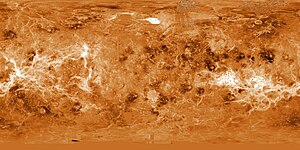


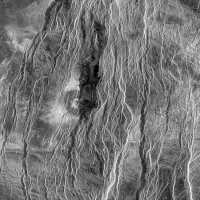
The Beta Region ( Latin Beta Regio ) is a volcanic hill about 2500 km [1] in size on Venus , with a center of [2] . On radar images it looks like a bright area.
Content
- 1 Opening and title
- 2 Description
- 3 notes
- 4 Literature
- 5 Links
Opening and title
The Beta region is one of the first discovered details of the surface of Venus [1] . Her first images were obtained using radar at a wavelength of 12.5 cm , made by Roland Carpenter in 1962 and Dick Goldstein in June 1964 in Goldstone [3] .
The name of the Beta domain is derived from the Goldstein symbol for “beta” (β). It was approved by the International Astronomical Union in 1979 [2] . The Maxwell Mountains , Alpha and Beta are three exceptions to the rule that details of the surface of Venus are called by the names of women and goddesses.
Description
The Beta Region is one of the largest volcanic massifs in the Solar System , and it is believed that there may be active volcanoes (not yet observed on Venus) [4] . A positive gravitational anomaly is associated with this area [1] . The Beta region is probably created by the mantle plume [1] .
The main parts of the Beta region are Mount Rhea Mons in the north and Mount Theia Mons in the south. Both overthe Venusian reference level of heights exceeds 5 km [1] . They are crossed by the canyon of Devana ( Devana Chasma ), which continues further south.
Volcanic hills, such as the Beta region, are vast highlands with a large slope of the surface, more than 1000 km in size, separated by deep gutters of 100-200 km in size. These gutters are examples of continental rifts and indicate tectonic surface activity .
October 22, 1975 on the northeast slope of the Beta region ( ) the Venus-9 descent vehicle landed, transmitting surface images and other data [5] . The rocks of the surface turned out to be close to terrestrial basalts [1] .
Notes
- ↑ 1 2 3 4 5 6 Basilevsky, AT; Head, JW Beta Regio, Venus: Evidence for uplift, rifting, and volcanism due to a mantle plume (English) // Icarus : journal. - Elsevier , 2007 .-- Vol. 192 , no. 1 . - P. 167-186 . - DOI : 10.1016 / j.icarus.2007.07.07.007 . - .
- ↑ 1 2 Beta Regio . Gazetteer of Planetary Nomenclature . International Astronomical Union (IAU) Working Group for Planetary System Nomenclature (WGPSN) (October 1, 2006). Date of treatment March 11, 2016. Archived December 14, 2012.
- ↑ Butrica, Andrew J., SP-4218 To See the Unseen , Chapter 5: Normal Science , NASA, 1996
- ↑ Rodionova J.F. Venus - the planet closest to us
- ↑ Venera 9 Descent Craft . NASA Space Science Data Coordinated Archive (May 12, 2016). Date of treatment March 11, 2016. Archived March 11, 2016.
Literature
- Basilevsky A. Geologic Map of the Beta Regio Quadrangle (V – 17), Venus . US Geological Survey (2008).
- Basilevsky, AT; Head, JW Beta Regio, Venus: Evidence for uplift, rifting, and volcanism due to a mantle plume (English) // Icarus : journal. - Elsevier , 2007 .-- Vol. 192 , no. 1 . - P. 167-186 . - DOI : 10.1016 / j.icarus.2007.07.07.007 . - .
Links
- Maps with current names of surface details: northern part , southern part