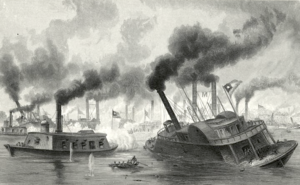
The Battle of Memphis (June 6, 1862) is a battle of the American Civil War that took place on the Mississippi River near the city of Memphis .
| Battle of memphis | |||
|---|---|---|---|
| Main Conflict: US Civil War | |||
 | |||
| date | June 6, 1862 | ||
| A place | Memphis | ||
| Total | US victory | ||
| Opponents | |||
| |||
| Commanders | |||
| |||
| Forces of the parties | |||
| |||
| Losses | |||
| |||


Content
Background
From the north, Mississippi's approaches to Memphis were defended by Fort Pillow, located on the east bank of the river. In April, the bombing ships of the Eastern Union Flotilla began shelling the fort, but were attacked by ramming steamships of the southerners. The defeat at the battle at Plum Point forced Assistant Secretary Gustavus Fox to declare that another failure of the Union of this magnitude to force Halleck to retreat, and "we will lose St. Louis, Cairo and all." By order of Secretary of War Stanton, a ram fleet was created in Mississippi, commanded by a ground officer, Brigadier General Charles Ellet; she did not submit to the Western Flotilla commanded by Captain Davis.
After Grant won at Pittsburgh Landing, West Tennessee came under Union control. On May 29, Halleck took possession of Corinth , after which he divided his forces: Don Carlos Buell ’s Ohio Army was sent to eastern Tennessee, and Grant was ordered to retain his conquered positions in the Mississippi Valley.
Ellett wanted to attack the Confederate River Defense Flotilla, based south of Fort Pillow, with her ramming ships, but since Davis refused to support him, the attack had to be canceled. Then Ellet sent one of his ramming ships for reconnaissance, and to everyone's surprise, it turned out that Fort Pillow was evacuated. This made Captain Davis forget about the grievances, get out of apathy and move south.
Composition of forces
Western Gunboat Squadron and Ramming Flotilla
The federal squadron consisted of five armored river gunboats built at the Eads factories in Cairo, and four rams. At the same time, there was a significant flaw in the organization of federal forces: while the armored gunboats were under the command of Charles Davis, reporting to Major General Henry W. Halleck, the ramming ships were reporting to Colonel Charles Ellet (Jr.), who was directly subordinate to Secretary of War Stanton in Washington. The interaction between the two parts of the federal forces represented was thus weak.
The structure of the Western gunboat squadron included armored gunboats:
- USS Benton
- USS Louisville
- USS Carondelite
- USS Kairo
- USS Saint Louis
Excluding the Benton (rebuilt from a civil excavator), all gunboats were river boats of special construction, carried powerful artillery weapons, and were protected by 2–3 inches thick armor.
The ram fleet consisted of:
- USS "Queen of West" - the only federal ship, disabled during the battle.
- USS Monarch
- Two other rams; the names are not known and did not participate in the battle.
Confederate River Defense Squadron
The Confederate Squadron consisted of eight mobilized ram ships - the so-called "Cotton-bearers", so nicknamed for the fact that cotton bales were used to protect the crew from bullets. Their bow was reinforced to allow ramming, and powerful double bulkheads of thick logs (the space between which was also filled with bales of cotton), reinforced with railroad rails, were installed in the front to protect the engine room from enemy fire.
There was no organization of a confederate squadron. Formally, the ships were subordinate to Captain James Montgomery, but in practice, civilian captains and crews of the confederate rams completely refused to obey him. Due to the lack of any military training in the crews of the rams, the Confederate army had to send their gunners to the ships to control the guns - while, in fact, the army gunners were not subordinate to the civilian captains of the ships.
- CSS “Colonel Lowell” - rammed, sunk by federal ships.
- CSS "General Beauregard" - ram, incapacitated. Later sunk by artillery fire of federal ships.
- CSS "General Bragg" - jumped aground. Captured by the federalists, included in the fleet as USS General Bragg
- CSS "General Earl Van Dorn" - fled.
- CSS "General Jeff M. Thompson" - caught fire, left by the crew, then exploded.
- CSS "General Sumter" - out of order, washed ashore. Captured by the federalists, included in the fleet as USS Sumter
- CSS "General Sterling Price" - sank in battle. Raised by the federalists after the battle, included in the fleet as the USS General Price
- CSS “Little Rebel” - incapacitated, washed ashore. Captured by the federalists, included in the fleet as USS Little Rebel
Event
Descriptions of the battle on the part of its participants are extremely different and often contradict each other, which makes it difficult to imagine the situation. There are more or less reliable data on the first phase of the battle. Waiting for the confederate river squadron to approach, the northerners lined their ships across the river: in front of them stood armored gunboats (deployed stern to the enemy, as gunboats descended down the river and wanted to have maximum speed against the tide), followed by federal rams. Seeing the enemy, two of the four federal rams moved forward. The two remaining, not having understood the order, remained in place, and, in fact, did not participate in the battle.
Both sides agree that the battle was opened by federal rams. The federalist flagship, the USS Queen of West, has rushed forward and successfully rammed the Confederate CSS Ram “Colonel Lowell”. Almost immediately, another confederate ram (it’s not exactly established which one) rammed the Queen of West and incapacitated it. At the same time, the Queen of West captain, Colonel Ellet, was wounded by a pistol bullet. The second federalist ramming ship, the USS Monarch, reportedly successfully attacked the Confederate CSS General Beauregard. Thus, the federal fleet managed to confuse the attack of the Confederates and prevent them from ramming armored gunboats.
Following this, the course of the battle, due to poor coordination of actions by both sides, degenerated into a landfill. Coordination of the actions of both parties was weak, management was practically absent. The superior artillery and good defense of the federal armored gunboats ultimately played a critical role: the defeat of the confederate squadron was complete. CSS Confederate Ram General Beauregard, trying to ram a federal Monarch in a bustle, collided with another Confederate ship, CSS General Sterling Price, lost its course, and was destroyed by the USS federal flagship Benton, which shot through its boiler. CSS "General M. Jeff Thompson" caught fire under fire and was left by the crew. The northerners disabled and captured the Confederate CSS ships General Bragg, CSS Sumter and CSS Little Rebel; in addition, after the battle, they picked up and rebuilt the sunk CSS General Stirling Price.
Of the entire confederate squadron, only one ship managed to retreat, CSS General Earl Van Dorn, who managed to hide down the river in Yazu City. Loss of southerners amounted to about 200 people. On the part of the northerners, Colonel Ellet, who died of an illness in a hospital, became the only victim.
Summary and Consequences
The defeat of the river flotilla of southerners opened the way for the northerners fleet to Memphis. However, the capture of Corinth by Hallek had already made the situation of Memphis hopeless, and the southerners, without waiting for the appearance of the federal flotilla, evacuated the city. After that, the entire Mississippi right up to Vicksburg became inseparable property of the ships of the Unionists.
Historically, this was the last major battle on the water in which warships were commanded by civilians without a military education. The catastrophic defeat of the confederate flotilla clearly demonstrated the need to appoint military officers to warships, even with civilian crews.
Literature
- K.Mal “Civil war in the USA (1861-1865)” - Moscow: AST, 2000. ISBN 985-13-0184-1