
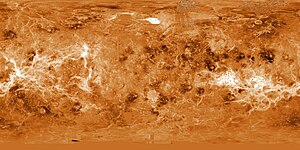

The Alpha Region ( Latin Alpha Regio ) is a region on Venus measuring about 1,500 km, with a center of .
Content
- 1 Opening and title
- 2 Zero Meridian
- 3 Building
- 4 notes
- 5 See also
Opening and title
The first images of the Alpha region were made, in particular, on the basis of data on the spectrum of an echo signal with a wavelength of 12.5 cm obtained by Roland Carpenter in 1962 and Dick Goldstein in June 1964 in Goldstone [1] .
The name, given the first letter of the Greek alphabet , was approved by the Working Party on the Planetary Nomenclature of the International Astronomical Union between 1976 and 1979 [2] . The Maxwell Mountains , the Alpha Region and the Beta Region are three exceptions to the rule that details of the surface of Venus are called by the names of women and goddesses.
Zero Meridian
In 1970, the Alpha region was chosen as the point through which the zero meridian of Venus passes [3] (in 1985, the MAC Working Group refined the coordinate system by drawing the zero meridian through the center of the Ariadne crater lying in this region [4] ).
Building
The surface of the Alpha region is the so-called tessera , that is, the area that was severely deformed and along which the deforming blows were directed in different directions and with high density. This term is taken from the Greek name for tiles (the Soviet researchers who invented it, who studied the images of Venus-15 and Venus-16 , drew attention to the similarity of this area with parquet ). Like all tessera regions, Alpha is located above the surrounding area, at an elevation of 1-2 km, and is strongly deformed by tapering folds. As with most tessers, the surrounding volcanic plateaus created influxes on the borders of Alpha, and therefore are younger than it.
An infrared map of Venus compiled by the Venus Express probe shows that the rocks on the plateau of the Alpha region are lighter and look older than most of Venus. On Earth, such light cliffs are usually granites that form continents [5] .
Notes
- ↑ 1 2 Butrica, AJ Chapter Five: Normal Science // To See the Unseen — A History of Planetary Radar Astronomy . - 1996.
- ↑ 1 2 Butrica, Andrew J., SP-4218 To See the Unseen , Chapter 6: Pioneering on Venus and Mars , NASA, 1996
- ↑ 1 2 Abalakin V.K. Fundamentals of Ephemeris Astronomy. - M .: Nauka , 1979.- 448 p.
- ↑ 1 2 Davies, ME, Abalakin, VK, et al. Report of the IAU / IAG / COSPAR working group on cartographic coordinates and rotational elements of the planets and satellites: 1985 (Eng.) // Celestial mechanics : journal. - 1986. - Vol. 39 . - P. 103-113 .
- ↑ 1 2 New map hints at Venus' wet, volcanic past | International Space Fellowship (link unavailable) . Date of treatment February 25, 2014. Archived on September 16, 2009.
- ↑ Aleksandrov, YN, Zyatitskii, VA, Rzhiga, ON Characteristics of the Spectrum of Radio Waves Reflected by Venus (English) // Soviet Astronomy : journal. - 1968. - Vol. 11 . - P. 852-855 .
See also
- List of areas on Venus