Hapalemur alaotrensis (lat.) Is a mammal from the genus of meek lemurs ( Hapalemur ) of the Lemur family ( Lemuridae ). Endemic of Madagascar .
| Hapalemur alaotrensis |
 |
| Scientific classification |
|---|
| No rank : | Bilateral symmetric |
| Nadotryad : | Euarchontoglires |
| Infrastructure : | Lemur-shaped |
| View: | Hapalemur alaotrensis |
|
| International Scientific Name |
|---|
Hapalemur alaotrensis ( Rumpler , 1975) |
| Area |
|---|

|
| Security status |
|---|
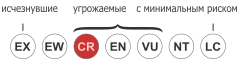
Endangered SpeciesIUCN 3.1 Critically Endangered : 9676 |
|
Content
The classification of this primate is quite controversial. Some primatologists classify it in the rank of a subspecies of the species Hapalemur griseus , others consider it as a separate species. [1] Molecular studies do not confirm species status. [2]
Body length about 40 cm, tail of the same length. Weight from 1.1 to 1.4 kg, males slightly larger than females. The coat is thick, long, grayish-brown on the back, light gray on the face and chest, chestnut on the head and neck. [3]
They are found in thickets of reeds and papyrus around Lake Alautra , in the east of Madagascar . There are two separated populations: a smaller population on the northern coast around the Belempona Peninsula, larger in the marshes near the south-western shores of the lake. The total area is less than 200 km². [one]
They live in the marshland (the only primates who live in the swamps). May be active both during the day and at night. Form family groups of up to 12 individuals. Each group protects a territory from one to eight hectares in size . Childbirth takes place from September to February, in the litter of one or two cubs. Unlike other members of the genus Hapalemurs, these animals do not eat bamboo. The diet includes papyrus stems ( Cyperus madagascariensis ), reed shoots ( Phragmites communis ) and two types of grass ( Echinocochla crusgalli and Leersia hexandra ). [3]
The International Union for Conservation of Nature has given this species the conservation status “Endangered”, since the range of this species is limited (its area is approximately 100 km²) and is quite unique (these are the only primates living on swamps), and the population is threatened with habitat destruction and hunting. [one]
- List of mammals of Madagascar
- ↑ 1 2 3 Hapalemur alaotrensis (English) . The IUCN Red List of Threatened Species .
- ↑ Pastorini, J., Forstner, MRJ and Martin, RD 2002. Phylogenetic relationships of gentle lemurs (Hapalemur). Evolutionary Anthropology 11, 150-154.
- ↑ 1 2 Mittermeier, R., Louis, E., Hawkins, F., Langrand, O., Ganzhorn, J., Konstant, W., Rasoloarison, R., Rajaobelina, S. and Richardson, M. Lemurs of Madagascar . - Conservation International, 2008.