Microcebus marohita (lat.) - a type of mouse lemur . Endemic of Madagascar . It was first discovered in 2003 in the eastern part of the island and described in 2013, along with another representative of mouse lemurs, Microcebus tanosi . They are one of the largest representatives of their kind, found in the same areas as Microcebus lehilahytsara , Microcebus simmonsi and Microcebus rufus , while all four species are very similar in appearance.
| Microcebus marohita |
| Scientific classification |
|---|
| No rank : | Bilateral symmetrical |
| Squadron : | Euarchontoglires |
| Grand detachment : | Euarchonta |
| Infrastructure : | Lemur-like |
|
| International scientific name |
|---|
Microcebus marohita Rasoloarison et al. , 2013 |
| Security status |
|---|
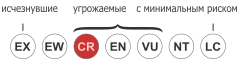
Endangered SpeciesIUCN 3.1 Critically Endangered : 46251646 |
|
The first Microcebus marohita samples were collected in 2003. Then three individuals were caught in the forest of Marojita, in the province of Tuamasina in eastern Madagascar [1] . Formally, the species was described only in 2013 together with another mouse lemur, Microcebus tanosi ). The holotype was caught on December 2, 2003. The species name comes from the toponym marohita [2] .
Despite the fact that the range of this primate intersects the range of M. lehilahytsara , M. simmonsi, and M. rufus , studies have shown that no gene flow between these four sympatric species is observed [3] .
The coat on the back is reddish-brown, a black stripe stretches along the ridge. On the belly and chest, the coat is gray, the undercoat is dark gray. Body length from 275 to 286 mm, tail length from 133 to 145 cm. Ears are short, about 18 mm long. The hind limbs are relatively long, an average of 35 mm [2] . This is possibly the largest mouse lemur [4] , its weight reaches 89 grams [2] . Females weigh 20% more than females of other previously considered largest species of mouse lemurs [4] .
They are found only in the eastern part of Madagascar in the forests of Marokhit [4] .
The International Union for Conservation of Nature has assigned the species an endangered status . The main threat to the population is habitat destruction [4] .