St. John's wort ( Latin Hypericum hircinum ) - perennial plant, shrub, species of the genus St. John's wort ( Hypericum ) of the family St. John's wort ( Hypericaceae ). Less commonly found is the name " St. John's wort ", as well as (especially in translations of foreign literature) " St. John's wort ." The plant got its name due to the fact that in winter the leaves die off and emit a strong characteristic smell (the smell of a goat). During flowering and fruiting, however, the leaves have a pleasant aroma of lemon grass .
| St. John's wort | |||||||||||||||||||||
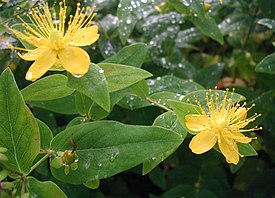 General view of a flowering plant | |||||||||||||||||||||
| Scientific classification | |||||||||||||||||||||
|---|---|---|---|---|---|---|---|---|---|---|---|---|---|---|---|---|---|---|---|---|---|
| |||||||||||||||||||||
| International scientific name | |||||||||||||||||||||
Hypericum hircinum L. | |||||||||||||||||||||
| Synonyms | |||||||||||||||||||||
Stinking Tutsan, Androsaemum hircinum, Erba di San Giovanni caprina, Erba caprina, Erba di San Giovanni, Ruta caprina | |||||||||||||||||||||
Content
Botanical Description
The life form of this species is a shrub (Nanophanerophyt). Height is from 20 cm to 2 m. Annual growth is 15-30 cm in height. The branches are thin and double-edged. The bark is initially smooth and brownish red, then turns brown with light stripes. The old bark exfoliates. The kidneys are opposite, small, burgundy. The leaves are opposite, leafless, ovate, whole-edge, with pubescence, from 40-70 mm in length, 12-30 mm in width and have a characteristic smell. The upper surface of the leaves is dark green, the lower side is gray-green. Flowers are 1-3 in the ends of the shoots. Bright yellow, correct. Numerous stamens are located in 5 clusters. Sepals are lanceolate, up to 6 mm long. The stigma of the pestle is divided into 3 or 5 sections, as well as the ovary. The fruit is a capsule, leathery, red (brown) or green.
The root system is fibrous . It consists of several well-developed main roots with a large number of small lateral roots.
It blooms from June to August.
Phytochemistry
Despite the fact that this species has long been used in folk medicine in the Middle East , it has been poorly studied by modern scientists. Among the described compounds: monoterpenes (α- pinene ), bicyclic sesquiterpenes (cis-β-guaen, δ-selinene, β- caryophyllene ), organic acids ( betulinic , shikimic , chlorogenic ), flavonoids ( quercetin and its derivatives), as well as phenylated acyl- phloroglucinolins ( hyperforin , adgerforin and others).
Essential Oils
Separately, the composition of the essential oil obtained from this species should be highlighted.
hyperforin
quercetin
Pharmacology and medical use
The plant is not official, but has long been widely used in folk medicine [2] of the peoples of the Middle East and the Mediterranean. At present, numerous studies of this type are being conducted at universities in Europe , Turkey , and India .
- Suppresses the activity of HIV-1 reverse transcriptase-linked DNA polymerase and H-active ribonuclease. [3]
- Protective effect against cardiotoxicity of doxorubicin (in rats). [four]
- Antimicrobial activity. [five]
- Antioxidant and antiproliferative activity. [6]
Ecology and distribution
Endemic to the Mediterranean region and Arabia . The plant is found in Egypt , Tunisia , Corsica (southern France), Malta , Cyprus , the Balearic Islands , southern Greece , and Turkey . The plant grows mainly near water bodies, riverbanks and streams, in forest floodplains, at altitudes from 0 to 1000 m.
In Israel, the plant is listed in the Red Book . Of all the country's numerous botanical gardens , only two copies are in the University Botanical Garden at the Hebrew University on Mount Scopus in Jerusalem . It is extremely rare in the wild.
In Russia, cultivated in the botanical garden of Pyatigorsk . It is also cultivated in Italy and Denmark .
Classification
Species St. John's wort is a member of the genus St. John's wort ( Hypericum ) family Hypericum ( Hypericaceae ). According to the classification of the British botanist NKB Robson, this species belongs to the Androsaemum section (section 5).
| another 45 orders of angiosperms (according to APG II System ) | 9 more births | |||||||||||||||
| department Flowering plants | Hypericum family | view St. John's wort | ||||||||||||||
| Kingdom of Plants | order Malpigh | clan St. John's wort | ||||||||||||||
| about 21 more departments | 36 more families (according to APG II System ) | about 490 more species | ||||||||||||||
The species has 4 subspecies:
- H. h. subsp. albimontanum
- H. h. subsp. cambessedesii
- H. h. subsp. hircinum
- H. h. subsp. majus
Images
Plant in bot. Hebrew University Garden , Mount Scopus, Jerusalem, Israel
Notes
- ↑ For the conventionality of specifying the class of dicotyledons as a superior taxon for the plant group described in this article, see the APG Systems section of the Dicotyledonous article .
- ↑ Folk pharmaceutical knowledge in the territory of the Dolomiti Lucane, inland southern Italy. . PubMed Date of treatment February 23, 2014.
- ↑ Hypericum hircinum L. components as new single-molecule inhibitors of both HIV-1 reverse transcriptase-associated DNA polymerase and ribonuclease H activities. . PubMed Date of treatment February 23, 2014.
- ↑ Protective effect of Hypericum hircinum on doxorubicin-induced cardiotoxicity in rats. . PubMed Date of treatment February 23, 2014.
- ↑ Antimicrobial activity of crude extracts and pure compounds of Hypericum hircinum. . PubMed Date of treatment February 23, 2014.
- ↑ Antioxidant and antiproliferative activity of Hypericum hircinum L. subsp. majus (Aiton) N. Robson essential oil. . PubMed Date of treatment February 23, 2014.
Literature
- Robson, NKB. 3. Sections: 1. Campylosporus to: 6a. Umbraculoides. // Studies in the genus Hypericum L. (Guttiferae). - T. 12.
- Shishkin B.K., Bobrov E.G. Genus 895 St. John's wort - Hypericum L. // Flora of the USSR : 30 tons / started at hand. and under chap. ed. V. L. Komarova . - M .; L .: Publishing House of the Academy of Sciences of the USSR , 1949. - T. 15 / ed. volumes B.K. Shishkin , E.G. Bobrov . - S. 227-228. - 742 s. - 4000 copies.
- Karpenko, V. A. Study of the chemical composition of goat grass hypericum. / V. A. Karpenko, A. S. Saushkina, L. B. Ligai, A. A. Akopov // Proceedings of the scientific-practical conference "Pharmacy from century to century." - St. Petersburg, 2008. Part 3. - S. 47-50.