Bosnian banat ( Serb. Banovina Bosna / Bosɖɴskɖ bɖɴovnɴɖ , Croatian. Banovina Bosna ) - a medieval state entity, formally a vassal of the Hungarian king.
| vassal of the kingdom of hungary | |
| Bosnian Banat | |
|---|---|
| Serb. Banovina Bosna , Horv. Banovina bosna | |
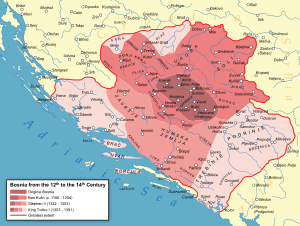 Bosnia in the Middle Ages | |
 → →1154 - 1377 | |
| Religion | Bosnian Church , Orthodoxy , Catholicism |
| Form of government | Monarchy |
| Ban bosnia | |
| • 1154 - 1167 | Borich |
| • 1180 - 1204 | Kulin |
| • 1204 - 1221 | Stepan |
| • 1232 - 1250 | Matvey Ninoslav |
| • 1250 - 1287 | Arrival I |
| • 1287— 1290 | Arrival II |
| • 1287— 1314 | Stefan I Kotromanich |
| • 1322 - 1353 | Stepan Kotromanich |
| • 1326-1353 | Vladislav Kotromanich |
| • 1353 - 1366 | Stepan Tvrtko I Kotromanich |
| • 1366— 1367 | Wook |
| • 1367— 1377 | Stepan Tvrtko I Kotromanich |
Content
Background
According to the Byzantine emperor Konstantin Bagryanorodny, Serbs appeared in the Balkans in the 1st half of the 7th century [1] . They occupied the territories of modern Serbia , Montenegro , Bosnia and Croatia [2] . After resettlement on the Balkan Peninsula, the first territorial associations of the Serbs, like most of the southern Slavs , had zhups . Zhupa usually occupied areas limited by the flow of rivers or mountains. Their centers were fortified settlements or cities. As the administrative territorial units of the упupa, they later became the solid foundation of the Serbian state [3] . However, the Byzantines called all of these lands "Slavonia." After the resettlement of the Slavs in the Balkans, in Byzantine sources, information appears on the many clavinias from Thessaloniki to Constantinople , and later on the clavias located above cities on the Dalmatian coast [4] .
Some time after the resettlement to the Balkans, the Serbs formed several large communities, which then became state entities. Between the rivers Cetina and Neretva there was the principality of Neretva , which the Byzantines called Pagania . She owned the islands of Brac , Hvar and Mljet . The area between Neretva and Dubrovnik was called Zahumle. The lands from Dubrovnik to the Boka Kotor Bay were occupied by Travunia and Konavle. Further south, to the Boyana River, was Duklja, which later became known as Zeta. Between the rivers Sava , Vrbas and Ibar there was Raska [5] [6] , and between the rivers Drina and Bosna - Bosnia [7] . On the territories of Bosnia and Raska, the first Serbian state arose - the Serbian principality of the dynasty of Vlastimirovich [8] [7] .
Soon after the resettlement of the Slavs on the Balkan Peninsula , political unions of neighboring zhups headed by princes or bani (in Bosnia) began to be created. The posts of zhupans, princes, and bans gradually became hereditary and assigned to certain wealthy and influential clans. The constant struggle and military clashes of these relatively small alliances led to the creation of more extensive territorial associations. All these political entities were under the supreme power of Byzantium. But their dependence on the empire was small and boiled down to paying tribute. Recognizing the supreme power of Byzantium , the Serbs were in fact politically independent [9] .
The collapse of the Serbian principality in the middle of the 10th century led to the gradual transition of Serbian lands, including Bosnia, to the rule of Byzantium. Immediately after the death of the Serbian prince Chaslav Klonimirovich, the Bosnia region became independent. In 968, Bosnia was captured by the Croatian king Mikhailo Kresimyr II , but a few years later the Byzantines drove his troops out of Bosnia and included it in their empire. In 1025, the Byzantine emperor Vasily died, which allowed the Serbian zhups and state. entities, including Bosnia, Raschke and Dukla, become independent [10] .
In the XI century, the center of Serbian statehood became Duklja, which in 1082-1085. annexed part of Bosnia. Her ban was appointed a certain Stefan Dr. Željko Fajfrić. Kotromanići (Serb.) . Date of appeal September 20, 2015 .. However, the unification of the Serbian lands under the rule of Dukli was temporary and did not lead to the economic and political consolidation of certain areas, to the strengthening of central authority. The lands that were part of the Duklian kingdom continued to live an independent life. Local princes , zupans and large feudal lords were in them full masters and only nominally subordinated to the power of kings. The constant struggle among feudal lords and members of the ruling dynasty, especially intensified at the beginning of the 12th century , weakened the state unity of the Serbs. Shortly after the death of Bodin ( 1099 [11] ), and possibly even earlier, Travunia, Zahumye, Bosnia and Raska fell away from Dukli. At the same time, Bosnia was formally independent for some time, but during the first half of the 12th century it alternately became dependent on Hungary and Byzantium and its historical development subsequently went on its own [12] .
History
The title “ ban of Bosnia” (initially purely nominal) was created by the Hungarian king Bela II in 1136 for his young son Laszlo . In reality, neither Hungary nor Byzantium had special power over this peripheral mountain region, and local rulers enjoyed considerable autonomy. In 1154, Boric became the Bosnian ban, which led troops to attack the Byzantines in Branichevo together with Belosh (the Hungarian Palatine and the Croatian ban). In 1166, the Byzantine Emperor Manuel I Komnin conquered Bosnia from the Hungarians and appointed Ban Kulin . However, already in 1183, Kulin, together with the Hungarian king Belaya III , the great zupan of Raska, Stefan Nemaney, and the ruler of Zakhumia, Miroslav Zavidovich, fought against Byzantium, again becoming a Hungarian vassal.
During the reign of Kulin, the first document that has survived to this day in the Bosnian Cyrillic alphabet , “ Povela Ban Kulin, ” appeared. Also at this time, the friction associated with the Bosnian church begins. In 1203, Vukan Nemanich accused Kulin of heresy and formally turned to the Pope. Kulin managed to save Bosnia from the Crusade, posing as an Orthodox Catholic.
After the death of Kulin in 1204, his son Stephen succeeded him. In 1232, it was thrown by the Bogomils , seated on the throne of Matei Ninoslav , which caused friction with Raska. In 1234, the Hungarian king Andras II gave the Bosnian banat to his son Koloman . Meanwhile, the rightful heir to the Bosnian throne, the Ussrian prince Sibislav (the son of the displaced Stephen) began to attack Matei Ninoslav, hoping to take Bosnia to himself. In 1233, Bishop Vladimir was removed from office by the papal legate, who occupied the pulpit in Dyakovar (modern Croatian Djakovo ) due to the fall into heresy . Johann von Wildeshausen was appointed the new bishop of Dyakowar, in parallel he headed the department of Kalochi . The pope recognized Koloman as the rightful ruler of Bosnia, and in 1235 the crusaders invaded Bosnia led by Koloman and von Wildeshausen, but only Sibislav took their side, and all the others supported Matej Ninoslav. Of the neighbors, however, only the Dubrovnik Republic supported Bosnia, while Serbia did not dare to spoil relations with Hungary and the Pope, so in 1240 Matei Ninoslav issued a decree on the protection of the Dubrovnik Republic in the event of an attack on it by the Serbian king Stefan Vladislav . Koloman handed over the title of the ban of Bosnia to the distant relative of Matey Ninoslav - Arrival.
In 1241, the Mongols invaded Hungary. Koloman was forced to return with the troops and take part in the battle on the Chaillot River . Matej Ninoslav seized the moment and regained control of Bosnia, forcing Arrival to flee to Hungary. In 1244, he intervened in the civil war that broke out in Croatia between Trogir and Split , taking the side of Split. In 1248, Matei Ninoslav, having asked the archbishop of Hungary, managed to save the country from a new crusade.
In 1250, Matei Ninoslav died, and his sons began to fight for power, but the Hungarian king Bela IV intervened, who seated Arrival on the Bosnian throne. The arrival began to brutally uproot the Bosnian church. In 1254, Bosnia joined the Hungarian war against Serbia and occupied Zahumye , but under a peace treaty this region of Serbia had to be returned.
After the death of the Arrivals in 1287, the sons of Arrival II and Kotoroman, who divided the country among themselves, began to rule the banat, but in 1290 Arrival II died, and Bosnia reunited. Kotoroman became the founder of the Kotoromanich dynasty, whose descendants ruled Bosnia until the end of the XIV century.
In 1290, the Hungarian king Laszlo IV Kun was killed, and the struggle for the Hungarian throne began. First, the throne was taken by Andras III of the Arpad dynasty, but the sister of the murdered Laszlo - Maria of Naples - claimed their throne, and then transferred them to her son Karl Martell of Anjou , these claims were supported by Pope Nicholas IV . In the territory of the Kingdom of Hungary, Pavel I Shubich took the side of the Anjou dynasty, declaring himself in 1293 a ban of Croatia. Since Pavel Shubich was married to the daughter of Stefan Dragutin Ursula, family ties forced the Bosnian ban Stefan Kotoromanich to support the coronation of Karl Martell. To increase his influence, Karl Martell issued a large number of decrees distributing the lands of Kotoromanich to small nobles. As a result, Pavel Shubich stripped Stefan Kotoromanich of power in Bosnia. In 1312, he died, and his son Mladen II убubić became the “lord of all Bosnia”. When Stephen I died in 1314, his widow Elizabeth chose to flee with the children to the Dubrovnik Republic .
Mladen II had many opponents both domestically and abroad, and gradually he came to the idea of making his deceased in Bosnia the son of the late Stephen I, who would be more acceptable to the Bosnian nobility than Mladen. In 1320, Stephen II Kotromanic became the ban of Bosnia. In 1322, Mladen II was arrested by the king, and Stephen II began to rule without tight outside control. His rule took place in wars with the Croatian princes, as well as with neighboring Serbia.
After the death of Stephen II in 1353, his 15-year-old nephew Tvrtko I , who in 1377 adopted the royal title, became the ban of Bosnia.
Notes
- ↑ History of Serbs, 2009 , p. 15.
- ↑ Serbian lands in the Middle Ages and Early Modern times, 2008 , p. 61.
- ↑ History of Yugoslavia, 1963 , p. 63.
- ↑ History of Serbs, 2009 , p. sixteen.
- ↑ Early feudal states in the Balkans, 1985 , p. 198.
- ↑ History of Serbs, 2009 , p. 18.
- ↑ 1 2 Leafing through pages of Serbian history, 2014 , p. 13.
- ↑ Serbian lands in the Middle Ages and Early Modern times, 2008 , p. 63.
- ↑ History of Yugoslavia, 1963 , p. 64.
- ↑ Dr. Željko Fajfrić. Kotromanići (Serb.) . Date of appeal September 20, 2015.
- ↑ Zhivkoviћ, Tibor. Two catering from the times of the Vladivostok region of Bodin (Serb.) // Zbornik Radova Vizantoloshkog insita / Љubomir Maksimovi. - Beograd : SANU - Vizantoloshki Institute, 2005. - T. 42 . - S. 56 . - ISSN 0584-9888 .
- ↑ History of Yugoslavia, 1963 , p. 68.
Literature
- Chirkovich Sim. History of the Serbs. - M .: The whole world, 2009 .-- 448 p. - ISBN 978-5-7777-0431-3 .
- History of Yugoslavia. - Moscow: Publishing House of the Academy of Sciences of the USSR, 1963. - T. 1. - 736 p.
- Makova E. S., Prozorov V. B. Serbian lands in the Middle Ages and the Early New Time // History of the Southern and Western Slavs. T. I / Ed. G.F. Matveeva, Z.S. Nenasheva. - M .: Publishing house of Moscow University, 2008. - T. 1. - 688 p. - ISBN 978-5-211-05388-5 .
- Leafing through the pages of Serbian history / E.Yu. Guskova. - M .: Indrik, 2014 .-- 368 p. - ISBN 978-5-91674-301-2 .
- Early feudal states in the Balkans of the 6th-12th centuries / Litavrin G.G. - Moscow: Nauka, 1985 .-- 363 p.
Links
- Dr. Željko Fajfrić. Kotromanići (Serb.) . Date of appeal September 20, 2015.
- Srpska Orthodox Church near Bosnia and Hercegovini (od 960. to 1930. year.) (Serb.) . Date of appeal September 20, 2015.