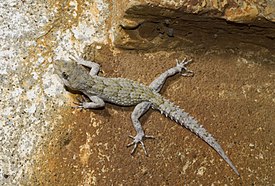
The Mediterranean thin-toed gecko [1] , or the Mediterranean bare-toed gecko [1] ( lat. Mediodactylus kotschyi ) is a small lizard from the gecko family.
| Mediterranean thin-fingered gecko |
 |
| Scientific classification |
|---|
| No rank : | Bilateral symmetrical |
| Infraclass : | Lepidosauromorphs |
| Gender: | Mediterranean thin-fingered geckos |
| View: | Mediterranean thin-fingered gecko |
|
| International scientific name |
|---|
Mediodactylus kotschyi
( Steindachner , 1870) |
| Synonyms |
|---|
- Gymnodactylus kotschyi Steindachner, 1870
- Cyrtodactylus kotschyi Steindachner, 1870
- Cyrtopodion kotschyi Steindachner, 1870
|
| Area |
|---|
|
| Security status |
|---|
Least ConcernedIUCN 3.1 Least Concern : 157281 |
|
Body length (without tail length) - up to 50 mm. The tail is usually slightly longer than the body. Weight up to 3 grams. Females are slightly larger than males (average length of females is 43 mm, males - 40 mm). The body above is covered with small scales, among which there are rows of keeled tubercles. The color on top is gray or brownish-brown with a pattern of transverse M-shaped stripes. The belly is white or yellow. The tail is below the ocher color.
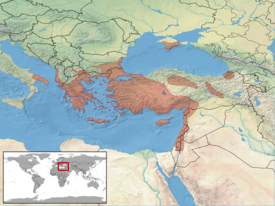
A common natural biotope is rocky xerophytic woodlands. The mountains rises to an altitude of 680 meters above sea level. Active from late February — March to November — early December. In spring, daytime activity predominates, in summer and autumn it is gloomy and nightly. Cracks in the rocks, crevices of walls, cavities under the bark of trees serve as shelters. It feeds on spiders, small insects, millipedes and wood lice. Mating takes place in April – early July. The only clutch of 1-2 eggs for the season is from the end of May to mid-August. The offspring appears in late July - in October.
The species is listed in the Red Book of Ukraine . It is of great scientific importance. It is under the special protection of the Berne Convention (annex II). It is protected in the nature reserves of Yalta Mountain Forest , Cape Martyan , Crimean , Karadag , as well as in the archaeological reserve of Tauric Chersonesos . Contained by terrarium workers and is the subject of illegal trade.
There are 31 subspecies of the Mediterranean thin-toed gecko ( Mediodactylus kotschyi ) [2] :
- M. k. kotschyi (STEINDACHNER 1870)
- M. k. adelphiensis (BEUTLER & GRUBER 1977)
- M. k. bartoni (STEPÁNEK 1934)
- M. k. beutleri ( BARAN & GRUBER 1981)
- M. k. bibroni (BEUTLER & GRUBER 1977)
- M. k. bolkarensis RÖSLER, 1994
- M. k. buchholzi (BEUTLER & GRUBER 1977)
- M. k. ciliciensis ( BARAN & GRUBER 1982)
- M. k. colchicus (NIKOLSKY 1902)
- M. k. concolor (BEDRIAGA 1882)
- M. k. danilewskii (STRAUCH 1887) - Crimean gecko
- M. k. fitzingeri (STEPÁNEK 1937)
- M. k. fuchsi (BEUTLER & GRUBER 1977)
- M. k. kalypsae (STEPÁNEK 1939)
- M. k. karabagi ( BARAN & GRUBER 1981)
- M. k. lycaonicus (MERTENS 1952)
- M. k. maculatus (BEDRIAGA 1882)
- M. k. oertzeni (BOETTGER 1888)
- M. k. orientalis (STEPÁNEK 1937)
- M. k. ponticus (BARAN & GRUBER 1982)
- M. k. rumelicus (MÜLLER 1940)
- M. k. saronicus (WERNER 1937)
- M. k. schultzewestrumi (BEUTLER & GRUBER 1977)
- M. k. skopjensis (KARAMAN 1965)
- M. k. solerii (WETTSTEIN 1937)
- M. k. steindachneri (STEPÁNEK 1937)
- M. k. stepaneki (WETTSTEIN 1937)
- M. k. syriacus (STEPÁNEK 1937)
- M. k. tinensis (BEUTLER & FRÖR 1980)
- M. k. unicolor (WETTSTEIN 1937)
- M. k. wettsteini (STEPÁNEK 1937)