Wok I from Rožmberka , ( Latin Woko de Rosenberch , Czech. Vok I. z Rožmberka ) (circa 1210 - June 4, 1262 , Graz ) - a medieval Czech feudal lord and statesman from the Witkowicz clan, founder of the powerful Czech feudal clan Rožmberk (panov from Rozmberka) , founder of the Rozmberk family castle and the Visebrod Monastery , which became the family burial place of the Pan from Rozmberk. Member of the conquests of King Przemysl Otakar II , the highest marshal of the Czech Kingdom , the royal governor in Upper Austria and Styria .
| Wok I from Rožmberk | |||||||
|---|---|---|---|---|---|---|---|
| Czech Vok I. z Rožmberka | |||||||
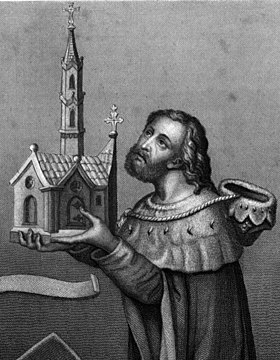 A fragment of the image of Vok I from Rozmberk with a fresco from the church of the Visebrod Monastery , beginning of the 15th century . Reproduction of Joseph Gellich, 1860 [1] | |||||||
 | |||||||
| Monarch | Przemysl Otakar II | ||||||
| Birth | about 1210 | ||||||
| Death | June 4, 1262 Graz , Styria | ||||||
| Burial place | Visebrod Monastery | ||||||
| Kind | Rozmberki | ||||||
| Father | Vitek III from Przice | ||||||
| Spouse | Gedwig von Schaumburg | ||||||
| Children | Jindrich I of Rožmberk , Vitek VI from Pribenitsa | ||||||

Content
Origin
Wok I came from the influential South Bohemian feudal clan Vitkovici , was the grandson of the founder of this clan Vitek I from Prčice and the son of Vitek III the Younger from Prčice and Planckenberk . Reliable information about the name and origin of his mother was not preserved [2] . According to Miroslav Marek, she came from the family of Counts von Schwarzburg-Blankenburg [3] , Vaclav Brzezan also indicates her belonging to the Schwarzburg house [4] .
Biography
For the first time in the written sources that have survived to this day, Wok I is mentioned with his brother Zacharias in 1220 ( Woco et Zacharias filii Witconis ). The next time, Wok is already mentioned with his other brother, Witek from Pribenitsy , as one of the witnesses in the letter dated December 28, 1243 [5] .
Wok I was first mentioned with the predicate "from Rozmberk" in the letter of King Wenceslas I of June 22, 1250 , where he again appears with his brother Witek ( "Woko de Rosenberch et Withigo de Pribinich frater ejus" ). This was the first written record that has survived to this day about the castle of Rožmberk , which is believed to have been laid by Vok shortly before. The next time, the brothers Vok and Vitek are mentioned in a letter dated March 29, 1252, after which the documentary references to Vitek from Pribenitsy cease. After the death of his brother Vitek V from Přebinice between 1252 and 1259, Wok inherited Přebinice [5] [6] [7] [8] .
The wok from Rožmberk participated in the war of Przemysl Otokar II with the Hungarian king Bela IV for the Austrian ducal throne , then represented the king in negotiations with the Hungarian side, which resulted in the conclusion of a peace treaty in April 1254. The king of Hungary recognized Przemysl Otakar II as duke of Austria, in return having received recognition of his authority over the duchy of Styria . After that, Wok took an active part in the Czech colonization of the Czech king of Silesian lands that came under the authority in the border region of Opava , where he was granted possession of some estates. Probably, at the end of 1255, he founded the future city of Prudnik , laying in its place the castle Vogendrossel ( Wogendrossel ), partially preserved to this day ("Wok Tower" in Prudnik) [9] .
In 1254, Wok I of Rožmberk as a marshal probably accompanied King Przemysl Otakar II on his crusade against the Prussians . In a document dated June 7, 1255, he Wok was first mentioned in the position of the highest marshal of the Czech Kingdom , although perhaps he took her back in 1254. In 1254 or 1256, he was appointed royal governor of Upper Austria with the title “iudex provincialis” . The wok from Rozmberk, apparently, participated as the royal representative in the preparation of the military alliance concluded between Przemysl Otakar II and Prince Bishop Passau Otto von Lonsdorf in Linz on April 23, 1257. In the summer of that year, he participated in the unsuccessful invasion of the Czech king to Bavaria , which ended in defeat. On August 24, during the passage of the retreating Czech army through the Inn near Mühldorf , a bridge collapsed under the Czechs. The remaining troops, together with Wok from Rozmberk, heroically defended themselves in Müldorf for nine days from the superior forces of the Bavarian dukes, after which an agreement was reached with the Bavarians on the free withdrawal of Czech forces to the Czech Republic [5] [8] .
The wok from Rožmberk was actively involved in the colonization of the lands of southern Bohemia, where his main possessions were concentrated. In 1258, he sent the first petition for the establishment of a Cistercian monastery in the south of the Czech Republic to the general chapter of the Sito Abbey . The following year, Vok sent a second petition to Sito for the establishment of a monastery in Vishshi Brod , to which he obviously received a positive answer. At the base of the Visebrod Monastery , the wife of Vok I Gedwig von Schaumburg, whose kind patronized the Austrian Cistercian Abbey in Wilhering, took an active part. Having received the approval of the General Chapter of Sito, the Wok from Rožmberk called 12 Cistercian monks from Wilhering, who made up the first brotherhood of the new monastery. With a diploma of June 11, 1261, the Wok from Rožmberk granted the Visebrod Monastery a church in Veselí nad Luznice and the village of Ponedrazh . The king officially approved the foundation of the monastery in Vishshi Brod after the death of Vok I in 1264 [5] [10] [8] .
In July 1260, Wok I took part in the victory for the Czechs against the Hungarians at Kresenbrunn , after which the king appointed him the hetman (governor) of Styria (in a letter dated May 1, 1262, the Wok from Rozmberk is referred to as “Wocho de Rosenberch marscalcus et capitaneus Stiriae” ) The wok also participated in peace talks with the Hungarian side, which began in Vienna shortly after the battle. In the same year, the Queen of the Czech Republic and the Duchess of Austria Margarita Babenberg gave Wok from Rozmberk the Austrian county of Racz with the castle of Rabs an der Thaya . The reason was that Wok’s mother was related to the Counts von Hardegg , whose family had recently received the county of Rakc from Przemysl Otakar II, but suddenly stopped [5] [8] [11] [12] .
Wok I from Rožmberk died on June 3, 1262 in the Styrian city of Graz and was buried in a crypt under the presbytery of the church of the Visebrod Monastery, which became his family burial place for his descendants. The will of Vok I, compiled by him in Graz before his death, is kept in the Visebrod Monastery. Wok bequeathed to his wife the castle of Podegusi and his estates in Stropnitsa and Veseli in the south of the Czech Republic, as well as bail rights to the Austrian city of Gmund . In his will, Wok indicated that these possessions were transferred to Gedwick in case she did not want to live with her sons. In addition, Vok bequeathed to the Visebrodsky monastery the trading village of Rozhnov [5] [6] [10] [8] [13] .
| Diploma of King Wenceslas I of 1250 , in which Wok I is first mentioned with the predicate "from Rozmberk" | Visebrod Monastery | Image of Wok I on the facade Visebrodsky monastery. 16th century fresco | Seal of Wok I from Rozmberk |
Family
In 1257, the Wok from Rozmberk married Gedwig von Schaumburg (or Schauenburg) (d. 1315), the widow of Henry III von Quenring, who also helped found the monastery in Vishshi Brod . In this marriage, the daughter of Hedwick from Rožmberk and two sons - Jindřich I of Rožmberk (d. 1310), who held the position of the highest comrade of the Czech Kingdom , and Witek VI from Přebínice (d. 1277) [3] [5] [8] [10 ] [10 ] ] .
Image in Literature
Wok I from Rozhmberk appears in Vladislav Vanchura 's work “Images from the History of the Czech People” (1949), as well as in the novels “Royal Fate” by Nina Bongardova (1971), “Fiery Autumn” by Frantisek Neuzhila (1973) and especially in the novel “The Iron King and gold ”by Ludmila Lankova (1977) [5] .
Notes
- ↑ Ferdinand Břetislav Mikovec, 1860 , s. 94-95.
- ↑ Jan Jůna, 2011 , s. 116-118.
- ↑ 1 2 Miroslav Marek .
- ↑ Karel Komárek, 1999 , Vítek.
- ↑ 1 2 3 4 5 6 7 8 Karel Komárek, 1999 , Vok.
- ↑ 1 2 Na výstavě Rožmberkové veřejnost poprvé spatří listinu českého krále Václava I ..
- ↑ Karel Komárek, 1999 , Příběnice.
- ↑ 1 2 3 4 5 6 Ottův slovník naučný, 1904 , s. 29.
- ↑ Dominiak, Wojciech. Slezsko-moravské pomezí v polovině XIII století a vznik Prudníku (Polish) // Slezské Kořeny. - Krnov: Městské informační a kulturní středisko Krnov, 2012 .-- S. 16, 18-19 . Archived November 24, 2015.
- ↑ 1 2 3 Založení kláštera .
- ↑ Jan Jůna, 2011 , s. 122.
- ↑ Kacetl, Jiří; Lazárek, Petr; Molík, David. Hrady a zámky moravsko-rakouského Podyjí slovem / Burgen und Schlösser des österreichisch-mährischen Thayatals in Wort . - Znojmo: Jihomoravské muzeum ve Znojmě ve spolupráci s Městským muzeem v Recu, 2013 .-- S. 13. - 80 S. - ISBN 978-80-86974-12-5 .
- ↑ Nástin historie měst Veselí a Mezimostí od počátků po jejich sloučení / Zpracováno dle Fr. Saláka. - Veselí nad Lužnicí: Informační středisko města Veselí nad Lužnicí, 2003. - S. 2. - 13 S.
Literature
- Enneper, Annemarie. Rosenberg (Familienartikel) (German) // Neue Deutsche Biographie . - Berlin: Duncker & Humblot, 2005 .-- Bd. 22. - S. 57-58 . - ISBN 3-428-11203-2 .
- Jůna, Jan. Vítkovci a jejich rod do roku 1312. - Jindřichův Hradec: Epika, 2011 .-- 253 S. - ISBN 978-80-87435-11-3 .
- Komárek, Karel. II. Páni z Rožmberka: část 1 (do roku 1310) // V erbu pětilistá růže. - Praha, 1999.
- Mikovec, Ferdinand Břetislav. Starožitnosti a Památky země České . - Praha: Kober a Markgraf, 1860. - T. 1. - S. 94-98. - 209 S.
- z Rožmberka (Czech) // Jan Otto Ottův slovník naučný: Illustrovaná encyklopaedie obecných vědomostí. - Praha: J. Otto, 1904. - Sv. 22: Rozkošný — Schloppe . - S. 28-35.
Links
- Na výstavě Rožmberkové veřejnost poprvé spatří listinu českého krále Václava I. (Czech) . Národní památkový ústav ČR (2011). Archived on June 20, 2015.
- Vítkovci (Czech) . Genealogy.eu . Miroslav Marek (2003). Archived March 15, 2016.
- Založení kláštera (Czech) . Cisterciácký klášter Vyšší Brod . Cisterciácké opatství Vyšší Brod (2009—2014). Archived March 15, 2016.