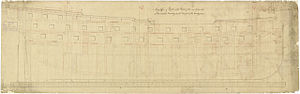
HMS Leviathan (1790) - 74-gun battleship of the third rank . The second ship of the Royal Navy , named HMS Leviathan in honor of the mythical leviathan. The third battleship type Courageux . Laid down in May 1782 . Launched on October 9, 1790 at the royal shipyard in Chatham [1] . He belonged to the so-called "ordinary 74-gun ships", carrying 18-pound guns on the upper gun deck. He took part in many battles of the period of the French revolutionary and Napoleonic wars , including in the glorious first of June and the Battle of Trafalgar .
| Hms leviathan | |
|---|---|
| Hms leviathan | |
 | |
| Service | |
 | |
| Class and type of vessel | battleship 3 rank type Courageux |
| Type of sailing weapon | Three mast ship |
| Organization |  Royal fleet Royal fleet |
| Manufacturer | royal shipyard, Chatham |
| Construction started | May 1782 |
| Launched | October 9, 1790 |
| Withdrawn from the fleet | Floating prison since 1816, sold for scrap, 1848 |
| Main characteristics | |
| Displacement | 1734.4 tons |
| Gondek length | 172 ft 3 in (52.50 m) |
| Midship Width | 47 ft. 9 in. (14.55 m) |
| Depth of intrum | 20 ft. 9 in. (6.3 m) |
| Engines | Sail |
| Crew | 758 |
| Armament | |
| Total number of guns | 74 |
| Gundeck Guns | 28 × 32 pound guns |
| Guns on the operdek | 28 × 18-fn. guns |
| Guns on the Trench | 14 × 9-fn. guns |
| Guns on the tank | 4 × 9-fnl. guns |
Content
Service
French Wars
At the beginning of the French Revolutionary Wars, he was part of the Mediterranean fleet, which in 1793 was in Toulon at the invitation of the royalists, but was forced to leave the city after the attack of the revolutionary troops led by Captain Napoleon Bonaparte , who here marked the beginning of his brilliant career.
In 1794, Leviathan , under the command of Lord Hugh Seymour, joined the Canal Fleet, led by Lord Howe . In the spring of 1794, Leviathan, together with the Canal Fleet, went to sea to intercept an important French convoy with grain from North America. Finding on May 5 the French fleet still in Brest , the squadron turned to the Atlantic, with the intention of intervening between the convoy and its future guards.
On May 28, Lord Howe’s frigates discovered the French fleet, but they turned up in the wind, so it was difficult for the British to force them into battle. Only the flying squadron of Rear Admiral Passley from the fastest two-deckers managed to get to the tail of the French line. The French 110-gun Révolutionnaire , a former Bretagne , on their own initiative turned to meet them and took turns under the fire of 74-gun Russell, Bellerophon, Leviathan, Thunderer and Audacious . The French ship was badly damaged and seemed to even lower the flag, but the inconsistency and poor connection at dusk between the damaged Audacious and Thunderer at least allowed him to escape and, under the protection of the 74-gun L'Audacieux, leave for Brest.
On May 29, Howe tried to break through the French line from the leeward. A dozen British ships entered into a serious skirmish, and although some were injured, none needed the help of a shipyard, all remained in service. The situation was different with the French: several had to return to Brest , but they were replaced by 5 ships of Neuilly, who were lucky to find their fleet the next day.
On June 1, both fleets formed a line 6 miles apart. Leviathan was the third ship of the British column; he made an important contribution to the British victory. For two hours Leviathan fought a close battle with French America , to which he inflicted serious damage. The Leviathan was also badly damaged by being hit by Eole and Trajan during the battle. In total, in the battle he lost 11 people killed and 32 wounded [2] .
In November 1798, Leviathan, under the command of Captain Henry Digby, was the flagship of Commodore John Thomas Duckworth 's squadron sent to capture Menorca . Late in the evening of November 11, Commodore Duckworth was anchored in Fornells when he received information that four “supposedly linear” ships were seen between the islands of Menorca and Mallorca . The Commodore immediately went to sea on Leviathan , escorted by Centaur, Argo , and several armed "merchants" and headed for Ciutadella . At dawn on November 13, five ships were spotted eight or nine miles southeast of Ciudadela. [3] The persecution began immediately. Unknown ships turned out to be four Spanish frigates - Flora, Casilda, Proserpine and Pomona , sailing from Barcelona to Mahon . The day before, November 12, the Spaniards managed to capture the British sloop Peterel and now they towed it to Mallorca. Peterel was recaptured by Argo , but the Spanish frigates managed to escape from the chase [4] .
On February 6, 1799, Leviathan, under the command of Captain John Buchanan, along with the 44-gun Argo ship (Captain James Bowen) sailed along the eastern tip of Mallorca when two Spanish frigates were found anchored under the protection of a coastal battery. The frigates , which turned out to be 34-gun Santa-Teresa and Proserpine , immediately dropped anchor and, having set all the sails, moved to the northeast. At dusk, the frigates split up and the British ships, not realizing it right away, continued to pursue Santa-Teresa . At midnight, Argo caught up with the Spanish frigate and opened fire on him from the bow guns, but even seeing that Leviathan had almost overtaken him, he stubbornly refused to give up. He lowered the flag only after receiving an airborne salvo of Argo , which injured two people and caused noticeable damage to his rigging [5] .
Napoleonic Wars
On April 5, 1800, Leviathan (Captain James Carpenter, Rear Admiral John Thomas Duckworth) was part of the English squadron, which, while in the Gulf of Cadiz, discovered a Spanish convoy of 13 ships and brig, which on April 3 left Cadiz to South America under the protection of three frigates , two of which were Carmen and Florentina , both 34-gun 12-pound [6] . At dawn on April 6, the squadron caught up with one of the brig, and boats with Leviathan and Emerald , commanded by Charles Grigory, the second Lieutenant of Leviathan , rushed after him. After a 40-minute shootout, the brig surrendered, and the British rushed in pursuit of the convoy. At dawn on April 7, Leviathan and Emerald caught up with the Spanish frigates Carmen and Florentina and forced them to surrender. Emerald chased a third frigate, but was recalled to capture merchant ships. Before dusk, the British managed to capture four ships, and they, together with their prizes, moved to Gibraltar [7] .
After Villeneuve sailed from Toulon to the West Indies on March 29, 1805 with a squadron of eleven battleships, six frigates and two sloops, Leviathan joined the Nelson squadron, which rushed after him. The British did not succeed in discovering the Franco-Spanish fleet there, and on June 12, Nelson found out about the departure of the Allies and he again with 11 ships set off in his indefatigable pursuit. However, Villeneuve headed for Ferrol , and Nelson for Cadiz , believing that the enemy was heading to the Mediterranean Sea .
In the Trafalgar battle, Leviathan, under the command of Captain Henry William Bountun, was the third ship of the windward column of Admiral Nelson on the HMS Victory . He cut through the enemy line and opened fire on Santisima Trinidad . He then engaged in a close battle with San Augustin and forced him to capitulate. After the battle, the prize was set on fire and destroyed. Levithan lost in the battle only 4 people killed and 22 wounded [8] .
In October 1809, Leviathan (Captain John Harvey) was part of Rear Admiral George Martin's squadron, which was off the coast of Catalonia and was sent to intercept the small French squadron of Rear Admiral François Boden, coming from Toulon . On the morning of October 23, HMS Volontaire discovered a French squadron and the British rushed in pursuit, but lost sight of it. HMS Tigre discovered Robuste, Borée, Lion and Pauline at dawn on October 24, but the fleets again lost each other. Contact was reestablished on the morning of October 25, and the chase resumed. Trying to escape the pursuit, Robuste and Lion ran aground near Frontignan. After two hours of fruitless attempts to save the ships, Boden ordered them to sink. They were set on fire and exploded at 22:30 [9] .
On May 9–10, 1812, under the command of Captain Patrick Campbell, the Leviathan , together with the 74-gun ship America and the 18-gun sloop Eclair, attacked a French convoy of 18 heavy ships that took refuge under the protection of coastal batteries near the city of Laigueglia . At dawn on May 10, marines from both ships (about 250 people) landed and destroyed two coastal batteries, after which boats were sent from the ships to capture merchant ships. The British managed to tow 16 loaded ships, another was burned in the harbor, and the other was too damaged by a shot and sank. In this operation, the British lost 16 people killed and 20 wounded.
In 1816, after the end of the Napoleonic Wars, Leviathan was transformed into a floating prison , and remained there until 1848, when it was sold for scrap [1] .
Links
- ↑ 1 2 B. Lavery. The Ship of the Line - Volume 1. - P. 180.
- ↑ Index of Naval Vessels
- ↑ James, V. II, p. 196
- ↑ James, V. II, p. 197
- ↑ James, V. II, p. 319
- ↑ James, V. III, p. 37
- ↑ James, V. III, p. 38
- ↑ Ships of the Old Navy
- ↑ James, V. V, p. 144
Literature
- Lavery, B. The Ship of the Line. The development of the battlefleet 1650-1850. - Conway Maritime Press, 2003. - Vol. I. - ISBN 0-85177-252-8 .
- William James The Naval History of Great Britain, from the Declaration of War by France in 1793, to the Accession of George IV. - R. Bentley, 1837. - ISBN 0-85177-906-9 .
- William James [1] = The Naval History of Great Britain, Volume 2, 1797-1799. - Conway Maritime Press, 2002 [1827]. - ISBN 0-85177-906-9 . Archived May 27, 2013 on Wayback Machine
- William James [2] = The Naval History of Great Britain, Volume 4, 1805-1808. - Conway Maritime Press, 2002 [1827]. - ISBN 0-85177-906-9 .
Links
- HMS Leviathan Index of 19th Century Naval Vessels and a few of their movements
- HMS Leviathan Ships of the Old Navy