The defense of the Mega Spileo monastery is one of the episodes of the Greek war of liberation . The battle took place on June 24, 1827 between the Ottoman forces and the Greek rebels and monks. The episode is a matter of pride for the Greek Orthodox Church and is often referred to in historiography as “monastic war” (Καλογερικός πόλεμος) [1] .
| Defense of the Mega Spileo Monastery | |||
|---|---|---|---|
| Main Conflict: Greek War of Independence | |||
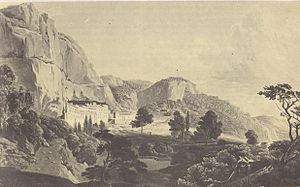 Mega Spileo. From the album of the English archaeologist and artist Dodwell "Views in Greece from drawings" 1801-1806 | |||
| date | June 24, 1827 | ||
| A place | Mega Spileo , Greece | ||
| Total | victory of the Greek rebels and monks of the monastery | ||
| Opponents | |||
| |||
| Commanders | |||
| |||
| Forces of the parties | |||
| |||
| Losses | |||
| |||


Background
The monks of the Mega Spileo monastery in the Peloponnese were involved in the activities of the Greek revolutionary organization Filiki Eteria . The monastery became one of the centers for the preparation of the uprising [2] . Since the uprising began, many monks of the monastery took a direct part in hostilities: in the battle of Levidi on April 14, 1821 (see the Siege of Tripolitsy ) [3] and in the destruction of the remnants of the Dramali Pasha army in the battle of Akrat on January 7-19, 1823 [ 3] . The monastery itself became a base of strategic importance for the rebels. In addition, thousands of refugees found refuge in the monastery, including more than 500 noble families of the Peloponnese [4] . Unable to cope with the uprising, and 3 years after it began, the Sultan called for help from his Egyptian vassal, promising him Peloponnese . Organized by the Europeans, the Egyptian army, under the command of Ibrahim Pasha , landed on the Peloponnese in 1824. Knowing the strategic importance of the monastery, Ibrahim unsuccessfully tried to force the monks to surrender by threats. Ibrahim undertook reconnaissance in battle in December 1825 [5] and in May 1826, but in both cases he did not dare to take the monastery with an attack [6] .
1827 Campaign
Ibrahim continued the tactics of "scorched earth", demanding recognition of humility from the population. His policy was somewhat successful after the warlord Nenekos, who began to promote Ibrahim [6] declared his humility. In response, Kolokotronis, Theodoros , the unspoken leader of the Peloponnese rebels, called the "Grandfather of Morea, " proclaimed the cry "Ax and fire to the conquered." In the spring of 1827, Ibrahim, leading 15,000 of his soldiers, 3,000 Turks from the garrison of the fortress of Patras , under the command of Delhi-Ahmed, and 2,000 people of Nenekos, marched from Patras to Mega Spileo. Halfway, the army of Ibrahim camped at Livadi. Ibrahim, taking a walk with his adjutant, got lost in the forest and went out to Nenekos and his people. Ibrahim rested (slept) for several hours visiting Nenekos, after which he took him to the Ottoman camp. When Kolokotronis learned that Ibrahim was in “Greek” hands and was not captured, he became furious. He “openly vowed to the Great God of the Hellenes that he wanted the death of Nenekos and was ready to kill him with his own hands. A similar, strange, statement first came out of the mouth of Kolokotronis ” [6] . Kolokotronis wrote an order to Athanasius Sayas, allowing him to kill Nenekos, in any way possible. Kolokotronis stood in front of the Virgin’s icon “on his knees, crossed himself three times and asked the Virgin for permission, after which he signed an order stating that he was doing this for the sake of the Fatherland and that he was not killing a Christian, but a Turk”. A few months later, at the beginning of 1828, Sayas found a moment to “deal with the traitor” [6] . Ibrahim went to the monastery and set up camp in Salmen. The monks requested help from Kolokotronis, who sent them reinforcements, led by his adjutant and secretary, Photakos [7] .
Fortifications
Monks and parishioners began to build fortifications from the previous, 1826, year after the second reconnaissance raid by Ibrahim. A tower was built north of the monastery. Two towers were built on top of a cliff, a short distance from one another. The southernmost of the towers was multi-story, had a cistern of water and the Ascension Chapel was built with it. The monastery had only two cannons: one was located at the top of the cliff, and the second north of the monastery. Around the monastery were dug numerous trenches [4] . The trenches were dug in two sectors important for the defense of the monastery: 500 meters northwest of the monastery and on the Feast of the Virgin, on the Vuraikos River and 600 meters west of the monastery. A wall 60 meters long was built in front of the facade of the monastery [8] .
Monastery Defense
On June 19, Ibrahim wrote a letter to the monks of the monastery demanding to submit. The monks replied that "since they have left this world and consider themselves not to exist in this life, they are not afraid of death." Having received the answer, Ibrahim decided to take the monastery in a fit. The monastery was defended by 600 fighters of N. Petimezas and 100 fighters of Fotakos. On June 23, Ibrahim sent 3,000 of his soldiers to occupy the mountains behind the monastery. He located 12,000 soldiers southeast of the monastery, at a position called Psilόs Stavrόs (High Cross). Nenekos, with its own forces, is located northeast of the monastery. On the morning of June 24, in the sight of the defenders of the monastery, the Turks and the people of Nenekos drove captured women and children through the gorge under the monastery. “The prisoners marched with cattle captured by the Turks and presented a picture of the herd,” wrote Fotakos. At this moment, the indignant monk told Fotakos that they, the fighters, should be ashamed of the fact that they allowed the Turks to "drag our women into slavery." Almost immediately, a hundred armed monks emerged from the monastery, led by the loser Gerasim . The monks changed their cassocks to the Greek fastanella and "spread their long hair." Passing by the positions of the fighters, the monks declared: "See how we will fight." Fotakos writes that "we blushed with shame and immediately stood up for our positions." The Turks and the people of Nenekos occupied the defenses, but could not repulse the attack of the monks and fighters. Fotakos admits that the monks killed more Turks than fighters “almost twice” and adds “the Turks felt what a monastic war was”. 500 Turkish riders attacked the Hill of the Virgin. Defenders of the hill repelled the attack, not least, thanks to the fire support of one single cannon firing from the monastery. The riders were forced to stop the attack, waiting for a general attack by Ibrahim. But the attack did not take place and the cavalry retreated with losses. Ottoman forces attacked the All Saints Chapel southeast of the monastery as well. The resistance of the chapel defenders forced the Ottoman to retreat [9] . In another sector of the battle, in the High Cross position, and despite the death of the commander of its defenders, Andreas Sardelianos, the rebels not only repelled the Ottoman attack, but also counterattacked themselves. The Ottomans lost more than 300 people killed and wounded. To top it off, the Ottoman forces were attacked by a small detachment left behind in the rear by N. Petmesas. Fearing the approach of the forces of Kolokotronis, Ibrahim decided not to tempt fate in a narrow gorge and not repeat the fate of Dramali Pasha . Ibrahim left the monastery once again, leaving his capture for the future. Delhi-Ahmed and Nenekos went to Patras . Ibrahim returned to Tripolitsa, burning villages on his way [6] .
Epilogue
Another case for the capture of Mega Spileo Ibrahim was not provided. After the destruction of the Turkish-Egyptian fleet in October 1827 under Navarino , Ibrahim lost the opportunity to receive reinforcements and lost the initiative. The monastery remained in Greek hands until the end of the war. A year after John Kapodistrias accepted the reign of Greece, still fighting, he celebrated the Resurrection of Christ in April 1829 in a monastery, along with monks and parishioners [6] .
Notes
- ↑ "Ο Καλογερικός πόλεμος" ομιλία Δημητρίου Οδυσ. Σταθακόπουλου (Μ.Σπήλαιο 26-6-11) | ΚΑΛΑΒΡΥΤΑ - NEWS
- ↑ Αμβ.Φραντζή, Επιτομή της ιστορίας της αναγεννηθείσης Ελλάδος, τ. Α ', εν Αθήναις 1839, σ. 79
- ↑ 1 2 Ν. Σπηλιάδου, Απομνημονεύματα, τ. Γ ', σ. 356 σημ. one
- ↑ 1 2 Κωνσταντίνος Οικονόμου, Κτιτορικόν Μεγάλου Σπηλαίου, σελ. 86. Αναφέρεται στο Σάθας Κωνσταντίνος, Τουρκοκρατουμένη Ελλάς , Αθήνα, 1869, σ. 492, 493, υποσημ.
- ↑ 54. Κ. Δεληγιάννη, Απομνημονεύματα, τ. Γ ', σ. 82
- ↑ 1 2 3 4 5 6 Δημήτρης Φωτιάδης, Η Επανάσταση του 1821, εκδ. Μέλισσα 1971
- ↑ Δ. Παναγόπυλου, Η Ιερά Μονή Μ. Σπηλαίου ..., σ. nineteen
- ↑ Δ. Παναγόπυλου, Η Ιερά Μονή Μ. Σπηλαίου ..., σ. 21
- ↑ Δ. Παναγόπυλου, Η Ιερά Μονή Μ. Σπηλαίου ..., σ. 29th