Cija , whitefish ( English sidjah, siga, seega, ceega, soja ) - an old logical board game for two participants. Distributed in northeast Africa. In Sudan it is called "cid", in Egypt - "whitefish" and has some differences in the rules [1] . In the countries of northern Europe, the game was called “desert checkers” ( Fin. Erämaashakki , Swede. Ökenschack , Norwegian Ørkensjakk ). Conditionally refers to the group "latrunkulorum" [2] category of "war games" [3] . This game is a transitional link between mankala , mill and clamping checkers.
| Cija / Whitefish | |
|---|---|
 | |
| Players | 2 |
| Complexity of rules | low |
| Strategy level | average |
| The influence of chance | not |
| Develops skills | tactics , strategy |



Content
History
Perhaps sidge comes from the ancient Roman games: “Ludus Latrunkulorum” or “ Latrunculi ” (a game of robbers), the rules of which are known from fragmentary information. Or from the board games of the Greeks: "petteia" - pebbles and "policy" - the city. From the Greeks and Romans who owned Egypt, the game could go to the Egyptians, as well as to the tribes of Sudan and Somalia. This also applies to the Somali high jump game, which is close by the rules to the cj.
According to other sources, whitefish was not known in Egypt in the 17th century, but it was born in Sudan and became popular among the fellahs of Egypt at the beginning of the 19th century [4] , and a hundred years later this game was popular in Somalia [5] . In Egypt, by the end of the 20th century, its popularity declined.
Shiga - a game, rather, the poor. Traditionally, the playing field was drawn on the ground. It is also possible to use holes in the ground or stone, which brings it closer to the Mankal games, popular in the same regions. There are many similar square fields of holes, carved on stones, including on ancient buildings. As chips, which are called "dogs", pebbles and pebbles are used.
Rules
Usually they play on a field of 5 × 5 cells and each player has 12 stones. But fields of 7 × 7 (24 stones each) and 9 × 9 (40 stones each) are also used [6] . The game process is divided into two phases.
Phase One in Siji
- Players alternately place two stones on any two squares of the field, except the central one. At the same time, they try to take more advantageous positions, taking into account who will make the first move in the second phase of the game.
However, setting up two stones is more suitable for multicellular fields. On a 5 × 5 field, placing one stone at a time makes the process “more thoughtful”. This does not preclude a swift arrangement with experience.
The first phase in whitefish
- According to various descriptions, two possible arrangements. First: the same as in siji. Second: the first four chips are placed with a “cross” at the ends of the central horizontal and vertical. The first player places on the right and left, the second on the top and bottom (see the second illustration). Then the actual arrangement begins.
Phase Two in Siji
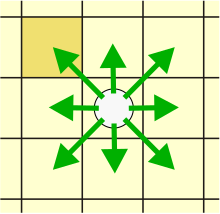
- A stone moves in any direction (including diagonally) on one cell, if it is free.
- The player who started the arrangement makes the first move to the central cell.
- You cannot skip a move.
- If after the move the opponent’s stone fell between the two stones of the walking player (captured by the guards), then it is considered eaten and removed from the field. Moreover, all captured stones are eaten at once in all directions. Theoretically, there can be up to seven. There is no need , but stones already eaten cannot be left on the field. Moreover, the stones that were originally sandwiched between the stones of the enemy are not eaten, as well as the stone placed between two stones of the enemy.
- A move can be idle (without eating). After him the enemy walks. But if the enemy’s stone is taken, new moves are made with any of its own stones. These moves cannot be missed either, and there can be any number of them, but not idle ones. Idling is no longer performed.
- An adversary is considered defeated if he has no more than one stone left. The player can also, having assessed the position, admit defeat, but only before 11 stones are eaten.
Sigi Phase 2
- The player who finished the last stone placement begins to walk.
- The stone walks only orthogonally (vertically and horizontally). Enemy stones also beat only vertically or horizontally. Therefore, the maximum number of stones eaten at a time can be no more than three. Also, a stone located in the central cell cannot be eaten .
- In some versions of the rules, jumping over stones and / or the central cell is allowed (details unknown).
- If a player takes an opponent’s stone on his own, he makes new moves, but only with the same stone he can eat. Idling is not performed. In another option: you can eat only two times in a row. Then the enemy walks.
- If the player’s stones are clamped and he cannot make a move, then the opponent must give him a pass, making an additional move. Although in another embodiment, a player who is unable to make a move is considered a loser.
- If there is a barrier position, when in fenced areas, opponents can simply move stones, not wanting to go on the attack, count the number of stones and award a victory by points. If their number is equal, a draw is declared.
- Similarly, if at any stage of the game no stones of any color were knocked down in twenty moves, the game stops and points are counted.
Strategy
The arrangement phase may lead to victory or defeat, depending on how well the player has taken the most advantageous positions with his stones. On the other hand, striving for this, he can fall into a prepared trap. This layout for siji is shown in the first illustration. White, having taken the most “advantageous” positions (they really are), make the first move with any stone and eat four red ones at once. They cannot do more moves. After that, the Reds select them completely.
The game often ends very quickly. But it can also go into a long phase of positional confrontation. And with the same number of last stones, long “catch-ups” can begin, where a less attentive and persistent player loses.
Notes
- ↑ The issue with the names has not yet been finally resolved.
- ↑ These are games with two captivating guards, like the Roman “Ludus Latrunculorum” (according to R. Bell).
- ↑ That is, games in which one can see a certain imitation of a military battle (according to R. Bell).
- ↑ Lane E. U. Modern Egyptians. - 1890.
- ↑ Marin.
- ↑ A 3 × 3 cell version of the game has been released for the smartphone .
Literature
- Bell R. Encyclopedia of Board Games of the World / Per. from English - M.: Tsentrpoligraf, 2001 .-- 318 p. - S. 133-135. - ISBN 5-227-01462-0 .
- Bolkhovitinov V.N., Koltovoy B.I., Lagovsky I.K. Your free time (Entertaining tasks, experiments, games). - M .: Children's literature, 1970. - 464 p. - S. 304-306.
- Shiga // Encyclopedia of home games. - M.: AST, Minsk: Harvest, 2002 .-- 632 p. - S. 56-57. - ISBN 5-17-008240-1 (AST), ISBN 985-130834-X (Harvest).
- Cija // Science and Life, 1965. - No. 11. - S. 145.
- Cija // Encyclopedia of board games. - Minsk: Harvest LLC, 2003, - 368 p. - S. 49-50. - ISBN 985-13-0892-7 .
- Sidzha // 105 most popular board games / Avt.-sost. E. A. Popova. - M .: LLC "Publishing house AST"; Donetsk: Stalker, 2004 .-- 320 p. - S. 113-114. - (Board games). - ISBN 5-17-0265727 (LLC "Publishing house AST"), - ISBN 966-696-635-2 (Stalker).
- Sidzha // 250 board games of the peoples of the world / Avt.-sost. I.R. Kireyevsky. - Donetsk: Agency Multipress LLC, 2005. - 288 p. - S. 71-73. - ISBN 966-519-115-2 .
- Abstract Games Magazine. 2001. - No. 7. (English)
- Bell RC Board and Table Games from Many Civilizations. - New York: Dover Publications, Inc., 1979. - Vol. 1 - P. 82-84. (eng.)
- Botermans J. et al. The World of Games. - New York: Facts on File, Inc., 1989. - P. 122-123. (eng.)
- Murray, HJR A History of Board-Games Other Than Chess. - Oxford: Oxford University Press, 1952. - P. 54-55. (eng.)
- Parker H. Ancient Ceylon - An Account of the Aborigines and of Part of the Early Civilization. - London: Luzac & Co. Publishers - 1909. (English)
- Parlett D. The Oxford History of Board Games. - Oxford: Oxford University Press, 1999 .-- P. 238. (English)
- Schädler U. (1994). Latrunculi, ein verlorenes strategisches Brettspiel der Römer // Homo Ludens IV. - 1994. p. 47-67 (German)
- Walker D. The Traditional Board Game Series. - 2011 .-- Leaflet # 19: Seega . (eng.)