Blackberry Armenian ( Latin: Rúbus armeníacus ) is a plant species native to Armenia , part of the Rubus genus of the Rosaceae family. Together with closely related species of early blackberry ( Rubus praecox ) and common blackberry ( Rubus ulmifolius ), it belongs to the species included in the group Rubus fruticosus in the broad sense.
| Blackberry Armenian |
 |
| Scientific classification |
|---|
| Section : | Bushy blackberry |
|
| International scientific name |
|---|
Rubus armeniacus Focke , 1874 |
|
Content
Deciduous shrubs , lashes reach 1-2 m in length, with strong spikes.
The leaves on longer petioles than on the black-leaved blackberry, consist of 3-5 unequal leaves, each with a blunt-edged edge, bright green.
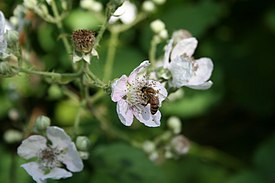
Flowers up to 2 cm in diameter. The calyx consists of five bent sepals, pubescent on both sides. Corolla is very pale pinkish.
The fruit is relatively large, black.
The set of chromosomes is 2n = 28.
The homeland of the blackberry is Armenia , but the plant is unknown in the wild in this region.
Naturalized in Central and Northern Europe , in the northwest of North America , in Australia and New Zealand . It was first introduced to Germany in 1837, to North America - in 1885, to New Zealand - earlier.
In British Columbia and California, it is a dangerous invasive species, crowding out local blackberry species and interbreeding with them. Some time ago, it was the most common blackberry species grown as a fruit shrub in Europe and North America. Subsequently replaced by a less sweet, however devoid of thorns, split blackberry .
Synonyms
- Rubus discolor auct.
- Rubus hedycarpus subsp. armeniacus (Focke) Erichsen , 1931
- Rubus hedycarpus var. armeniacus (Focke) Focke, 1914
- Rubus macrostemon f. armeniacus (Focke) Sprib. , 1906
- Rubus procerus auct.
- ↑ For the conventionality of specifying the class of dicotyledons as a superior taxon for the plant group described in this article, see the APG Systems section of the Dicotyledonous article .
- CK Schneider. Illustriertes Handbuch der Laubholzkunde. - 1906. - Bd. 1. - S. 516-517.
