HMS Dragon (1798) - 74-gun battleship of the third rank . The eighth ship of the Royal Navy , named HMS Dragon . Laid in August 1795 . Launched on April 2, 1798 at the shipyard in Rotherchit. The ship was designed by Sir William Roule as one of the usual 74-gun ships. The only ship of its type [1] .
| HMS Dragon | |
|---|---|
| HMS Dragon | |
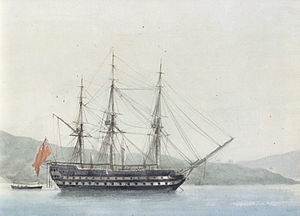 HMS Dragon Brush Antoine Roux | |
| Service | |
 | |
| Ship class and type | battleship 3 rank |
| Type of sailing equipment | Three-masted ship |
| Organization | Great Britain |
| Manufacturer | shipyard in roterhit |
| Author ship drawing | William Rule |
| Construction started | August 1795 |
| Launched | April 2, 1798 |
| Removed from the fleet | disassembled, 1850 |
| Main characteristics | |
| Displacement | 1815 tons (BM) |
| Gondek length | 178 feet (54.3 m) |
| Mid- width width | 48 feet 3 inches (14.7 meters) |
| Depth of intrum | 20 feet 6 inches (6.2 m) |
| Engines | Sail |
| Armament | |
| Total number of guns | 74 |
| Guns on the gandek | 28 × 32 pound guns |
| Operdeck guns | 28 × 18 fn. guns |
| Guns on shkantsah | 14 × 9 fn. guns |
| Tank guns | 4 × 9 fn. guns |
Content
French Wars
In 1799, Dragon was sent to the Mediterranean to join a squadron under the command of Sir Charles Cotton. In February 1801 he was part of a squadron under the command of Sir John Warren blocking Cadiz .
In 1801 he took part in the Egyptian operations. Since Dragon took part in the Egyptian campaign from March 8 to September 2, 1801, his officers and crew received the right to a medal with a “Egypt” buckle, which the Admiralty awarded to all surviving participants in 1850 [2] .
In April 1803, the Dragon sailed from Gibraltar to England in company with the Alligator and the merchant ship Prevoyante when they saw two French ships of the line near Cape St. Vincent. The French ships did not engage in battle with the British and turned off course. [3]
On June 18, 1803, Dragon and Endymion captured the French 16-gun corvette Colombe , which was on its way to Brest from Martinique .
In 1804, the Dragon, under the command of Captain Edward Griffith, joined the squadron blocking Ferrol . July 15 with a squadron Caldera sailed to the area of Cape Finisterre to intercept the French-Spanish squadron, returning from the West Indies .
On July 22, the Calder fleet of 15 battleships, two frigates, a cutter and a lugger was near Cape Finisterre when he encountered a combined French-Spanish fleet of 20 ships of the line, seven frigates and two sloops. Calder decided to attack and moved to the French with his squadron. The battle lasted more than four hours, the two fleets mixed up in conditions of poor visibility and in thick fog, which prevented a decisive victory. However, the British were able to capture two Spanish battleships, the 80-gun San Rafael and the 74-gun Firme . Four people were injured aboard the Dragon [4] .
In 1806-1808, the Dragon , commanded by Captain Matthew Henry Scott, was part of the Canal fleet.
The War of 1812
Dragon under the command of Robert Barry took part in the war of 1812 with the United States .
In August 1814, Dragon took part in an expedition up the Penobscot River in the state of Maine . The first ships went there Sylph, Dragon, Endymion, Bacchante, Peruvian , as well as some transports. Bulwark, Tenedos, Rifleman and Pictou joined them on August 31. On the evening of August 31, Sylph, a Peruvian, and a Harmony transport ship, accompanied by boats from the Dragon , taking aboard the marines, soldiers and Royal Artillery detachment, went up the Penobscot River under the command of Captain Robert Barry with the Dragon [5] . The purpose of the trip was the American frigate Adams , armed with twenty-six 18-pounder cannons, who took refuge 27 km upstream of the river near the city of Hampden, Maine. Here the Americans removed his gun from Adams and installed nine of them on a nearby hill and fourteen on the pier next to the ship.
The trip upriver took the English two days, and ended up with the battle of Hampden. As a result of the battle, the British were able to break the garrison defending the city and began the pursuit of the Americans, who were retreating towards Bangor . In this case, the Americans managed to set fire to Adams and the ship soon exploded. But the British managed to capture eleven other ships and six more they destroyed. They lost only one person, a sailor from the Dragon crew, and several more were injured. [6]
In January 1815, Dragon was the flagship of Admiral Sir George Cockburn at the Battle of Fort Peter and the capture of the city of St. Marys in Georgia .
From 1824, Dragon remained in service in the harbor, becoming the naval barracks in Portland in 1829. It was renamed HMS Fame in 1842. It was scrapped and dismantled in 1850 [1] .
Links
- ↑ 1 2 B. Lavery. The Ship of the Line - Volume 1. - P. 185.
- ↑ №21077, p. 791–792 (Eng.) // London Gazette : Newspaper. - L .. - Iss. 21077 . - No. 21077 . - P. 791-792 . - ISSN 0374-3721 .
- ↑ Naval Chronicle , Vol. 9, p.337.
- ↑ National Maritime Museum Warship Histories Archived August 2, 2011. , Vessel ID 365765
- ↑ №16944, p. 2029-2033 (Eng.) // London Gazette : Newspaper. - L .. - Iss. 16944 . - No. 16944 . - P. 2029-2033 . - ISSN 0374-3721 .
- ↑ The Anglo-American Magazine , (Toronto: Maclear), Vol. 5, pp.418-9.
Literature
- Lavery, B. The Ship of the Line. The development of the battlefleet 1650-1850. - Conway Maritime Press, 2003. - Vol. I. - ISBN 0-85177-252-8 .
- JJ Colledge. Ships of the Royal Navy From the Fifteenth Century to the Present. - Annapolis, Maryland: Naval Institute Press, 1987. - ISBN 0-87021-652-X .
- William Patrick Gossett. The lost ships of the Royal Navy, 1793-1900. - Mansell, 1986. - ISBN 0-7201-1816-6 .
Links
- HMS Dragon Index of 19th Century Naval Vessels and a few of their movements (Eng.)
- HMS Dragon Ships of the Old Navy (eng.)