Alva ( Eng. Ulva , Gaelic. Ulbha ) - an island in the archipelago of the Inner Hebrides , Argyll and Butte , Scotland , UK .
| Alva | |
|---|---|
| English Ulva , Gaelic. Ulbha | |
 South Coast Basalt Cliffs | |
| Specifications | |
| Square | 19.9 km² |
| Highest point | 313 m |
| Population | 11 pax (2011) |
| Population density | 0.55 people / km² |
| Location | |
| Archipelago | Inland Hebrides |
| Water area | Atlantic Ocean |
| A country |
|
| Region | Scotland |
| Area | Argyle and Butte |



Etymology
The origin of the name of the island is reliably unknown. According to the most plausible hypothesis ( Samuel Johnson , , 1775) [1] it is translated from Old Norse as "Wolf Island". The island’s official website and tourist guides provide a more beautiful version [2] :
The scout, sent ashore, returned with the words of Ullamhdha , which in the Viking language meant "No one is home."
R.W. Munroe and Alan McQuarry (1996) state that that scout pronounced Ullamh dha , which in Gaelic means “[island] is ready for him [the leader of the Vikings]” [3] .
Geography
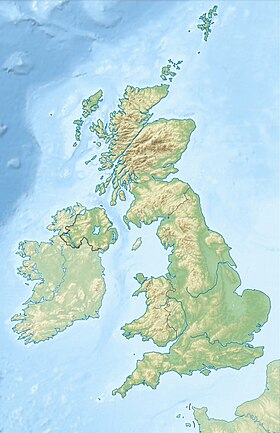
The island is stretched from west to east by about 7 kilometers, from south to north by about 3 kilometers, its area is 19.9 km², the highest point is 313 meters above sea level. From the north, east and south, the island of Alva surrounds the island of Mall - in the east, the distance between them is only 200 meters, there is a regular ferry service [4] . One and a half kilometers to the south-west is the Little Colonsey islet, and from the west, at a distance of only 30 meters (at high tide) is the island of Gometra , Gometra and Alva are connected to each other by a bridge, but during low tide you can go on dry land .
Geology
Most of the island is composed of basalt , which in some places forms bizarre columns. The predominant type of terrain is moorland . The highest point of the island is Mount Beinn Chreagach (313 meters above sea level), the neighboring Mount Beinn Eoligarry just below - 306 meters.
History
Evidence has been found on the island that people settled it in the Mesolithic . In the caves heaps of burnt oyster shells dating from the middle of the sixth millennium BC, several menhirs set in the middle of the second millennium BC were found. The flints and infant skeletons found were in the same layer with the skeletons of lemmings and arctic foxes , which indicates that then there was a much more severe climate. The remains of two duns are also found. Residents of Alva were among the first in Northern Scotland to get to know Christianity, in particular, it is known that in 563 the island was visited by the Irish monk preacher Columbus . Later, Alva was settled by the Picts , the island became part of the kingdom of Dal Riad , and then entered the Kingdom of the Islands . In the Early Middle Ages, the island was ruled by the Scandinavians. In the X century, Alva passed into the possession of the Macquarie clan (controlled the island until the middle of the XIX century) [5] , was a diocese of Sodor and Maine and .
The island's population grew and, at its peak at the turn of the 18th and 19th centuries, amounted to about 800 people, however, in 1835 (1845?), Alva, like several neighboring islands, had a new owner - lawyer Francis William Clark, who was an ardent supporter of the idea of the deportation of the Scottish highlanders , because of which the population of the island sharply declined. In the XIX century, the main source of income for the islanders was the collection, processing and export of kelp . For example, from 1817 to 1828 at least 256 tons of these algae were collected on the island. In 1837 there were 16 settlements on the island, there lived merchants, carpenters, tailors, weavers.
Clark's descendants owned the island until 1945, after which they were sold to Lady Edith Congleton. As of 2014, the island is owned by its descendants, the Howard family [6] .
Demographics
- 1841 - 859 people (Alva and Gometra ), on Alva - 570 people
- 1848 - 150 people (such a sharp decline in population is associated with the repression of F.W. Clark and the failure of potatoes (see Highland Potato Famine ) - the main food of the islanders)
- 1889 - 83 people (Alva and Gometra), on Alva - 53 people [7]
- 1981 - 13 people [8]
- 1991 - 30 people (11 households) [8]
- 2001 - 16 people (6 households) [8]
- 2011 - 11 people (6 households) [9] . Over the first decade of the 21st century, the island’s population has declined by more than 31%. For comparison: during the same time, the population of all the islands of Scotland increased by 4% [10] .
Flora and Fauna
The island has a large number of birds common to other Scottish islands: buzzards , golden eagles , white-tailed eagles , snipe , black grouse , pheasants , woodcocks and many others. Among mammals, deer , rabbits , hares , otters , less common stoats and hedgehogs can be noted. There are no foxes or wolves on the island. Also, there are no snakes, the only recorded reptile is the spindle . In the surrounding waters, Minke minke whales , porpoises , dolphins and grinds are often visible [7] . In 1966, 1987 and 1991, there were recorded cases of ejection of whales ashore, and in 1991 two whales did it simultaneously. More than 500 plant species have been described, especially ferns , bluebells , orchids , sundews , cloves [11] .
Buildings and Structures
Most of the island’s buildings were built hundreds of years ago, so they now only have ruins (for example, the grandfather of the famous African explorer David Livingstone lived here) [6] . However:
- Church - built in 1827-1828, architect Thomas Telford , the cost of work amounted to 1495 pounds, 14 shillings and 1 penny. It was restored and rebuilt in the 1950s: now there is not only the church itself, but also the community center [12] .
- Sheila's House - Sheila McFadyen, a milkmaid who lived in thatched house from the early 1900s to the early 1950s. Having lost her breadwinner early, she procured a piece of bread for herself for several decades, collecting and selling litorin . Nowadays, the House is a museum - both rooms, furniture in them, household items are maintained in order, illustrating to tourists the life of an ordinary islander of the first half of the XX century [13] .
Other information
- There are no paved roads or cars on the island, with the exception of a few ATVs and tractors .
- There is a restaurant-teahouse on the island for tourists at the pier, but there is no hotel. Island guests can rent small individual cabins.
Alva Island in Art
- The island was sung in Walter Scott poem (1815) [3] :
And Ulva dark, and Colonsay ,
And all the group of islets gay
That guard famed staffa round
- The island was visited by the heroes of Jules Verne's novel The Green Ray (1882):
At six o'clock in the evening everyone gathered on the top of the Abbot hill, from where the surroundings were clearly visible. In the east, the cliffs of the island of Mull rose, in the north - the island of St. Staff emerged from the water, like the shell of a giant tortoise thrown by the surf aground. Behind him, the islands of Elva and Gometra were visible , they merged together, forming as if one large island. In the west and southwest, a vast sea stretched.
- Jules Verne . The Green Ray , ch. sixteen
- In the dedication of the children's story Beatrice Potter (1912) it says: FOR FRANCIS WILLIAM OF ULVA - SOMEDAY! Interestingly, the two main characters of this book are the fox and the badger, but neither of them live on the island. In general, Potter often visited the island and drew inspiration here for her books [6] .
See also
- List of islands in Scotland
- (1549) - work by priest
Notes
- ↑ A Journey to the Western Isles of Scotland, a non-fiction book by Samuel Johnson - Ulva (link not available) . Date of treatment February 6, 2014. Archived February 23, 2014. on readbookonline.net
- ↑ History on the Isle of Ulva, Scotland. (inaccessible link) . Archived on August 22, 2007.
- ↑ 1 2 R.W. Munroe, Alan McQuarry. Clan MacQuarrie: A History - Ch. 1 “Alva Island” (unavailable link) . Archived January 9, 2015. on albanach.org
- ↑ The Isle of Ulva: A day trip from Mull, Scotland on daydreams.hubpages.com
- ↑ Clan McQuarrie at electricscotland.com
- ↑ 1 2 3 Alva Island on isle-of-mull.net
- ↑ 1 2 Visit the Island of Ulva (unavailable link) . Date of treatment February 6, 2014. Archived February 1, 2014. on scotland.com
- ↑ 1 2 3 Scotland's Census 2001 . Archived December 23, 2014. p. 11
- ↑ 2011 Census: First Results on Population and Household Estimates for Scotland , p. 12
- ↑ Scotland's 2011 census: Island living on the rise on bbc.co.uk , August 15, 2013
- ↑ Where the wild things are on scotsman.com , October 21, 2004
- ↑ Alva Church on undiscoveredscotland.co.uk
- ↑ Sheila's House on undiscoveredscotland.co.uk
Links
- Official site of the island (inaccessible link) . Archived on October 10, 2007.
- History of the island (inaccessible link) . Archived on August 22, 2007.
- Alva Island
- R.W. Munroe, Alan McQuarrie. Clan MacQuarrie: A History (link not available) . Archived November 12, 2007. on albanach.org
- Alva Island on undiscoveredscotland.co.uk
- Now who be ye, would cross Loch Gyle? (Ulva) on scotlandmag.com