The conquest of Shu by the kingdom of Wei ( Chinese trade. 魏滅蜀 之 戰 , ex. 魏灭蜀 之 战 , September - November 263) is a military campaign of the kingdom of Wei against the kingdom of Shu . With the fall of Shu, the end of the Three Kingdoms era began in China .
| The conquest of the kingdom of Shu by the kingdom of Wei | |||
|---|---|---|---|
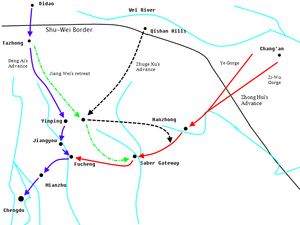 Combat scheme | |||
| date of | 263 | ||
| A place | western china | ||
| Total | Shu is attached to Wei | ||
| Opponents | |||
| |||
| Commanders | |||
| |||
| Forces of the parties | |||
| |||
Content
- 1 Background
- 2 Course of events
- 2.1 General strategic situation
- 2.2 Wei Kingdom Plan
- 2.3 Plan of the Shu Kingdom
- 2.4 Prelude to war
- 2.5 Offensive by Zhong Hui
- 2.6 Offensive by Dan Aya
- 2.7 Fall of Shu
- 3 Summary and Consequences
Background
In 220, Cao Pei , having deposed the last emperor of the Han dynasty , proclaimed himself emperor and began to rule as emperor of the state of Wei . Another, Liu Bei , who claimed to be related to the ruling house of Han, soon declared himself the ruler of the southwestern part of the country where the Shu state was formed. The third, Sun Quan , became the ruler of southeastern China, the Wu kingdom, with its capital in Nanjing .
Since the Wei state was the strongest of the three kingdoms, Chancellor Zhuge Liang from the Shu kingdom initiated an alliance between his state and the U kingdom, and tried to capture Wei , but he did not succeed. After the death of Zhuge Liang, Jiang Wei from the same Shu kingdom continued his work, but he also failed to crush Wei. These campaigns drained the kingdom of Shu, while its incompetent ruler Liu Shan was mired in entertainment and abandoned state affairs.
Meanwhile, in the Wei state, the Clan of Sima, thanks to many years of political maneuvering, managed to remove the emperors from real power. Regent of the kingdom of Wei Sima Zhao decided that the successful unification of China will raise the prestige of his family and show that the "mandate of Heaven" has passed to the Sima clan, which will facilitate the formal transfer of the throne. Annoyed by the constant attacks of Jiang Wei and aware of the internal decline of Shu, Sima Zhao decided that conquering Shu would be an important step in the unification of the Celestial Empire.
Event
In 262, Sima Zhao announced his intention to conquer Shu. Most of the members of the imperial court were against it, including General Deng Ai , who had been at the forefront of the struggle against Shu in past years, but Zhong Hui spoke in support of the plan, and this was a decisive factor in the court's inclination in support of the decision of Sima Zhao. Then, Sima Zhao sent his personal secretary Shi Quan to the army of Deng Ai, and he managed to reverse Deng Ai's opinion in favor of the campaign.
General strategic situation
The decision to attack Shu was the result of a thorough analysis of the strategic situation. The third of the Chinese kingdoms (Wu kingdom) was separated by a strategic barrier - the Yangtze River - and had a powerful river fleet of five thousand ships. Wei did not have a fleet, therefore, in order to attack Wu, it was first necessary to build ships and train sailors, and the attack on Shu could be carried out by land. With the elimination of Shu, the kingdom of Wei could concentrate efforts against Wu without a threat from the west. Shu was the smallest of the kingdoms of the Three Kingdoms era, his army totaled only 100 thousand people, which amounted to less than half of the 230 thousandth army of Wei.
Wei Kingdom Plan
To disguise his real intentions, Sima Zhao placed General Tang Tzu at the head of the construction of a powerful fleet to imitate the preparation of the campaign against the kingdom of W. Actually, the 200,000-strong army under the command of Zhong Hui concentrated in Guanzhong .
The main blow was to be delivered from the east by Hanzhong through three mountain passes, after which the combined forces were to attack the center of Shu. The Western force must strike from four directions to defeat Jiang Wei in Tazhong, and then unite with the main forces. The group of forces in the center was supposed to hit the Ujie bridge, cutting off Jiang Wei's retreat and preventing him from blocking the path of the main attacking group.
Shu Kingdom Plan
In the past, Wei Yan developed a mechanism to repel enemy intrusions by creating "sheltered camps" near the paths leading to Hanzhong. Even after Wei died, Yang Shu continued to adhere to this strategy, and successfully repelled Wei's invasions. However, Jiang Wei stated that Wei Yan’s construction "can only repel the enemy, but does not give much benefit." In the event of an attack from the kingdom of Wei, Jiang suggested leaving the camps created by Wei Yan and leaving passages in the Qinling mountains free so that the Wei troops could reach the Hanzhong plain, where they would be vulnerable to a counterattack by the Shu kingdom. However, Jiang Wei's strategy failed due to the fact that the kingdom of Wei mobilized forces of a size that he could not imagine.
Before the Wei invasion, Jiang Wei received information from the intelligence that Wei was preparing a large attack, and wrote to the emperor in Chengdu so that Liao Hua would be sent with troops to the Yan'an passage, and Zhang Yi to Yinping. However, Liu Shan trusted the eunuch Huang Hao , who believed in magic. Huang Hao believed that Wei would not dare to attack Shu, and this confidence was confirmed by the shaman asked. As a result, Jiang Wei's letter was kept secret "so as not to raise unnecessary panic." However, after some reflection, Liu Shan still sent Liao Hua and Zhang Yi with the troops.
Prelude to War
In the fall of 263, the imperial court of Wei issued a formal decree on the war with Shu. Xu Yi (son of Xu Chu ) was placed at the head of the construction of tracks for the Wei army. However, the roads turned out to be poorly constructed, and one of the bridges almost broke when Zhong Hui passed on it. As a result, Xu Yi was executed on the orders of Zhong Hui, which shocked many, but Zhong Hui thereby raised his own authority, and in fear of severe punishment, roads began to be built with much greater efficiency.
When the Wei troops moved to Shu, the Jian Wei plan worked halfway - the Wei troops freely reached the Han and Yue fortresses, where the Shu troops retreated, and then cut off the Wei’s retreat route. The Shu kingdom also requested help from the U kingdom, which quickly attacked the Wei kingdom in the east to divert Wei forces. The commander of the kingdom's forces, Wu Ding Feng Sr., attacked Shouchun, while Generals Liu Ping and Shi Ji attacked the Southern Region, and Ding Feng Jr. and Sun Yi attacked Mianzhong. However, Wei was ready for these attacks, and they did not affect the general course of the war.
Zhong Hui's Offensive
Things on the eastern front, where the main blow was inflicted, did not go exactly as Jiang Wei expected. When Zhong Hui reached the fortresses of Han (defended by Jiang Bin) and Yue (defended by Wang Han), he did not fall into the trap set for him, but left the 10,000th unit under Li Fu to block the Yue fortress, and the 10,000th unit under Xun Kaya to block the Han fortress, and he continued the offensive. The uninitiated Shu commanders carried out Jiang Wei’s order on the defense of cities, and thereby allowed the main forces of the enemy to go further.
Jiang Wei asked Emperor Liu Shan to send Liao Hua with troops to Yinping, but he instead sent Liao Hua to Tazhong to save Jiang Wei from total destruction. The forces of Jiang Wei suffered serious losses under the blows of the Wei generals Wang Qi and Yang Qu, but still managed to retreat. Meanwhile, the Wei General Zhuge Xu captured the Yinping Bridge. To force him to open the passage, Jiang Wei led his troops from the Kunhan Gorge to the rear of Zhuge Xu's troops, as if about to cut their communications. Fearing this, Zhuge Xu withdrew his troops 15 km, and Jiang Wei immediately turned back and passed through the bridge. When Zhuge Xu realized what was happening, Jiang Wei's troops were already far away.
Zhong Hui arrived in Yan'an , overcoming the resistance of Dong Jue and Zhang Yi . Moving deep into the enemy’s territory lengthened communications, which could eventually lead to a retreat due to supply problems, and therefore he sent the vanguard under the command of Hu Le to capture Guancheng, where the supplies of the Shu army were stored. There, Jiang Shu , unhappy that he was placed under the command of Fu Qian , went over to the side of Wei and opened the city gates. Fu Qian put up fierce resistance, but died in battle, and the Shu army had food supplies at the disposal of the Wei army; Zhong Hui's food problems were temporarily resolved. Meanwhile, Jiang Wei was still halfway to the main battle sites. Upon learning of the fall of Guancheng, he changed direction and went to Jiang , where he hoped to detain the enemy.
The successes in Hanzhong gave Sima Zhao grounds for accepting the Jin-gong (晉 公) title in Luoyang on October 22, 263. However, the advance of Zhong Hui to Chengdu was stopped by the Shushki troops under Jiang, and the situation became stalemate.
Offensive Dan Aya
When Deng Ai reached Yinping, he invited Zhuge Xu to go with him through Jianyu directly to Chengdu, leaving Jiange aside. However, Zhuge Xu found Deng Ai's plan too risky. Stating that the order he received was to destroy Jiang Wei’s troops, he went east to join Zhong Hui. However, Zhong Hui, wanting to get his troops under his arm, secretly informed the capital about the cowardly refusal of Zhuge Xu to cooperate with Deng Ai. As a result, Zhuge Xu was sent to Luoyang under arrest, and the command over his troops was transferred to Zhong Hui. However, numerical superiority did not help: the mountainous area contributed to the defenders, and the 50,000th army of Jiang Wei successfully defended under Jiangge against the 130,000th army of Zhong Hui. Moreover, with the increase in the number of troops, the problems with their food supply increased so much that Sima Zhao was about to command a retreat. Believing that the idea of Deng Ay was still unrealizable, Zhong Hui allowed him to go to Chengdu via Jianyu, and even allocated additional troops.
The terrain that Dan Ay was going to go on was almost impassable. Even if troops could be led along mountainous terrain, deprived of supplies they would become easy prey for the enemy. However, it was for this reason that Shu troops were not there; moreover, aware of Zhong Hui's supply problems, Shu hoped that the Wei troops would soon retreat. As a result, the troops needed to protect the capital of the kingdom were not allocated.
The troops of Deng Aya, led by him personally, reached Jiangyu after a 350-kilometer crossing in October 263. Shocked by their appearance in the deep rear, Ma Miao , who was responsible for Jiang, surrendered without a fight. Deng Ai’s troops received much-needed rest and food, after which they continued their movement to Chengdu. Zhuge Zhan (son of Zhuge Liang), who was in Fuchen with the army, tried to stop Deng Ai in the Mianzhu pass, but was defeated and died in battle. The path to Chengdu was open.
Fall of Shu
The Shu troops were far away at the front, and the appearance of Deng Ai's troops in Luo caused a panic at the Shu imperial court. Some offered to leave for Nanzhong (the border region at the junction of the modern provinces of Sichuan , Yunnan and Guizhou ), others - to escape to the eastern kingdom of Wu, but Emperor Liu Shan eventually decided to capitulate. First, he sent Zhang Shao (the second son of Zhang Fei ) and Dan Liang (son of Dan Zhi ) to Dan Ayu in Lu with the imperial seal of Shu, announcing his intention to surrender, and then went there personally, with his hands tied behind and a coffin in front (which symbolized willingness to accept death). Dan Ai accepted his surrender, untied his hands and burned the coffin.
Jiang Wei, meanwhile, continued to defend himself in Jiange against Zhong Hui. At first, he received news of the defeat of Zhuge Zhang, but he did not have information about the fate of the emperor. He decided to retreat from Jiangge, so as not to be caught in the enemy from two sides, and successfully reached Bazhou . Arriving in Qi County , he received an imperial decree ordering him to surrender.
Meanwhile, General Sheng Xian from the Wu kingdom, under the pretext of help and support, led his army to the Shu garrison in Yunan, hoping to extend the line of defense of the Wu kingdom along the Yangtze to the west. Luo Xian , who ruled Badong , decided that the U.S. allies were not trustworthy, built a line of defense against Wu and surrendered to Wei, following the last imperial decree of Liu Shan. The U.S. forces, under the command of Lu Kang, besieged the garrison for six months, until the Wei General Hu Le threatened their supply lines, and they were forced to retreat.
Summary and Consequences
The rivalry between Deng Ai and Zhong Hui during the conquest of Shu led to the fact that shortly after the fall, Shu Zhong Hui rebelled against Wei , hoping to become an independent ruler on the territory of the conquered Shu.