Monkey Campbell [1] ( lat. Cercopithecus campbelli ) - a species of primates from the monkey family.
| Monkey Campbell |
 |
| Scientific classification |
|---|
| No rank : | Bilateral symmetrical |
| Squadron : | Euarchontoglires |
| Parvotryad : | Narrow-nosed monkey |
|
| International scientific name |
|---|
Cercopithecus campbelli Waterhouse , 1838 |
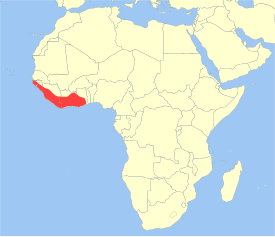
| Joint area of Cercopithecus campbelli and Cercopithecus lowei |
|---|
|
| Security status |
|---|
Least ConcernedIUCN 3.1 Least Concern : 136930 |
|
Content
Classification of the species is debatable. Some primatologists (Grubb et al. 2003) distinguish two subspecies: Cercopithecus campbelli campbelli and Cercopithecus campbelli lowei , [2] while others (Kingdon 2001, [3] Groves 2005 [4] ) distinguish Cercopithecus lowei as a separate species.
The coat is brown, the lower part of the body is lighter than the upper. The tail is long, straight. [5] Has cheek pouches in which to store excess food. [6]
The range extends across West Africa from the Gambia and Senegal to the north of the Casamance River to the Volta River. Campbell's monkeys inhabit various types of rainforests, including primary and secondary forests, mangroves , savannahs, and shrubby farmland borders. [7]
Daytime animals. In the diet, fruits, leaves and wood juices. They form groups ranging in size from 8 to 13 individuals protecting their territory. Not only the mother takes care of the offspring, but all the females from the group. [8] There are two types of groups, in the first one male, a harem of females and their offspring, in the second group made up exclusively of males. [9] There is one cub in the litter. [10] Research conducted in 2009 showed that the sound system of these monkeys is one of the most complex in the animal world. The rudiments of the syntactic structure are even present in it. [eleven]
- ↑ Sokolov V.E. The pagan dictionary of animal names. Mammals Latin, Russian, English, German, French. / edited by Acad. V. E. Sokolova. - M .: Rus. lang., 1984. - S. 90. - 10,000 copies.
- ↑ Grubb, P., Butynski, TM, Oates, JF, Bearder, SK, Disotell, TR, Groves, CP and Struhsaker, TT Assessment of the Diversity of African Primates // International Journal of Primatology. - 2003. - No. 24 (6) . - S. 1301-1357 .
- ↑ Kingdon, J. The Kingdon Field Guide to African Mammals. - San Diego, California, USA: Academic Press Natural World, 1997.
- ↑ Groves, CP Primate taxonomy. - Washington, DC, USA: Smithsonian Institution Press, 2001.
- ↑ Lowe's Guenon (Cercopithecus campbelli lowei)
- ↑ Campbell's Monkey (Cercopithecus campbelli)
- ↑ Cercopithecus campbelli . The IUCN Red List of Threatened Species .
- ↑ Bourliere, F., Hunkeler, C., and Bertrand, M. Ecology and Behavior of Lowe's Guenon (Cercopithecus campbelli lowei) in the Ivory Coast // Old World Monkeys. - Academic Press, 1970.
- ↑ Cords, M. Forest Guenons and Patas Monkeys: Male-Male Competition in One-Male Groups // Primate Societies. - University of Chicago Press, 1987.
- ↑ Estes, RD The Behavior Guide to African Mammals. - University of California Press, 1991.
- ↑ Karim Ouattara, Alban Lemasson, Klaus Zuberbühler. Campbell's Monkeys Use Affixation to Alter Call Meaning // PLoS ONE. - 2009. - No. 4 (11) . - DOI : 10.1371 / journal.pone.0007808 . - arXiv : kari2009 .