Reionization (epoch of reionization [1] , re-ionization [2] , secondary ionization of hydrogen [3] ) is the period of the history of the Universe (epoch) between 550 Ma [4] and 800 Ma after the Big Bang (approximately, the red shift from before ) [2] . Reionization is preceded by the Dark Ages . And after it - the current era of matter . First stars (population stars III), galaxies [5] , quasars [6] , clusters and superclusters of galaxies are formed . Reionization of hydrogen by the light of stars and quasars. The rate of reionization depended on the rate of formation of objects in the Universe [7] . Due to gravitational attraction, matter in the Universe begins to be distributed among isolated clusters (“ clusters ”). Apparently, the first dense objects in the dark universe were quasars . Then, early forms of galaxies and gas-dust nebulae began to form. Begin to form the first stars in which the synthesis of elements heavier than helium . In astrophysics it is accepted to call any elements heavier than helium "metals" (see metallicity ).


On July 11, 2007, Caltech at the 10-meter Keck II telescope discovered 6 star clusters that were formed 13.2 billion years ago. Thus, they arose when the universe was only 600 million years old [8] .
Content
Star Formation


Star formation is an astrophysical term for a large-scale process in a galaxy in which stars start to form in large quantities from interstellar gas [9] . The spiral branches , the general structure of the galaxy , the stellar population , the luminosity and chemical composition of the interstellar medium are all the result of this process. [ten]
The size of the region covered by star formation, as a rule, does not exceed 100 pc. However, there are complexes with a star formation flare, called super-associations, with dimensions comparable to an irregular galaxy.
In our and several nearby galaxies, direct observation of the process is possible. In this case, signs of star formation occurring are [11] :
- the presence of stars of the OBA spectral classes and related objects (HII regions, flares of new and supernova stars );
- infrared radiation , both from heated dust and from young stars themselves;
- radio emission of gas and dust disks around emerging and newborn stars;
- Doppler splitting of molecular lines in a rotating disk around stars;
- Doppler splitting of molecular lines of thin fast jets ( jets ) escaping from these disks (from their poles) at a speed of about 100 km / s;
- the presence of associations, clusters and star complexes with massive stars (massive stars are almost always born in large groups);
- presence of globules .
As the distance increases, the apparent angular size of the object also decreases, and, starting from a certain moment, it is not possible to discern individual objects inside the galaxy. Then the criteria for star formation in distant galaxies are [9] :
- high luminosity in emission lines , in particular, in H α ;
- increased power in the ultraviolet and blue parts of the spectrum , for which the emission of massive stars directly corresponds;
- increased radiation at wavelengths in the vicinity of 8 μm ( IR );
- increased power of thermal and synchrotron radiation in the radio band ;
- increased x-ray power associated with hot gas .
In general, the star formation process can be divided into several stages: the formation of large gas complexes (with a mass of 10 7 M ʘ ), the emergence of gravitationally bound molecular clouds in them, the gravitational compression of their most dense parts before the emergence of stars, the heating of gas by new stars and supernovae, gas withdrawal.
The most common star-forming region can be found [11] :
- in the nuclei of large galaxies,
- at the ends of the spiral sleeves,
- on the periphery of irregular galaxies,
- in the brightest part of the dwarf galaxy .
Star formation is a self-regulating process: after the formation of massive stars and their short life, a series of powerful flashes occur, condensing and heating the gas. On the one hand, compaction accelerates the compression of relatively dense clouds inside the complex, but on the other hand, the heated gas begins to leave the star-forming region, and the more it is heated, the faster it leaves.
The most massive stars live a relatively short time - several million years . The fact of the existence of such stars means that the processes of star formation were not completed billions of years ago , but take place in the present epoch.
The stars, the mass of which many times exceeds the mass of the Sun , most of their lives are of enormous size, high luminosity and temperature . Because of the high temperature, they have a bluish color , and therefore they are called blue supergiants . Such stars, heating the surrounding interstellar gas, lead to the formation of gas nebulae . During its relatively short life, massive stars do not have time to shift a considerable distance from the place of their origin, so bright gas nebulae and blue supergiants can be considered as indicators of those areas of the Galaxy where star formation has occurred or is happening now.
Young stars are distributed in space in a non-random manner. There are vast areas where they are not observed at all, and areas where there are relatively many of them. Most blue supergiants are observed in the region of the Milky Way , that is, near the galactic plane, where the concentration of gas-dust interstellar matter is particularly high.
But even near the galactic plane, young stars are unevenly distributed. They almost never meet alone. Most often, these stars form scattered clusters and more rarefied stellar groups of large sizes, called stellar associations , which number tens and sometimes hundreds of blue supergiants. The youngest of the star clusters and associations are less than 10 million years old. In almost all cases, these young formations are observed in areas of high density of interstellar gas. This indicates that the star formation process is associated with interstellar gas.
An example of a star formation area is a giant gas complex in the constellation of Orion. It occupies almost the entire area of this constellation in the sky and includes a large mass of neutral and molecular gas , dust and a whole series of bright gas nebulae. The formation of stars in it continues at the present time.
Basic Information
To begin the process of star formation from interstellar gas-dust nebulae in galaxies requires the presence of matter in space, which is in a state of gravitational instability for one reason or another. [12] For example, the explosions of supernova types Ib \ c and II close to a cloud, proximity to massive stars with intense radiation and the presence of external magnetic fields, such as the magnetic field of the Milky Way , can serve as a trigger. Basically, star formation occurs in clouds of ionized hydrogen or H II regions . Depending on the type of galaxy , intense star formation occurs either in randomly distributed areas, or in areas arranged into spiral structures of galaxies. [13] Star formation has the character of “local flares”. The “flare” time is short, on the order of several million years, the scale is up to hundreds of parsecs . [ten]
The composition of the areas of interstellar gas from which stars were formed determines their chemical composition, which allows dating of the formation of a particular star or attributing it to a certain type of stellar populations . Older stars were formed in areas in which practically there were no heavy elements and, accordingly, are deprived of these elements in their atmospheres , which is determined on the basis of spectral observations . In addition to the spectral characteristics, the initial chemical composition of the star affects its further evolution and, for example, the temperature and color of the photosphere .
By the number of stars of a population, the rate of star formation in a certain area is determined over a long period of time. The total mass of emerging stars in one year is called the star formation rate (SFR, Star Formation Rate).
The process of star formation is one of the main subjects of the study of astrophysics . From the point of view of the evolution of the universe, it is important to know the history of the rate of star formation . According to modern data, stars with masses of 1 - 10 M ☉ are predominantly formed in the Milky Way.
Basic Processes
The basic processes of star formation include the emergence of gravitational instability in the cloud, the formation of an accretion disk and the onset of thermonuclear reactions in a star. The latter is also sometimes called the birth of a star . The beginning of thermonuclear reactions, as a rule, stops the growth of the mass of the forming celestial body and contributes to the formation of new stars in its vicinity (see, for example, the Pleiades , Heliosphere ).
Star Formation
In contrast to the term Star Formation , the term Star Formation refers to the physical process of the formation of specific stars from gas-dust nebulae .
The emergence and evolution of galaxies
The emergence of galaxies - the emergence of large gravitationally- related clusters of matter , which took place in the distant past of the universe . It began with the condensation of a neutral gas, starting with the end of the Dark Ages [5] . At the moment, there is no satisfactory theory of the origin and evolution of galaxies. There are several competing theories explaining this phenomenon, but each has its own serious problems.


As the data on the relic background show, at the time of separation of radiation from matter, the Universe was actually homogeneous, the fluctuations of matter were extremely small, and this is a significant problem. The second problem is the cellular structure of superclusters of galaxies and at the same time sphere-like - in clusters of smaller sizes. Any theory trying to explain the origin of the large-scale structure of the Universe must necessarily solve these two problems (and also correctly model the morphology of galaxies).
The modern theory of the formation of large-scale structure, as well as individual galaxies, is called “hierarchical theory”. The essence of the theory is as follows: at the beginning, the galaxies were small in size (approximately like the Magellanic cloud ), but over time they merge to form all large galaxies.
Recently, loyalty to the theory has been called into question and downsizing has contributed to this to no small degree. However, in theoretical studies, this theory is dominant. The most striking example of such a study is the Millennium simulation (Millennium run) [14] .
Hierarchical Theory
According to the first, after the appearance of the first stars in the Universe, the process of the gravitational unification of stars into clusters and further into galaxies began. Recently, this theory has been questioned. Modern telescopes are able to "look" so far that they see objects that existed approximately 400 thousand years after the Big Bang . It was found that at that time there were already formed galaxies. It is assumed that too little time has passed between the appearance of the first stars and the aforementioned period of the Universe development, and the galaxies would not have time to form.
General Provisions
Any theory, one way or another, assumes that all modern formations, starting from stars and ending with superclusters, were formed as a result of the collapse of the initial perturbations. The classic case is the Jeans instability , in which an ideal fluid is considered, which creates a gravitational potential in accordance with the law of Newton. In this case, it follows from the hydrodynamic and potential equations that the size of the perturbation at which the collapse begins is [15] :
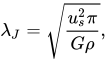
where u s is the speed of sound in the medium, G is the gravitational constant, and ρ is the density of the unperturbed medium. A similar consideration can be carried out against the background of the expanding Universe. Due to the convenience, in this case the relative fluctuation value is considered. Then the classical equations will take the following form [15] :

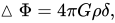
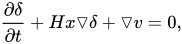

This system of equations has only one solution, which increases with time. This equation of longitudinal density fluctuations:

From it, in particular, it follows that fluctuations of exactly the same size as in the static case are unstable. And perturbations grow in a linear or weaker manner, depending on the evolution of the Hubble parameter and energy density.
The Jeans model adequately describes the collapse of disturbances in a nonrelativistic medium if their size is much smaller than the current event horizon (including for dark matter during the radiation-dominated stage). For opposite cases, it is necessary to consider exact relativistic equations. The energy-momentum tensor of an ideal fluid with small density perturbations

covariantly preserved, from which the hydrodynamic equations follow, generalized for the relativistic case. Together with the equations of GR, they represent the initial system of equations determining the evolution of fluctuations in cosmology against the background of Friedman's solution [15] .
Inflation Theory
Another common version is as follows. As is known, quantum fluctuations constantly occur in a vacuum. They also occurred at the very beginning of the Universe, when there was a process of inflationary expansion of the Universe, expansion with superlight speed. This means that the quantum fluctuations themselves have expanded, and to sizes that may be 10 10 12 times the initial one. Those of them that existed at the time of the cessation of inflation remained “bloated” and thus turned out to be the first indistinguishable inhomogeneities in the Universe. It turns out that matter had about 400 thousand years for gravitational compression around these inhomogeneities and the formation of gas nebulae . And then began the process of the emergence of stars and the transformation of nebulae into galaxies.
Protogalakage

Protogalaxy ( “primitive galaxy” ; English protogalaxy, primeval galaxy ): in physical cosmology , a cloud of interstellar gas at the stage of transformation into a galaxy . It is believed that the star formation rate during this period of galactic evolution determines the spiral or elliptical shape of the future star system (slower star formation from local bunches of interstellar gas usually leads to the appearance of a spiral-shaped galaxy). The term “protogalactica” is mainly used in the description of the early phases of the development of the Universe within the framework of the Big Bang theory.
Study
The Webb telescope will be able to tell about when and where the reionization of the Universe began and what caused it [16] .
Notes
- ↑ S. B. Popov. ANK of the Day Astronomical Scientific Picture of the Day . Galaxy in the twilight zone . Astronet, " Trinity Option-Science " (October 22, 2010). The date of circulation is January 29, 2014. Archived November 29, 2013.
- ↑ 1 2 N.T. Ashimbaev. The most distant quasar is found . Astronet (July 5, 2011). The date of circulation is January 29, 2014. Archived on March 5, 2012.
- ↑ D.S. Gorbunov, V.A. Rubakov. Scalar perturbations: results for one-component media. // Introduction to the theory of the early Universe: Cosmological perturbations. Inflationary theory. - Moscow: LKI, 2008. - 552 p. - ISBN 978-5-396-00046-9 .
- Are Stars are younger: 'Reionization' is more recent than predicted . phys.org . The appeal date is December 27, 2017.
- ↑ 1 2 N.T. Ashimbaev. The most distant, most desirable . Astronet (May 7, 2009). The date of circulation is January 29, 2014. Archived March 14, 2012.
- ↑ Sergey Popov, Maxim Borisov. How the Universe expanded in 2010 . Galaxies: active and not very . Elements.ru , the “Trinity Option” (January 18, 2011). The date of circulation is February 3, 2014. Archived on February 3, 2014.
- ↑ Type of hidden mass and detailed ionization balance . The date of circulation is February 1, 2014. Archived February 1, 2014.
- ↑ Astronomers discovered the most distant and ancient galaxies . Membrane (July 11, 2007). The appeal date is February 4, 2014. Archived April 16, 2012.
- ↑ 1 2 A.V. Zasov, K.A. Postnov. Galaxies and clusters of galaxies // General Astrophysics. - Fryazino: Century 2, 2006. - p. 356-359. - ISBN 5-85099-169-7 .
- ↑ 1 2 A.V. Zasovb K.A. Postnov General Astrophysics 356
- ↑ 1 2 Yu. A. Nasimovich. Stars / How stars are born . Archived August 11, 2011.
- ↑ Star Formation , Astronet
- ↑ The latter takes place in the Milky Way, which is a spiral galaxy .
- Formula Theory And Observation . - Journal of Cosmology, 2010.
- ↑ 1 2 3 D.S. Gorbunov, V.A. Rubokov. Jeans instability in the Newtonian theory of infancy // Introduction to the theory of the early Universe: Cosmological perturbations. Inflationary theory. - Moscow: Krasnad, 2010. - 568 p. - ISBN 978-5-396-00046-9 .
- B Webb Science: The First Light and Reionization Unopened . NASA . The appeal date is March 18, 2013. Archived March 21, 2013.
Links
- Lecture arxiv: 0711.3463 Borders of Reionization: Theory and Future Observations (The Frontier of Reionization: Theory and Forthcoming Observations) . Astronet . The date of circulation is January 29, 2014. Archived January 29, 2014.
- End of the Dark Ages
- LOFAR EoR , the site of a reionization era research team using LOFAR.
- PAPER official website