Crash DHC-6 on Moorea - an aircraft crash that occurred on Thursday , August 9, 2007 off the coast of the island of Moorea ( French Polynesia ). Airliner De Havilland Canada DHC-6-300 of Air Moorea operated a short passenger flight QE 1121 along the Moorea – Papeete route, but lost control several seconds after take-off at an altitude of 90-120 meters, went into a dive and crashed into water about 700 meters from the coast. Killing all 20 people on board - 19 passengers and 1 crew member [1] .
| Flight 1121 Air Moorea | |
|---|---|
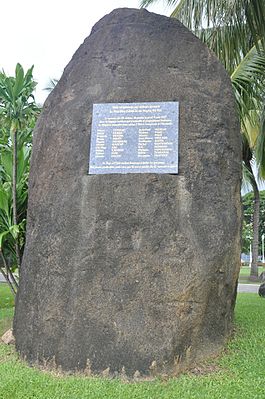 Memorial Flight 1121 | |
| General information | |
| date | August 9, 2007 |
| Time | 22:01 UTC |
| Character | Crash after take-off |
| Cause | LOC-I (loss of control) |
| A place |  700 m from the coast of Moorea ( French Polynesia ) 700 m from the coast of Moorea ( French Polynesia ) |
| Coordinates | |
| Dead | 20 (all) |
| Aircraft | |
 A crashed plane 4 months and 13 days before the crash | |
| Model | De Havilland Canada DHC-6-300 |
| Airline | Air moorea |
| Departure point | Moorea |
| Destination | Faaa , Papeete |
| Flight | QE 1121 |
| Board number | F-oiqi |
| Date of issue | February 2, 1979 (first flight) |
| Passengers | nineteen |
| Crew | one |
| Survivors | 0 |
Content
Aircraft
De Havilland Canada DHC-6 Twin Otter 300 (DHC-6-300) (registration number F-OIQI, serial 608) was released in 1979 (the first flight took place on February 2). Prior to operating at Air Moorea, it was operated by parachuting in the United States under DPN N228CS. October 3, 2006 was sold to the airline of French Polynesia Air Moorea , while its tail number was changed to F-OIQI. The aircraft was designed to be controlled by one person, and the passenger capacity of the cabin was 19 seats. The weight of the empty aircraft was 3544 kilograms, and the maximum take-off weight was 5670 kilograms. On March 11, 2005, when the aircraft had already completed 48,674 take-off and landing cycles and flew 29,652 hours, stainless steel control cables were installed on it. At Air Moorea, this was the only such aircraft, since on other aircraft the cables were made of ordinary carbon steel. It is equipped with two Pratt & Whitney Canada PT6A-27 turboprop engines , which on the day of the disaster had 5146 take-off and landing cycles and 841 hours. The liner itself on the day of the disaster completed 55,044 take-off and landing cycles and flew 30,833 hours 51 minutes [2] . At the time of admission to Air Moorea, it completed 49,898 take-off and landing cycles and flew 30,005 hours 10 minutes [3] .
Pilot Information
The aircraft was flown by 53-year-old pilot Michel Santurenne ( fr. Michel Santeurenne ). He received a commercial pilot license for the first time on October 16, 1992 in Canada, and then again on May 30, 1997 in France. In the same year it was certified for flights on multi-engine aircraft. He was certified at DHC-6 on May 18, 2007 after 9,300 hours of practice, worked at Air Moorea from May 28 to May 30, 2007, before that he worked at Finist'air . According to the data, 3514.5 hours flew on the day of the disaster, during the period of work in Air Moorea made 23 short flights with a total duration of 7.8 hours [4] [2] .
Holocaust
On Thursday, August 9, 2007, De Havilland Canada DHC-6-300, the F-OIQI operated scheduled passenger flight QE 1121. This flight was supposed to be operated from Moorea airport (Moorea island) to Faaa (Tahiti island) according to the rules of visual flights to cruising altitude of about 180 meters, and the flight duration was only 7 minutes. In total, there were 1 pilot and 19 passengers on board the aircraft [5] .
At 11:53:22 (21:35:22 UTC) the engines were started, after which the pilot in English and French made an announcement: Ladies and gentlemen, hello and welcome aboard. Please fasten your seat belts . Then, at 11:57:19, the dispatcher gave permission to follow the Bravo runway 12 preliminary launch, and at 11:58:10 permission was given to take an executive start. DHC-6 taxied to the lane and stood at the level of the second taxiway [5] .
At 12:00:06 permission was given to take off, after which after 6 seconds the engine operating mode was increased. At 12:00:58, after takeoff, the flaps were removed, and at 12:01:07 the engine mode was reduced. But then, after a couple of seconds, at a flight altitude, a pilot exclaimed in surprise. The ground hazard warning system ( GPWS ) issued two warning signals, and then the propeller speed increased. After four more GPWS signals, flight QE 1121 at 12:01:20, that is, 1 minute 20 seconds after the start of take-off, crashed into water. All 20 people on board died [5] .
Exploration work
When conducting search operations, rescuers and fishermen found 14 bodies, as well as parts of the right main gear and seat cushions. A few days later, during the work on lifting the flight recorders , the 15th body was found. In total, apart from the recorders, both engines, the dashboard, the front part of the cabin, including the controls, the screw jacks of the flaps and the tail part, were lifted. When lifting debris, it was noted that the control cables for elevators and directions turned out to be torn in front of [5] .
Investigation
The investigation into the causes of the QE 1121 crash was undertaken by the Civil Aviation Safety Investigation and Analysis Bureau (BEA) .
During the investigation, the BEA concluded that at the time of flap retraction, the tail rudder control cables were broken and the DHC-6 aircraft tended to “peck” at the time of flap retraction, which caused the airliner to lower its nose and go into a dive. The cable breakage occurred due to their significant wear. Air Moorea did not know that the F-OIQI is the only aircraft in their fleet that has stainless steel cables, and therefore, unlike high-carbon steel cables on other aircraft, they are not subject to rapid corrosion in salty climates, however wear out faster. The cable breakage was also accompanied by the fact that on the night before the crash, the F-OIQI board, when parked at the Faaa airport, fell into the satellite stream of the Airbus A340 that was taxiing around the airport. A powerful stream of exhaust gases coming out of the Airbus engines hit the control surfaces of a small aircraft, which led to a strong weakening of the cables [6] [7] .
The disaster was also contributed by such factors as an insufficient assessment by air traffic controllers and pilots of the danger of light aircraft getting into the jets of a jet aircraft, the airline's refusal to conduct special inspection inspections, and the fact that the replacement of stainless steel cables depended on the calendar date and not on the number of cycles [ 7] [8] .
The final report of the BEA investigation was published on December 4, 2008.
Cultural Aspects
The crash of Flight 1121 Air Moorea is shown in season 13 of the Canadian documentary television series Investigation of the Crash in the Nightmare in Paradise series.
Notes
- ↑ Rapport , p. 7.
- ↑ 1 2 Rapport , p. 13.
- ↑ Rapport , p. 14.
- ↑ Rapport , p. 12.
- ↑ 1 2 3 4 Rapport , p. eleven.
- ↑ Rapport , p. 67.
- ↑ 1 2 Rapport , p. 68.
- ↑ Rapport , p. 69.
Links
- Accident du DHC6 - 300 survenu au large de l'île de Moorea (Polynésie française) le 9 août 2007 (Fr.) (link not available) . Bureau for the Investigation and Analysis of the Safety of Civil Aviation (4 décembre 2008). Date of treatment January 26, 2014. Archived February 2, 2014.
- Rapport Final (Fr.) (4 décembre 2008). - The final report in French. Date of treatment January 26, 2014.
- Final Report (English) (December 4, 2008). - The final report in English. Date of treatment January 26, 2014.