Echinococcus granulosus (lat.) Is a species of tapeworms of the cyclophillid order ( Cyclophyllidea ). In adulthood, it parasitizes in the intestines of dogs, wolves, jackals.
| Echinococcus granulosus |
Histological preparation Echinococcus granulosus |
| Scientific classification |
|---|
| No rank : | Bilateral symmetrical |
| View: | Echinococcus granulosus |
|
| International scientific name |
|---|
Echinococcus granulosus ( Batsch , 1786 ) |
|
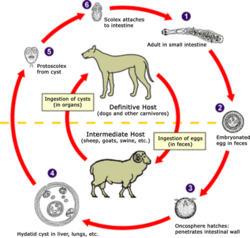
Life cycle of
E. granulosusThe body is 3-5 mm long and consists of a head (with 4 suction cups and 2 rims of hooks) and 3-4 joints. The last (single, mature) segment is half the length of the body. Echinococcus eggs leave the intestines of the host along with excrement and can get on its coat. An intermediate host of echinococcus is a cow, a sheep, a pig, etc.
Animals, as well as humans, become infected by swallowing Echinococcus eggs. In the intestines of the intermediate host, an oncosphere larva emerges from the egg. Through the intestinal wall, it enters the portal vein system and is introduced into the liver with blood, less often into the lungs, muscles, bones or other organs. Here it develops into the bladder stage, which is also called echinococcus. Each oncosphere forms a bubble, secondary and even tertiary bubbles form on its walls, on which many heads similar to those of adult worms are formed. Echinococcus vesicles grow very slowly and can reach large sizes. The final host becomes infected with echinococcus when a sick animal containing the bladder stage of this parasite eats.
The diversity of the structure of the vesiculate stages of Echinococcus granulosus suggests the existence of two separate species - Echinococcus unilocularis (single-chamber echinococcus) and Echinococcus multilocularis (multi-chamber echinococcus). The latter is sometimes allocated in an independent genus - Alveococcus .
