Hoffmans jumper [2] ( lat. Plecturocebus hoffmannsi ) is a species of primates from the Sak family. In 2016, according to molecular genetic studies, Byrne and colleagues transferred the species from the genus Callicebus to the genus Plecturocebus [1] .
| Hoffmans Jumper |
| Scientific classification |
|---|
| No rank : | Bilateral symmetrical |
| Squadron : | Euarchontoglires |
| Parvotryad : | Wide-nosed monkeys |
|
| International scientific name |
|---|
Plecturocebus hoffmannsi
( Thomas , 1908 ) |
| Synonyms |
|---|
- Callicebus hoffmannsi
Thomas, 1908 [1]
|
| Area |
|---|
|
| Security status |
|---|
Least ConcernedIUCN 3.1 Least Concern : 41559 |
|
Content
The color of the coat is gray and yellowish white. The upper body, head and limbs are gray, sometimes light gray. A black mark may be present on the forehead. Ears without crests. The sides, lower body and inner surface of the limbs are yellowish white. The tail is black or dark gray throughout. It differs from Plecturocebus moloch by the black color of the feet and hands of the forelimbs, as well as the black tail. It differs from Plecturocebus baptista and Plecturocebus cinerascens in the light yellow color of the lower body. It differs from Plecturocebus bernhardi in the absence of tufts around the ears and the white tip of the tail [3] .
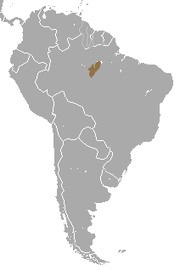
They are found in central Amazonia in Brazil south of the Amazon [4] .
Found in both primary and secondary forests. In the diet, fruits, leaves, insects and seeds. They form small family groups protecting their territory. In search of food, they cover a distance of 500 to 1,500 m per day [5] [3] .
- ↑ 1 2 Byrne H. , Rylands AB , Carneiro JC , Alfaro JW , Bertuol F. , da Silva MN , Messias M. , Groves CP , Mittermeier RA , Farias I. , Hrbek T. , Schneider H. , Sampaio I. , Boubli JP Phylogenetic relationships of the New World titi monkeys ( Callicebus ): first appraisal of taxonomy based on molecular evidence (English) // Frontiers In Zoology. - 2016. - Vol. 13 . - P. 10 . - DOI : 10.1186 / s12983-016-0142-4 . - PMID 26937245 .
- ↑ Complete Illustrated Encyclopedia. "Mammals" Prince. 2 = The New Encyclopedia of Mammals / Ed. D. MacDonald . - M .: Omega, 2007 .-- S. 457. - 3000 copies. - ISBN 978-5-465-01346-8 .
- ↑ 1 2 van Roosmalen MGM, van Roosmalen T. und Mittermeier RA A Taxonomic Review of the Titi Monkeys, Genus Callicebus Thomas 1903, with the Description of two New Species: Callicebus bernhardi and Callicebus stepehnnashi , from Brazilian Amazonia // Neotropical Primates. - 2002. - No. 10 . - P. 1-52 . Archived on October 1, 2011.
- ↑ Plecturocebus hoffmannsi (English) . The IUCN Red List of Threatened Species .
- ↑ Hershkovitz P. Origin, speciation, and distribution of South American titi monkeys, genus Callicebus (Family Cebidae, Platyrrhini) (English) // Proceedings of the Academy of Natural Sciences of Philadelphia. - 1988. - Vol. 140 , no. 1 . - P. 240—272 .