A collar jumper [1] , or a collar jumper [2] ( lat. Cheracebus torquatus ), is a species of primates from the sak family.
| Collar jumper |
 |
| Scientific classification |
|---|
| No rank : | Bilateral symmetrical |
| Squadron : | Euarchontoglires |
| Parvotryad : | Wide-nosed monkeys |
|
| International scientific name |
|---|
Cheracebus torquatus
( Hoffmannsegg , 1807 ) |
| Synonyms |
|---|
Callicebus torquatus |
| Area |
|---|
|
| Security status |
|---|
Least ConcernedIUCN 3.1 Least Concern : 41562 |
|
Content
It was originally described as part of the genus Callicebus , in which until the end of the 1980s there were only three species [3] , then the number of species rose to thirteen, among which was Callicebus torquatus with four subspecies [4] . In 2001, a subspecies of C. t. medemi was raised to the rank of Callicebus medemi species, and a year later the remaining subspecies were separated into separate species [5] . In 2016, after molecular studies, this species and several related ones were isolated into a separate genus Cheracebus . [6]
Small primates. The weight of males is from 1410 to 1722 g (average 1462), body length from 290 to 390 mm, tail length from 350 mm to 400 mm. The muzzle is practically hairless. Sexual dimorphism is not pronounced, although the fangs of males are slightly longer than that of females. The coat is red-brown or black-brown, the tail is black, with reddish hairs, the feet and hands are white [4] .
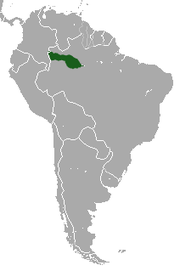
They are found in the Amazonian jungle of Colombia at an altitude of up to 500 m in Putumayo and possibly in Kaketa . In addition, in Brazil to the Rio Negro River [4] .
The diet is mainly fruit, in addition, leaves and small animals, such as insects and their larvae, spiders, small lizards. [7] The final cycle is about 16 days. During the period of sexual reciprocity (which lasts from 2 to 3 days), the clitoris and labia swell and harden, females show interest in individuals of the opposite sex [7] .
The International Union for Conservation of Nature has assigned this species a conservation status of “least concern”, but in some areas the species is vulnerable due to the destruction of its habitat [8] .
- ↑ Complete Illustrated Encyclopedia. "Mammals" Prince. 2 = The New Encyclopedia of Mammals / Ed. D. MacDonald . - M .: Omega, 2007 .-- S. 457. - 3000 copies. - ISBN 978-5-465-01346-8 .
- ↑ Sokolov V.E. The pagan dictionary of animal names. Mammals Latin, Russian, English, German, French. / edited by Acad. V. E. Sokolova. - M .: Rus. lang., 1984. - S. 88. - 10,000 copies.
- ↑ Hershkovitz P. (1963): A systematic and zoogeographic account of South American titi monkeys, genus Callicebus (Cebidae) of the Amazonas and Orinoco river basins, Mammalia 27 (1): 1–80.
- ↑ 1 2 3 Hershkovitz P. (1990): Titis, new world monkeys of the genus Callicebus (Cebidae, Platyrrhini): a preliminary taxonomic review, Fieldiana (Zoology, New Series, no. 55): 1-109.
- ↑ Van Roosmalen, MGM et al. A taxonomic review of the titi monkeys, genus Callicebus Thomas, 1903, with the description of two new species, Callicebus bernhardi and Callicebus stephennashi from the Brazilian Amazon (English) // Neotropical Primates: journal. - 2002. - Vol. 10 , no. Suppl. . - P. 1-52 . Archived on October 1, 2011.
- ↑ Byrne H. , Rylands AB , Carneiro JC , Alfaro JW , Bertuol F. , da Silva MN , Messias M. , Groves CP , Mittermeier RA , Farias I. , Hrbek T. , Schneider H. , Sampaio I. , Boubli JP Phylogenetic relationships of the New World titi monkeys ( Callicebus ): first appraisal of taxonomy based on molecular evidence (English) // Frontiers In Zoology. - 2016. - Vol. 13 . - P. 10 . - DOI : 10.1186 / s12983-016-0142-4 . - PMID 26937245 .
- ↑ 1 2 Defler TR 2003. Primates de Colombia . Conservation International, Bogota.
- ↑ Callicebus torquatus (English) . The IUCN Red List of Threatened Species .