Brown capuchin ( lat. Sapajus nigritus ) - a species of primates of the family of chain-tailed monkeys that live in South America.
| Brown capuchin |
 |
| Scientific classification |
|---|
| No rank : | Bilateral symmetrical |
| Squadron : | Euarchontoglires |
| Grand detachment : | Euarchonta |
| Parvotryad : | Wide-nosed monkeys |
| Family: | Chain-tailed monkeys |
|
| International scientific name |
|---|
Sapajus nigritus ( Goldfuss , 1809) |
| Synonyms |
|---|
Cebus nigritus |
| Subspecies |
|---|
See text |
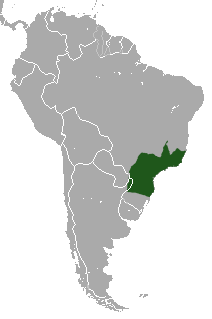
| Range of subspecies S. n. nigritus and S. n. cucullatus . S. n. robustus is found north |
|---|
|
| Security status |
|---|
Close to vulnerableIUCN 3.1 Near Threatened : 136717 |
|
Content
Representatives of the species are easily identified by the presence of two horn-like crests that adult animals possess. Brown capuchins are one of the largest representatives of their family. The coat is dark brown or black, white on the cheeks and forehead. Some individuals have a slightly lighter brown coat on the back and neck. Tail grip type. Weight from 2.2 to 3.5 kg. [one]
Form groups from 6 to 20 individuals in size. In the group of females there are usually more than males. The group is headed by a dominant female and a dominant male. [2]
A system of sounds and gestures is developed. [3]
Omnivores. In the diet, fruits, plants, insects, spiders, small vertebrates, including rodents. Spend 70 to 90 percent of the time looking for food. [one]
Pregnancy lasts from 151 to 155 days. There is usually one cub in the litter. Sexual maturity in females is reached at the age of 4 years, in males somewhat later. [four]
There are (Groves, 2001) 3 subspecies of these primates:
- Sapajus nigritus nigritus (Goldfuss, 1809)
- Sapajus nigritus cucullatus Spix, 1823 - some primatologists [5] consider it the youngest synonym for Sapajus nigritus .
- Sapajus nigritus robustus Kuhl, 1820 - some primatologists [5] consider it a separate species. Its range extends north of the range of the first two subspecies. [6]
The population size is unknown, but it is believed that it is declining due to the destruction of the habitat, hunting and illegal trade in exotic animals. [7] Two southern subspecies are quite widespread, but the International Union for Conservation of Nature has assigned them the protection status “Close to vulnerable”, since it is estimated that in 2008 the population has declined by more than 30% over the past 48 years (3 generations). The northern subspecies, considered separately, received the “Endangered” conservation status. [2]
- ↑ 1 2 Burton, M. and Burton, R. International Wildlife Encyclopedia. - New York: Marshall Cavendish, 2002.
- ↑ 1 2 Cebus nigritus . The IUCN Red List of Threatened Species .
- ↑ Lynch Alfaro, J. Scream embrace displays in wild black-horned capuchin monkeys // American Journal of Primatology. - 2008. - No. 70 (6) . - S. 551–559 .
- ↑ Di Bitetti, MS and Janson, CH Reproductive socioecology of tufted capuchins (Cebus paella nigritus) in northeastern Argentina // International Journal of Primatology. - 2001. - No. 22 (2) . - S. 127-142 .
- ↑ 1 2 Silva Jr., J. de S. (2001). Especiação nos macacos-prego e caiararas, gênero Cebus Erxleben, 1777 (Primates, Cebidae). Ph.D. thesis. Federal University of Rio de Janeiro , Brazil
- ↑ Rylands, AB, Kierulff, MCM, & Mittermeier, RA (2005). Notes on the taxonomy and distributions of the tufted capuchin monkeys (Cebus, Cebidae) of South America. Lundiana 6 (supp.): 97-110
- ↑ Wildlife as Canon sees it. na National Geographic Magazine, June 2008.
- Thomas Geissmann: Vergleichende Primatologie. Springer-Verlag, Berlin ua 2003, ISBN 3-540-43645-6 .