25 cm schwerer Minenwerfer , abbreviated 25 cm sMW ("25-centimeter heavy mortar") - German mortar mortar of the First World War .
| 25 cm schwerer Minenwerfer | |
|---|---|
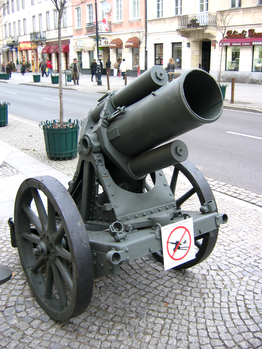 250 mm heavy mortar of the Polish Army in Warsaw | |
| Type of | mortar mortar |
| A country |  German Empire German Empire |
| Service History | |
| Years of operation | 1910s - 1920s |
| Adopted | |
| In service | German Empire Poland Poland |
| Wars and conflicts | World War I |
| Production history | |
| Constructor | Rheinmetall |
| Designed by | 1907-1909 |
| Manufacturer | Rheinmetall |
| Years of production | 1910-1918 |
| Total released | 1234 |
| Options | 25 cm sMW neuer Art |
| Specifications | |
| Weight kg | 768 |
| Barrel length mm | 750 (L / 3 alter Art) 1250 (L / 5 neuer Art) |
| Projectile weight, kg | 50/97 |
| Caliber mm | 250 mm |
| Recoil device | hydro spring |
| Carriage | standard |
| Elevation angle | from + 45 ° to + 75 ° |
| Angle of rotation | 12 ° |
| Rate of fire rounds / min | 20 |
| starting speed projectile, m / s | 200 |
| Sighting range , m | 540 |
| Maximum range, m | 970 |
Description
Mortars as a class of weapons appeared during the Russo-Japanese War , as an effective means to destroy enemy fortifications and acted better than conventional artillery because of the hinged trajectory. The 25-centimeter (250-mm) mortar was developed by Rheinmetall (Germany) and could fire mines weighing 50 or 97 kg, which had a larger explosive mass compared to standard artillery shells. The low initial flight speed allowed the use of more powerful explosives, although when testing mortars, ruptures of barrels and subsequent accidents were not uncommon.
When making a new model, known as neuer Art , the appearance of this mortar was changed: the wheels were removed from the carriage, and a shield was installed in front of the barrel, which protected the crew from fragments and bullets. Despite the small radius of fire, the mortar had a powerful destructive force and was inferior in this indicator to the legendary mortar " Big Berta " with a caliber of 420 mm.