The Battle of San Juan is a British fleet operation to seize Spanish possessions in the West Indies during the French Revolutionary Wars . After signing the treaty in San Ildefonso in 1796, Spain and France became allies and the Spaniards declared war on the British. In response, they sent a fleet to the Caribbean with the intention of capturing the Spanish colonies. On April 17, 1797, a British squadron commanded by Ralph Ebercrombie approached San Juan in Puerto Rico. The British landed on the island, but after a series of battles they could not break the stubborn resistance of the defenders and were forced to retreat on May 2, 1797.
| Battle of San Juan | |||
|---|---|---|---|
| Main Conflict: French Revolutionary Wars | |||
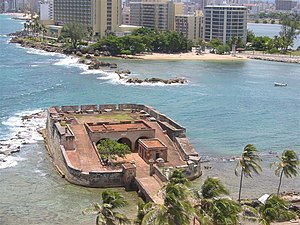 Fort San Geronimo was a key point in the defense of San Juan | |||
| date | April 17 - May 2, 1797 | ||
| A place | San Juan , Puerto Rico | ||
| Total | The victory of the Spaniards | ||
| Opponents | |||
| |||
| Commanders | |||
| |||
| Forces of the parties | |||
| |||
| Losses | |||
| |||


Content
Background
In February 1797, an English squadron under the command of Ralph Ebercrombie attacked the island of Trinidad . The island’s garrison offered little resistance, and two days later the governor surrendered Trinidad to the British. Encouraged by such an easy victory, the British decided to capture another Spanish colony in the region - Puerto Rico . On April 8, after all the necessary measures were taken to ensure the safety of Trinidad, Rear Admiral Harvey and Lieutenant General Sir Ralph Ebercrombie with four battleships ( Prince-of-Wales , Bellona , Vengeance and Alfred ), several frigates and the sloops, and with the number of troops that were able to gather (6-7 thousand people), sailed from Martinique . [3] On April 10, the squadron arrived in St. Kitts , where the 38-gun Arethusa frigate joined it, after which it took a direct course to Puerto Rico. On the morning of April 17, 1797, the British fleet arrived from the shores of the island.
The Governor of Puerto Rico, Ramon de Castro , knew about the capture of Trinidad, and therefore was ready to attack the British. 4500 soldiers, including 70 artillerymen, and two police battalions were brought to the defense of the island. In addition, volunteers from local residents and even some prisoners participated in the defense of the island. The French consul also helped defend the city by identifying 50 compatriots to defend Fort San Geronimo and another 10 people who joined the Spanish soldiers. Port defense was provided by 12 cannon boats commanded by Francisco de Paula Castro.
Invasion
When trying to approach the shore, the British fleet ran into a problem. Submarine reefs were located along the entire northern coast of the island, and the only passage was a narrow canal, through which only two sloops and transport vessels could pass.
They went ashore and by the morning of April 18 landed 3,000 soldiers ashore, fighting off the attack of 100 Spaniards who were trying to stop them. [4] The British sent two frigates to block the harbor entrance and not to allow other vessels. The anchored British ships began to fire at the Spanish defensive positions in order to protect the landing site.
On the same day, Ebercrombie sent a ship to the port with an offer of honorable surrender, and having received a negative answer, Ebercrombie and Harvey came to the conclusion that it was necessary to completely isolate the island. To this end, it was decided to send ships to blockade the port and another squad to capture the bridge of San Antonio. [5] On April 19, the British attempted to capture the San Antonio Bridge, but when they fell under the fire of Fort San Geronimo and Fort Escambron, they were forced to retreat.
On Friday, April 21, the Spanish troops were ordered to destroy the San Antonio Bridge in order to thwart the British advance.
On April 22, Governor Castro sent reinforcements to the east coast of the island, fearing that enemy artillery fire would destroy the first line of defense.
On April 23, Ebercrombie lost the support of the English fleet when Admiral Harvey ordered his ships to be sent to the open sea, fearing that strong winds could destroy ships on the reefs of the northern coast.
On Monday, April 24, police sergeant Francisco Diaz with a detachment of 70 people organized a raid on British positions. They attacked a detachment of 300 British soldiers and forced them to retreat, despite their numerical superiority. Diaz’s detachment attacked the cannon battery and captured 14 soldiers, after which the British launched a counterattack, and the Spaniards were forced to retreat.
On April 25, British troops conducted an operation in the area of the island of Miraflores and installed new batteries on it, which began shelling the second line of defense and the territory near the city itself. On April 26, the defenders of the island tried to dislodge the English from the island of Miraflores, but this attempt ended in failure.
Over the next two days, April 27 and 28, artillery exchange continued between Miraflores and the city. Castro recognized the danger posed by the English batteries on the island and ordered the batteries of Fort La Puntilla to neutralize English positions on the island of Miraflores. [five]
Taking advantage of the fact that the British offensive stopped, Castro ordered a counterattack against the British position, and on Sunday, April 30, the British began their retreat from San Juan.
Implications
British troops retreated to the coast and on May 1, 1797, they began loading on their ships. On the morning of May 2, the British squadron left Puerto Rico. Thus ended the British military operation, which lasted more than two weeks. Losses of British troops, according to British sources, amounted to 37 killed 70 wounded and 124 taken prisoner or missing. [6] Spanish sources give slightly different figures: 225 people killed and wounded and 290 people taken prisoner. [5] The loss of the Spaniards amounted to 42 killed, 156 wounded and 2 missing. [five]
In a private letter, Sir Ralph Ebercrombie explains the reason for his failure. It specifically states:
An attempted expedition may have been too frivolous. After capturing Trinidad, the admiral agreed with me that another attack was needed, and when we received reinforcements and instructions to attack Puerto Rico, we decided to try our luck, hoping more for the weakness of the enemy. But he turned out to be well prepared, with a large number of troops than ours, and with powerful garrison artillery. Of course, their troops were weaker, but they were outside the walls, which could not but bring them victory.
Links
- ↑ Van Middeldyk, p. 79
- ↑ Marley, p. 362
- ↑ James, p. 99
- ↑ Van Middeldyk, p. 80
- ↑ 1 2 3 4 History of the Regent of Puerto Rico
- ↑ James, p. 100
Literature
- RA Van Middeldyk. The History of Puerto Rico. - Londres: Echo Library, 2008 .-- ISBN 978-1-40687-497-6 .
- David Marley Wars of the Americas: a chronology of armed conflict in the New World, 1492 to the present. - ABC-CLIO, 1998. - ISBN 978-0-87436-837-6 .
- William James The Naval History of Great Britain, Volume 2, 1797-1799 . - Conway Maritime Press, 2002 [1827]. - ISBN 0-85177-906-9 . Archive dated May 27, 2013 on Wayback Machine
- Maria Alonso. The Eighteenth Century Caribbean in 1797. - San Juan: Publicaciones Puertorriquenas, 1997. - ISBN 978-1-88171-320-3 .
- History of the Fixed Regiment of Puerto Rico English Invasion of 1797 (Spanish)