| Tesseract | |
|---|---|
 | |
| Type of | The correct 4-D |
| Schläfli Symbol | {4.3,3} |
| Cells | eight |
| Facets | 24 |
| Rib | 32 |
| Tops | sixteen |
| Vertex figure | Correct tetrahedron |
| Dual polytopic | 16-cell |
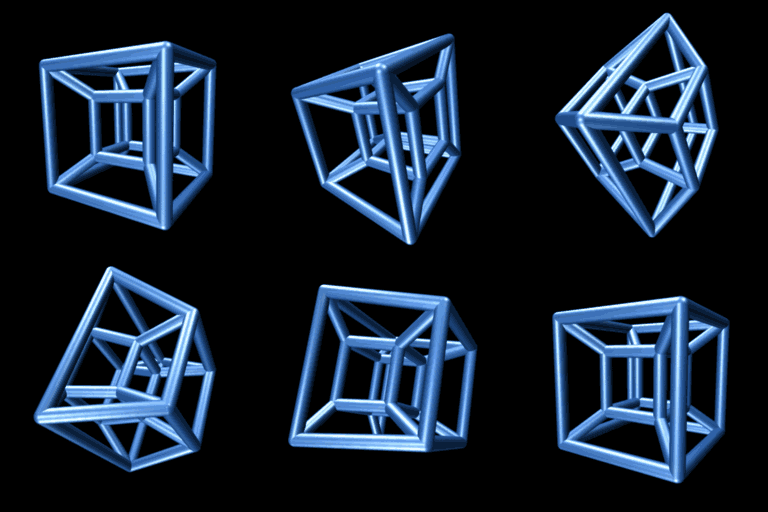
The tesserakt (from the ancient Greek τέσσαρες ἀκτῖνες - “four rays”) is a four-dimensional hypercube , an analog of a usual three-dimensional cube in four-dimensional space . Other names: 4-cube , tetracubus , octahedron [1] , octachore (from the other Greek words . “Eight” + χώρος “place, space”), hypercube (if the number of dimensions is not specified).
According to the Oxford Dictionary , the word tesseract was coined by (1853-1907) and first used in 1888 in his book The New Era of Thought.
Geometry
An ordinary tesseract in Euclidean four-dimensional space is defined as the convex hull of points (± 1, ± 1, ± 1, ± 1). In other words, it can be represented as the following set:
Tesseract is bounded by eight hyperplanes. , the intersection of which with the tesseract itself defines its three-dimensional faces (which are ordinary cubes). Each pair of non-parallel three-dimensional faces intersects, forming two-dimensional faces (squares), and so on. Finally, the tesseract has 8 three-dimensional faces, 24 two-dimensional, 32 edges and 16 vertices.
The four-dimensional hyper volume of a tesseract with a side of length a is calculated by the formula:
The volume of the tesseract hypersurface can be found by the formula:
The radius of the described hypersphere:
The radius of the inscribed hypersphere:
Popular Description
Let us try to imagine what the hypercube will look like without leaving the three-dimensional space .
In the one-dimensional “space” - on the line - select the segment AB with the length L. On the two-dimensional plane at a distance L from AB we draw a segment DC parallel to it and connect their ends. Get a square CDBA. Repeating this operation with the plane, we get the three-dimensional cube CDBAGHFE. By moving the cube in the fourth dimension (perpendicular to the first three) at a distance L, we get the hypercube CDBAGHFEKLJIOPNM.
The one-dimensional segment AB is the side of the two-dimensional CDBA square, the square is the side of the CDBAGHFE cube, which, in turn, will be the side of the four-dimensional hypercube. The line segment has two boundary points, the square has four vertices, the cube has eight. In a four-dimensional hypercube, thus, there will be 16 vertices: 8 vertices of the original cube and 8 vertices shifted in the fourth dimension. It has 32 edges — 12 each give the initial and final positions of the original cube, and another 8 edges will “draw” eight of its vertices that have moved to the fourth dimension. The same reasoning can be done for the faces of the hypercube. In two-dimensional space, it is one (the square itself), the cube has 6 of them (two faces each from the moved square and four more will describe its sides). The four-dimensional hypercube has 24 square faces - 12 squares of the original cube in two positions and 12 squares from its twelve edges.
As the sides of the square are 4 one-dimensional segments, and the sides (edges) of the cube are 6 two-dimensional squares, so for the “four-dimensional cube” (tesseract) the sides are 8 three-dimensional cubes. The spaces of opposite pairs of tesseract cubes (that is, the three-dimensional spaces to which these cubes belong) are parallel. In the figure, these are cubes: CDBAGHFE and KLJIOPNM, CDBAKLJI and GHFEOPNM, EFBAMNJI and GHDCOPLK, CKIAGOME and DLJBHPNF.
Similarly, one can continue the reasoning for hypercubes of a greater number of dimensions, but it is much more interesting to see how a four-dimensional hypercube will look to us, the inhabitants of three-dimensional space. We use for this the already familiar method of analogies.
Take the ABCDHEFG wire cube and look at it with one eye from the side of the face. We will see and can draw on the plane two squares (near and far of its face), connected by four lines - side edges. Similarly, a four-dimensional hypercube in a three-dimensional space will look like two cubic “boxes” inserted into each other and connected by eight edges. At the same time, the “boxes” themselves - three-dimensional faces - will be projected onto “our” space, and the lines connecting them will stretch in the direction of the fourth axis. You can also try to imagine a cube not in a projection, but in a spatial image.
Just as a three-dimensional cube is formed by a square shifted by the length of a face, a cube shifted to the fourth dimension will form a hypercube. It is limited by eight cubes, which in the future will look like a kind of rather complex figure. The four-dimensional hypercube itself consists of an infinite number of cubes, just as a three-dimensional cube can be “cut” into an infinite number of flat squares.
Cutting the six faces of a three-dimensional cube, you can expand it into a flat shape - unfolding . It will have a square on each side of the source face, plus one more — the face opposite to it. And the three-dimensional scanning of a four-dimensional hypercube will consist of an initial cube, six cubes "growing" out of it, plus one more - the final "hyper face".
The tesseract properties are a continuation of the properties of geometric shapes of a lower dimension into four-dimensional space.
Tesseract sweeps
Just as the surface of a cube can be expanded into a polygon consisting of six squares , the surface of the tesseract can be expanded into a three-dimensional body consisting of eight cubes [2] .
There are 261 tesseract sweeps [3] . A hypercube sweep can be found by enumerating “twin trees”, where a “ paired tree ” is a tree with an even number of vertices that are divided into pairs so that no pair consist of two adjacent vertices. There is a one-to-one correspondence between “twin trees” with 8 vertices and sweeps of tesseract. There are a total of 23 trees with 8 vertices, by dividing the vertices of which into pairs of non-adjacent vertices we get 261 “double trees” with 8 vertices [4] .
The cross-shaped unfolding of the tesseract is an element of the Corpus Hypercubus (1954) painting by Salvador Dali [5] .
In Robert Heinlein 's story “The House that Teel built” ( “—And He Built a Crooked House” ), Californian architect Quintus Teale builds a house in the form of a hypercube development, which during an earthquake develops into a four-dimensional tesseract [5] .
Projections
On two-dimensional space
This structure is difficult for the imagination, but it is possible to design a tesseract into two-dimensional or three-dimensional spaces . In addition, the projection on the plane makes it easy to understand the location of the vertices of the hypercube. Thus, it is possible to obtain images that no longer reflect spatial relationships within the tesseract, but which illustrate the structure of the vertex connection, as in the previous examples:
The first picture shows how a tesseract is obtained by combining two cubes. The scheme is similar to the construction of a cube of two squares. | The second picture illustrates the fact that all the edges of the tesseract are the same length. It is notable for the fact that all eight cubes have the same appearance. | The third picture shows a tesseract in isometry , relative to the point of construction. This image is of interest when using tesseract as a basis for a topological network to link multiple processors in parallel computing. |
To three-dimensional space
One of the tesseract projections onto three-dimensional space consists of two nested three-dimensional cubes, the corresponding vertices of which are interconnected by segments. The inner and outer cubes have different sizes in three-dimensional space, but in four-dimensional space they are equal cubes. To understand the equality of all tesseract cubes, a rotating tesseract model was created.
- The six truncated pyramids along the edges of the tesseract are images of equal six cubes. However, these tesseract cubes are like squares (faces) for a cube. But in fact, a tesseract can be divided into an infinite number of cubes, like a cube into an infinite number of squares, or a square into an infinite number of segments.
Another interesting tesseract projection onto three-dimensional space is a rhombododecahedron with its four diagonals drawn, connecting pairs of opposite vertices at large angles of the rhombus. At the same time, 14 out of 16 tesseract vertices are projected onto 14 vertices of a rhombododecahedron , while the 2 remaining projections coincide at its center. In such a projection onto three-dimensional space, equality and parallelism of all one-dimensional, two-dimensional and three-dimensional sides are preserved.
Stereopair
The tesseract stereo pair is depicted as two projections onto the plane of one of the variants of the three-dimensional representation of the tesseract. The stereo pair is viewed in such a way that each eye can see only one of these images, a stereoscopic effect arises, allowing you to better perceive the tesseract projection onto three-dimensional space.
Tesseract in Culture
- In the story "... And he built himself a crooked little house" (in another version of the translation of The House That Til Built) Heinlein described an eight-room house in the form of an expanded tesseract.
- Henry Kuttner 's story “ All the Tale of Borogova ” describes a developmental toy for children from a distant future, similar in structure to a tesseract.
- In Robert Sheckley’s story “Miss Mouse and the Fourth Dimension,” the esoteric writer, an acquaintance of the author, tries to see a tesseract, looking at the device designed by him for hours: a ball with legs and rods stuck into it, covered with all esoteric symbols. The story mentions the work of Hinton.
- In Mark Clifton ’s fiction story “On Möbius Strip”, child prodigies travel through space and time using models of Möbius stripes , Klein bottles and tesseracts.
Notes
- ↑ D.K. Bobylev . Four-dimensional space // Encyclopedic dictionary of Brockhaus and Efron : in 86 tons (82 tons and 4 extra). - SPb. , 1890-1907.
- ↑ Gardner, 1989 , pp. 48-50.
- ↑ Gardner, 1989 , p. 272: "Peter Turney, in his 1984 paper" Unfolding the Tesseract, "uses 261 distinct unfoldings.".
- ↑ Peter Turney. Unfolding the Tesseract (Eng.) // Journal of Recreational Mathematics : journal. - 1984-85. - Vol. 17 , no. 1 .
- ↑ 1 2 Gardner, 1989 , p. 50.
Literature
- Charles H. Hinton. Fourth Dimension, 1904. ISBN 0-405-07953-2
- Gardner M. Mathematical Carnival. - Washington, DC: MAA , 1989. - P. 41-54, 272. - ISBN 0-88385-448-1 .
- Ian Stewart, Concepts of Modern Mathematics, 1995. ISBN 0-486-28424-7
- Halperin G.A. Multidimensional cube - M .: MTSNMO , 2015. - 80 p. - ISBN 978-5-4439-0296-8 .
- Duzhin S., Rubtsov V. Four-dimensional cube // Kvant . - 1986. - № 6 . - p . 3-7 .
Links
- In Russian
- Getting out of the sweep
- Hypercube
- Transformator4D program. Formation of models of three-dimensional projections of four-dimensional objects (including the Hypercube).
- The program that implements the construction of tesseract and all its affine transformations, with source code in C ++.
- A tesseract stereo pair with edges of the same length.
- Tesseract rotation - a projection in three-dimensional space
- In English
- Tesseract
- Cut the knot! The tesseract
- Charles Howard Hinton
- A four dimensional version of Rubik's Cube
- Fourth Dimension: Tetraspace
- Mushware Limited is a tesseract trainer output program (license compatible with GPLv2) and a first-person shooter in four-dimensional space ( Adanaxis ; graphics are mostly three-dimensional; there is a version under the GPL in the OS repositories).