Black mangobey [1] , or black mangabey [2] , or bearded mangabey [2] ( lat. Lophocebus aterrimus ) is a species of monkey in the monkey family of primates , one of the species of the genus Bearded mangobeys .
| Black mangobey |
 |
| Scientific classification |
|---|
| No rank : | Bilateral symmetrical |
| Squadron : | Euarchontoglires |
| Grand detachment : | Euarchonta |
| Parvotryad : | Narrow-nosed monkey |
|
| International scientific name |
|---|
Lophocebus aterrimus
( Oudemans , 1890) |
| Area |
|---|
|
| Security status |
|---|
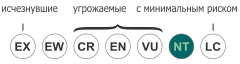
Close to vulnerableIUCN 3.1 Near Threatened : 12310 |
|
Sometimes there are two subspecies:
- Lophocebus aterrimus aterrimus - found in the central part of the Congo Basin
- Lophocebus aterrimus opdenboschi - found in northeast Angola and the southwest of the Democratic Republic of the Congo . [3]
Some primatologists, however, consider this species to be monolithic and do not distinguish subspecies. [four]
Primates are medium in size, of a rather elegant physique, with a very long tail. This species differs from other mangobey species in its distinctive black tuft on the top of its head. The coat is black; on the muzzle there are dark gray whiskers. The body length of males is from 45 to 65 cm, the tail length is from 80 to 85 cm. Sexual dimorphism is expressed , the weight of males is from 6 to 11 kg, the weight of females is from 4 to 7 kg. [five]
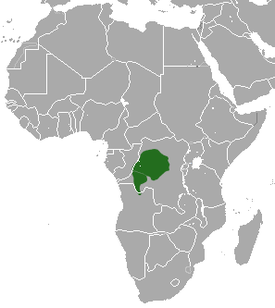
It occurs in the dry tropical and subtropical forests of Angola and the Democratic Republic of the Congo. [four]
Spends almost all the time on trees, meeting on all tiers of the forest, preferring the middle tiers. Occasionally descends to the ground. The diet is mainly fruits and seeds, in some months of the year a significant part of the diet is plant nectar. It usually gets food in the early morning. [6]
The main threats to the population are hunting and habitat destruction. The International Union for Conservation of Nature has assigned this species a conservation status of “Close to Vulnerable” ( Eng . According to 2008 data, the population has declined by 25% over 27 years. [four]