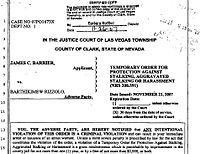
Restraining order [1] - a type of court order in Anglo-Saxon law , especially in the United States (in British law it is known as the English non-molestation order - lit. - "order to undermine" [2] ), by which the court orders a person to perform certain actions in relation to another person or, on the contrary, to refrain from such actions. A person who violates the order may be brought to civil or criminal liability. Most often used as a means of protecting victims of domestic violence, sexual harassment, invasion of privacy.
Content
Contents of the order
The content of the restraining order usually consists in the obligation of the person to whom the order (persecutor) is addressed to keep a distance from a certain person (victim), his home, his place of work or study, the prohibition of physical contact with the victim ( stay away condition). It is also possible to prohibit any contact with the victim, including phone calls, correspondence via regular and electronic mail, sending faxes, sending flowers and gifts, etc. ( no contact condition). An order may also oblige the persecutor not to harm or threaten the victim ( cease abuse condition).
In some cases, the court, when issuing an order, may oblige the persecutor to provide financial assistance to the victim or to participate in the costs of the mortgage in respect of property shared with the victim (condition support ), to pay alone to use the dwelling or car shared with the victim ( exclusive use condition), and also to compensate for harm caused to the victim’s health or property (condition of restitution ). The court also has the right to oblige the stalker to deposit their firearms and ammunition ( relinquish firearms condition), attend psychological correction classes, regularly take drug tests, and begin treatment for alcohol or drug addiction.
Courts may also impose certain obligations on the stalker related to children. In particular, the court may order the stalker to avoid contact with pediatric doctors, nannies, and teachers. It happens that the courts temporarily restrict the stalker in parental rights. Orders may also be issued to check the living conditions of the child or to recover funds for the maintenance of children. The victim may ask the court to issue an order for a controlled visit to the child or to determine safe ways to transfer the child ( custody, visitation and child support condition).
Types of U.S. Law Restrictive Orders
- Ex Parte Order (EPO) or Temporary restraining order (TRO) : a temporary order that a judge is entitled to issue immediately upon contacting the victim with a statement. It is issued without a court hearing and taking into account the opinion of the defendant for a period until the start of the court session, which is usually about two weeks.
- Order for Protection (OFP) : A standing order, issued for a period of up to one year based on court hearings. It is usually applied in relations with persons related by blood relationship, having common children, spouses or former spouses, cohabitants or simply consisting in a romantic or sexual relationship.
- Harassment Restraining Order (HRO) : A standing order is issued for a period of up to two years, and court hearings are not required if the defendant does not require them or the judge considers it necessary. It is used in cases not covered by OFP, namely to protect victims who are not related or have sexual relations with a persecutor (colleagues, friends, guests, acquaintances, etc.).
Notes
- ↑ According to the translation suggested here: restraining order . ABBYY Lingvo . Date of treatment January 9, 2014. (unavailable link)
- ↑ Family Law Act 1996 . Part IV Non-molestation orders Section 42 . legislation.gov.uk. Date of treatment January 7, 2014.
Sources
- Restraining Orders (PDF) (inaccessible link) . The Aurora Center for Advocacy & Education .. Date accessed January 9, 2014. Archived July 1, 2014.
- County Court Restraining Orders (PDF). Customer Service Colorado Judicial Branch (June 2002). Date of treatment January 9, 2014.
- Restraining Orders . National Network to End Domestic Violence, Inc. (June 8, 2012). Date of treatment January 9, 2014.